The Agentic Era: Multimodal Video, Autonomous Execution, and Quantum Convergence
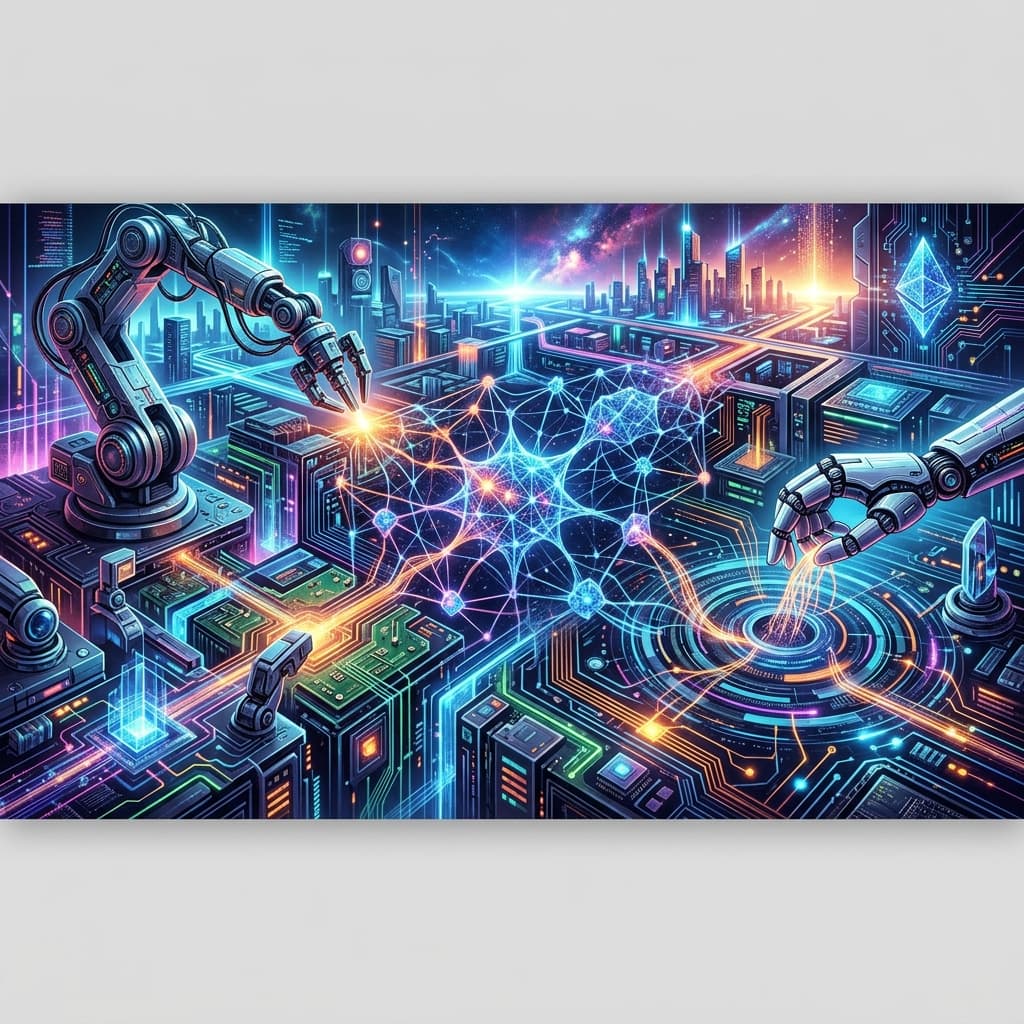
The Agentic Era: Multimodal Video, Autonomous Execution, and Quantum Convergence
As we progress through the second half of 2026, the artificial intelligence sector is undergoing a profound paradigm shift. Moving decisively past the constraints of passive chatbots and narrow generative applications, we are witnessing the emergence of deeply integrated, autonomous digital systems capable of advanced reasoning and real-world execution.
🤖 The Rise of Agentic AI
The most consequential development dominating enterprise and consumer tech is the transition from AI "copilots" to fully autonomous Agentic AI. Rather than waiting for step-by-step prompts, these new systems are designed to parse high-level objectives, formulate strategic plans, and independently execute complex workflows. They possess the ability to dynamically adjust their approaches in real-time when encountering obstacles, effectively simulating human problem-solving methodologies.
This breakthrough carries immense implications for enterprise operations. Agentic AI is moving rapidly from experimental sandboxes into core business infrastructure. These systems are now coordinating entire supply chains, automating end-to-end financial audits, and functioning as proactive digital coworkers rather than reactive tools. The significance lies not just in efficiency gains, but in the structural reimagining of organizational design, where smaller human teams are amplified by fleets of autonomous agents.
We are entering a phase where the defining metric of AI utility is no longer parameter count, but execution reliability. As frameworks for multi-agent collaboration become standardized, we can expect to see compounding productivity leaps across software development, legal discovery, and operational management.
👁️ Native Multimodal Understanding and Video Comprehension
Simultaneously, foundational models have crossed a critical threshold in their sensory architecture, achieving native multimodal understanding. Previous generations of AI often relied on fragmented systems—stitching together separate text, audio, and vision models—which created latency and context loss. Today's state-of-the-art architectures synthesize multiple data streams natively and simultaneously, closely mirroring human perception.
The most striking advancement within this domain is the mastery of temporal video comprehension. Modern AI no longer just labels static frames; it maintains deep contextual awareness across long-form video, understanding the physics, intent, and cause-and-effect relationships embedded within the visual data. For example, the model can now analyze a complex manufacturing error in a factory feed, identify the mechanical failure leading up to it, and propose predictive maintenance strategies.
This marks a pivotal evolution for autonomous systems, robotics, and embodied AI, which heavily rely on real-time spatial and temporal understanding to navigate the physical world. As video generation and comprehension become flawlessly intertwined, we are approaching an inflection point for synthetic media, advanced robotics, and real-time interactive simulations.
⚛️ The Convergence of AI and Quantum Computing
Perhaps the most structurally transformative, albeit nascent, development of 2026 is the tangible convergence of artificial intelligence and quantum computing. For years, the intersection of these two deep tech fields was largely theoretical. However, recent breakthroughs have established a powerful synergy where quantum processors are actively accelerating specific AI workloads, particularly those involving complex combinatorial optimization and molecular simulation.
This hybrid approach allows computational barriers that previously bottlenecked scientific discovery to be bypassed. By utilizing quantum algorithms to process datasets exponentially faster than classical supercomputers, AI models are now driving unprecedented advancements in drug discovery, materials science, and high-fidelity climate modeling. These systems can navigate vast possibility spaces—such as folding complex proteins or discovering novel battery materials—in a fraction of the time historically required.
While we are not yet at the point of generalized quantum neural networks, the operationalization of quantum-assisted AI for specialized domains signifies a new era of computational capability. This convergence is setting the stage for an exponential curve in deep tech R&D, potentially solving some of the most intractable scientific challenges of our generation.
📌 The Bottom Line
- agentic-ai: AI is evolving from passive assistants into autonomous agents capable of independent planning and execution within complex enterprise workflows.
- multimodal-understanding: Foundational models can now natively comprehend long-form video and multimodal data, enabling deep cause-and-effect reasoning.
- quantum-ai: The practical integration of quantum computing and AI is shattering computational bottlenecks in drug discovery, materials science, and complex modeling.
📬 Stay Updated
Get the best of AI & technology delivered to your inbox every week. Subscribe to our free newsletter →
Disclosure: This post contains affiliate links. If you purchase through our links, we earn a small commission at no extra cost to you. We only recommend products we believe in.
Enjoyed this post?
Get our weekly digest delivered free.
Share this post:
Knowelth is reader-supported. We may earn a commission from links in this article at no extra cost to you. Read our disclosure.
Related Posts
AMD Launches MI400 Chips, Meta Scales 5GW Supercluster, and EU AI Act GPAI Rules Take Effect
AMD Launches MI400 Chips, Meta Scales 5GW Supercluster, and EU AI Act GPAI Rules Take Effect The artificial intelligence landscape is witnessing a convergence of massive infrastructure scaling, unprec…
Frontier Governance, Autonomous Cloud Labs, and Strategic Hardware Alliances: Redefining the AI Landscape
Frontier Governance, Autonomous Cloud Labs, and Strategic Hardware Alliances: Redefining the AI Landscape Artificial intelligence is undergoing a foundational pivot in mid-2026, transitioning from rea…
Agentic Model Architectures, In-House Custom Silicon, and the Commercial Acceleration of Embodied AI
Agentic Model Architectures, In-House Custom Silicon, and the Commercial Acceleration of Embodied AI The artificial intelligence ecosystem is undergoing a structural paradigm shift, moving beyond prom…