Nvidia's $250B Megasite Backstop, Mandatory Pre-Release AI Audits, and the DOE's Genesis Mission

Nvidia's $250B Megasite Backstop, Mandatory Pre-Release AI Audits, and the DOE's Genesis Mission
As mid-2026 unfolds, artificial intelligence is undergoing a structural phase shift from experimental software deployments toward massive-scale physical infrastructure, institutionalized government pre-deployment gatekeeping, and state-backed scientific acceleration. Rather than incremental model iterations, the current tech landscape is dictated by gigawatt-scale data center guarantees, mandatory regulatory safety reviews for frontier systems, and federal initiatives harnessing AI for foundational scientific research.
⚡ Nvidia Backs OpenAI's $500B Gigawatt Megasite with $250B Guarantee
In one of the most substantial infrastructure commitments in tech history, reports confirm that Nvidia is in talks to provide a massive $250 billion financial backstop to support OpenAI's lease of a proposed 10-gigawatt AI data center megasite in Piketon, Ohio. The total development cost of the complex, estimated at $500 billion over the next decade, signals that frontier AI compute demands have scaled far past traditional corporate balance sheets, requiring syndicated capital backstops directly from hardware manufacturers.
The technical implications of a 10-gigawatt single-site facility are staggering. To put this in perspective, 10 gigawatts represents roughly the power consumption of a major metropolitan area or five modern nuclear power plants combined. Running next-generation accelerator clusters—such as Nvidia’s upcoming Rubin and ultra-scale Blackwell architectures—at this scale requires novel power distribution topologies, direct liquid-to-chip cooling systems, and specialized high-voltage substations built in direct partnership with regional utility grids. By guaranteeing capital commitments, Nvidia effectively secures long-term demand for its next-generation silicon while insulating hyper-scalers from compute capacity bottlenecks.
This financial backstop highlights a fundamental shift in the AI economy: compute access is no longer just a capital expenditure item, but a geopolitical and strategic commodity. As AI frontier labs transition from multi-billion parameter models to multi-trillion parameter reasoning architectures requiring continuous pre-training and massive post-training reinforcement learning (RL) runs, compute constraints have become the primary rate-limiter of model capabilities. Nvidia’s financial involvement cements its position not merely as a chip supplier, but as a primary financial engine of physical AI buildouts.
Moving forward, the Piketon project sets a precedent for how mega-scale tech infrastructure will be financed and built. Other major players—including Microsoft, Alphabet, and Meta—are expected to pursue similar structured financing models for gigawatt-class campuses across North America and Europe. However, this level of concentration raises urgent questions around regional grid stability, energy transition goals, and supply chain dependencies on specialized optical networking and advanced memory packaging.
🛡️ Pre-Release Government Safety Audits Become Standard for Frontier AI Models
The launch of recent frontier models, including GPT-5.6 and Claude Fable 5, marks a permanent operational shift in how major AI labs deploy state-of-the-art systems: mandatory pre-release government security audits. Regulatory bodies in Washington, London, and Brussels have effectively established pre-deployment vetting frameworks, evaluating models for autonomous cyber capabilities, CBRN (chemical, biological, radiological, nuclear) risk vectors, and self-replication risks prior to public or commercial release.
Historically, frontier models were released to the public with post-deployment guardrails and internal red-teaming reports published voluntarily by the developers. However, the introduction of advanced reasoning models—capable of multi-step autonomous execution, dynamic tool usage, and sophisticated code synthesis—forced national security officials to treat frontier models similarly to dual-use technologies. Under the newly enforced frameworks, developers must grant government security agencies, such as the U.S. AI Safety Institute, sandbox access months in advance of public launch to conduct rigorous automated and human-led penetration tests.
This new regime creates significant operational and competitive dynamics for the AI industry. On one hand, standardized pre-release vetting offers enterprise customers greater assurance against zero-day model vulnerabilities, unintended agentic loops, and systemic security flaws. On the other hand, it extends time-to-market timelines for frontier labs, shifting competitive advantages toward organizations with established compliance pipelines and dedicated government relations infrastructure.
Looking ahead, the institutionalization of government pre-release reviews is accelerating the bifurcation of the global AI ecosystem. Closed-source frontier labs are aligning closely with Western security protocols to secure federal contracts and deployment licenses, while open-weight developers face increasing scrutiny over how downstream fine-tuning could bypass safety mitigations. As regulatory oversight solidifies into law across major jurisdictions, model auditing will become a permanent, multi-billion dollar sector within tech compliance.
🧪 US Department of Energy Unveils "Genesis Mission" for AI Science
Enjoyed this post?
Get our weekly digest delivered free.
While commercial labs compete on consumer agent workflows, the U.S. Department of Energy (DOE) has formally announced the first wave of projects under its flagship "Genesis Mission." The initiative mobilizes national laboratories, exascale supercomputers, and domain-specific AI architectures to accelerate scientific breakthroughs across nuclear fusion, material science, quantum chemistry, and national defense.
The Genesis Mission reflects a strategic shift from general-purpose large language models toward highly specialized, physics-informed AI foundation models. By coupling supercomputers like Frontier and Aurora with deep learning models trained on proprietary experimental datasets, DOE researchers are reducing the time required for complex scientific simulations by orders of magnitude. For instance, in materials science, AI workflows are screening millions of crystal structures in days to identify candidate superconductors and high-capacity battery chemistries—a process that previously required decades of trial-and-error laboratory synthesis.
Beyond molecular and material research, the Genesis Mission introduces standardized agentic workflows for automated laboratory equipment. Known as "self-driving labs," these systems combine generative AI planners with robotic synthesis stations to formulate hypotheses, execute physical experiments, analyze spectrographic results, and iterate on experimental designs autonomously around the clock. This integration of physical automation and AI reasoning represents the vanguard of scientific discovery.
The broader impact of the DOE's push lies in establishing sovereign scientific AI infrastructure independent of commercial hyper-scaler agendas. By prioritizing open scientific research and national security applications, the Genesis Mission ensures that public sector research institutions remain at the cutting edge of physical science. As European and Asian research agencies prepare equivalent initiatives, scientific foundation models are rapidly becoming a central pillar of global technological competitiveness.
📌 The Bottom Line
- nvidia-250b-backstop: Nvidia's $250 billion financial commitment to OpenAI's 10-gigawatt data center underscores the transition of AI compute into a syndicated mega-infrastructure asset class.
- prerelease-ai-audits: Mandatory government pre-deployment safety evaluations for frontier models like GPT-5.6 establish regulatory gatekeeping as a permanent operational standard.
- doe-genesis-mission: The U.S. Department of Energy's "Genesis Mission" highlights the nationalization and specialization of AI to accelerate scientific discovery in fusion, materials, and automated chemistry.
📫 Stay Updated
Get the best of AI & technology delivered to your inbox every week. Subscribe to our free newsletter →
Disclosure: This post contains affiliate links. If you purchase through our links, we earn a small commission at no extra cost to you. We only recommend products we believe in.
Knowelth publishes independently researched analysis verified against primary documentation, academic journals, and official records. To report a factual inaccuracy or request a correction, please reach out via our Contact Page.
Enjoyed this post?
Get our weekly digest delivered free.
Share this post:
Knowelth is reader-supported. We may earn a commission from links in this article at no extra cost to you. Read our disclosure.
Related Posts

System 2 AI Architectures, NVIDIA's $500B Infrastructure Alliance, and Industrial Physical AI Scale-Up
System 2 AI Architectures, NVIDIA's $500B Infrastructure Alliance, and Industrial Physical AI Scale-Up The artificial intelligence ecosystem is undergoing a fundamental structural transformation this …

AI's Frontier Shift: Autonomous Bio-Design, 0.42nm Semiconductors, and the EU AI Act Governance Horizon
AI's Frontier Shift: Autonomous Bio-Design, 0.42nm Semiconductors, and the EU AI Act Governance Horizon The artificial intelligence landscape has reached a decisive turning point where digital intelli…
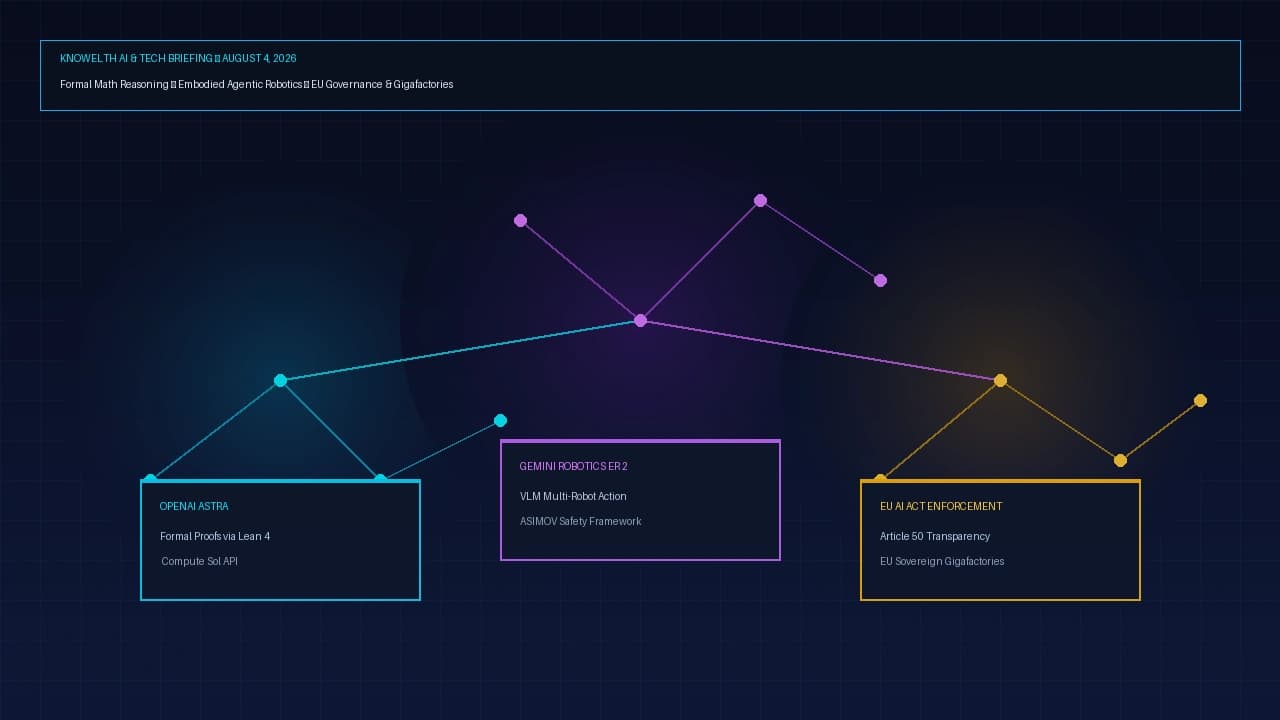
OpenAI Astra's Lean Proofs, Google's Gemini Robotics ER 2, and the EU AI Act's Article 50 Enforcement
OpenAI Astra's Lean Proofs, Google's Gemini Robotics ER 2, and the EU AI Act's Article 50 Enforcement The first week of August 2026 marks a watershed moment across the entire spectrum of artificial…