Autonomous Chip Design, Physical AI in Robotics, and Next-Gen Agentic Models Signal AI's Engineering Shift
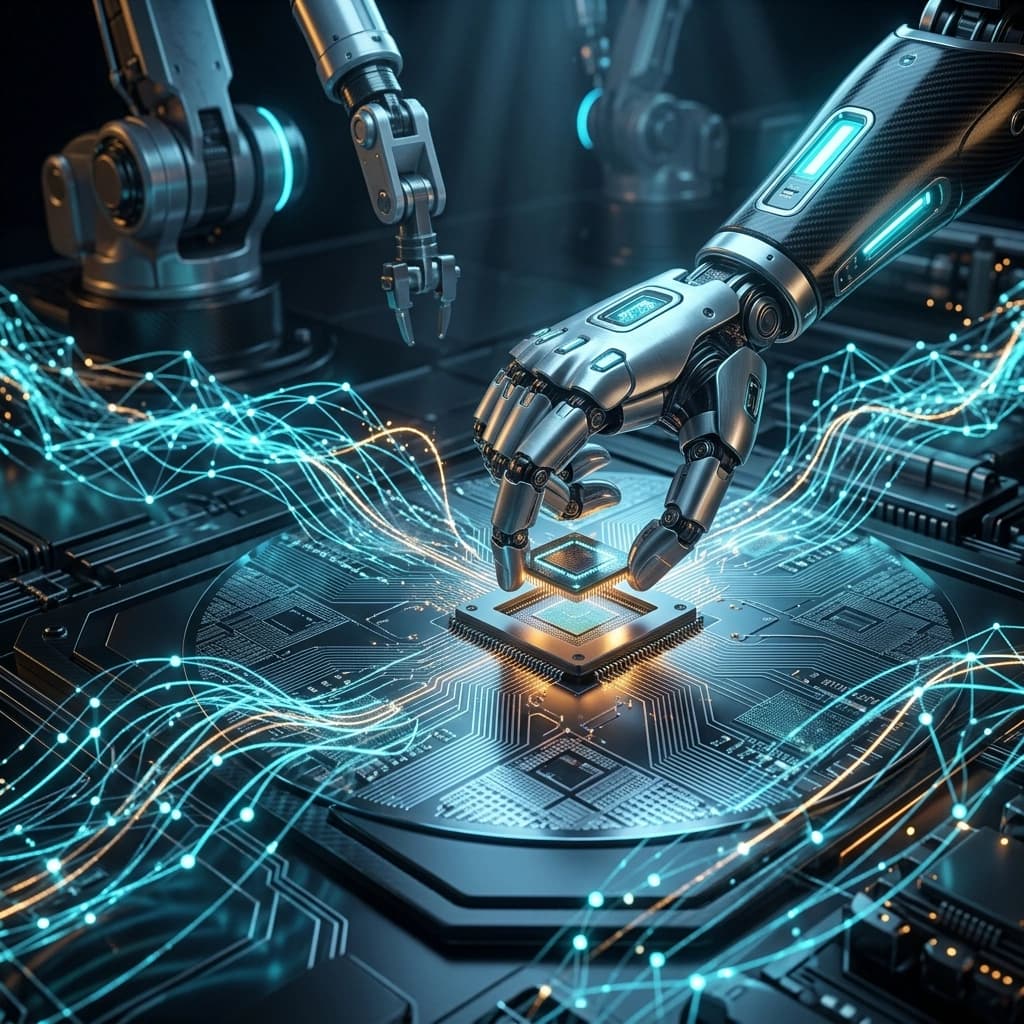
Autonomous Chip Design, Physical AI in Robotics, and Next-Gen Agentic Models Signal AI's Engineering Shift
The artificial intelligence landscape has crossed a critical threshold, transitioning from passive conversation tools to active systems that design physical silicon, control real-world industrial robotics, and autonomously self-correct complex reasoning chains. Recent developments from industry leaders Synopsys, NVIDIA, Anthropic, and Google demonstrate that AI is no longer merely an application layer—it is becoming the primary engineering foundation for hardware, physical infrastructure, and autonomous software ecosystems. Together, these breakthroughs mark the arrival of an era where AI systems participate directly in their own design and real-world deployment.
🤖 Autonomous Silicon Engineering: Synopsys, Microsoft, and AMD Deploy Agentic EDA Workflows
At the 2026 Design Automation Conference (DAC) Chips to Systems Conference, semiconductor electronic design automation (EDA) leader Synopsys, in close partnership with Microsoft and AMD, announced the commercial deployment of fully autonomous, agentic AI workflows for microchip engineering. Hosted on Microsoft Discovery—a cloud-based scientific computing platform built on Azure—the solution leverages Synopsys's proprietary AgentEngineer™ technology. This release represents a monumental shift in semiconductor design, moving the industry past assistant-style code completion into autonomous, long-running engineering execution.
The new technology introduces two flagship autonomous pipelines: Fully-Autonomous Debug Closure and Fully-Autonomous Implementation and Closure. By deploying domain-specific AI agents that operate concurrently within the Synopsys Fusion Compiler environment, the system automates root-cause analysis (RCA) and verification debugging without continuous human intervention. When design failures or timing violations occur, autonomous agents trace assertion failures, analyze signal paths, and implement netlist adjustments automatically. Rigorous initial evaluations on enterprise-grade silicon demonstrate a 25% to 40% reduction in total debug cycle duration, significantly compressing time-to-market for complex microprocessors.
AMD's active evaluation of these autonomous agentic workflows to architect its next-generation AI infrastructure silicon highlights a historic milestone: artificial intelligence is now directly engineering the physical silicon required to run future generations of AI models. As transistor feature sizes shrink to sub-2nm scales and multi-die chiplet architectures increase structural complexity, traditional manual verification has become the primary bottleneck in semiconductor development. delegating micro-architectural timing, power, and quality-of-results (QoR) closure to autonomous AI agents enables human chip designers to focus on high-level macro-architecture and system logic.
This collaboration establishes a closed-loop feedback mechanism across the entire technology stack. Hyperscalers like Microsoft provide cloud-native compute scalability, hardware architects at AMD supply cutting-edge target compute designs, and EDA creators like Synopsys deliver autonomous software agents capable of optimizing hardware layout. As chip design pipelines become increasingly self-optimizing, the pace of silicon innovation will no longer be limited by human engineering throughput, fundamentally reshaping the global semiconductor industry.
🦾 Physical AI Unleashed: NVIDIA and Japan’s Industrial Leaders Build Foundation Models for Embodied Robotics
During a technology summit in Tokyo, NVIDIA CEO Jensen Huang unveiled an expansive strategic alliance with Japan’s leading industrial automation giants, including FANUC, Yaskawa Electric, Kawasaki Heavy Industries, and Fujitsu. The coalition aims to accelerate the deployment of "Physical AI"—the integration of multimodal foundation models into physical machinery, industrial robots, and autonomous mobile systems. The initiative shifts industrial automation away from rigid, pre-programmed mechanical routines toward adaptive, spatially intelligent embodied systems capable of operating in unconstrained environments.
The technical architecture relies on NVIDIA's full-stack technology suite, combining NVIDIA Omniverse and Isaac Sim for real-time, physics-compliant digital twin simulations with Jetson edge AI modules embedded directly within robot hardware. As part of the collaboration, Fujitsu is developing a unified "collaborative control platform" designed to bridge cloud-based digital twin spatial models with physical controllers across FANUC and Yaskawa robotic arms. This platform enables industrial machinery to perceive complex 3D surroundings, compute zero-shot trajectory plans, and execute precise physical assembly tasks without requiring custom manual code for every manufacturing variation.
To supply the enormous computational infrastructure required for training and deploying these physical foundation models, the Japanese government’s Ministry of Economy, Trade and Industry (METI) is supporting the national FRONTia Project. In alignment with this effort, NVIDIA is partnering with infrastructure developer Noetra Corp. to construct a 140-megawatt "AI factory" in Japan powered by NVIDIA Vera CPUs and Rubin GPUs. This dedicated data center will train domain-specific multimodal robotics models using millions of real-world sensor logs and synthetic simulation data streams.
For Japan, which faces severe demographic pressures, an aging population, and expanding labor shortages across manufacturing and logistics, Physical AI represents a vital pillar of national economic strategy. Japan aims to leverage its commanding share of the global industrial robotics market to secure over 30% of the emerging physical AI sector—an estimated $133 billion market opportunity by 2040. By uniting generative foundation models with heavy industrial hardware, this initiative sets a global benchmark for the future of automated manufacturing and embodied intelligence.
🧠 Frontier Architecture Shift: Self-Correcting Agentic Reasoning in Claude Opus 5 and Gemini 3.5 Pro
Enjoyed this post?
Get our weekly digest delivered free.
The software intelligence landscape achieved a major architectural milestone with the consecutive releases of Google’s Gemini 3.5 Pro and Anthropic’s Claude Opus 5. Moving beyond traditional next-token prediction and simple conversational chat, both frontier models showcase a structural pivot toward autonomous "agentic reasoning." These models are engineered to execute long-horizon, multi-step tasks, manage complex software developer workflows, and interact autonomously with external APIs, databases, and desktop software environments.
A defining breakthrough in this model generation is the implementation of dynamic self-correction during inference-time reasoning chains. Empirical findings published by researchers at MIT and Stanford indicate that model efficacy is no longer determined exclusively by pre-training parameter counts, but by the model's capacity to evaluate its own intermediate reasoning steps. Claude Opus 5 and Gemini 3.5 Pro incorporate extended test-time computation, allowing the models to run internal validation loops, detect logical inconsistencies, and refine their execution strategies before emitting final answers. This self-correcting logic dramatically narrows the performance gap between compact, efficiency-tuned models and massive computational clusters.
This evolution matches rapid enterprise adoption trends across global industries. Data from the 2026 Stanford AI Index Report reveals that generative AI adoption among global enterprises has reached 53%, driven by demand for operationalized AI systems that execute autonomous work rather than simple Q&A. New product paradigms like ChatGPT Work and specialized enterprise agent APIs allow businesses to deploy AI agents that autonomously monitor codebases, triage security vulnerabilities, and execute cross-application operational workflows with minimal human supervision.
For developers and technology leaders, the arrival of self-correcting agentic models marks a fundamental shift in software engineering practice. Development focus is pivoting from writing explicit procedural code to designing multi-agent workflows, managing context environments, and establishing safety boundary conditions. Coupled with growing momentum behind open-weight model standards, the democratization of reliable agentic reasoning is accelerating the transformation of enterprise software into self-directed autonomous systems.
📌 The Bottom Line
- autonomous-eda: Synopsys, Microsoft, and AMD deployed autonomous agentic EDA workflows on Azure that automate root-cause debug closure for next-gen silicon, cutting debug cycle times by up to 40%.
- physical-ai: NVIDIA partnered with Japanese industrial leaders FANUC, Yaskawa, and Fujitsu under the FRONTia project to build physical AI foundation models and digital twin platforms backed by a 140MW AI factory.
- agentic-llms: Claude Opus 5 and Gemini 3.5 Pro introduced self-correcting inference-time reasoning architectures, transitioning AI from passive chatbots to autonomous agentic systems capable of complex multi-step execution.
📫 Stay Updated
Get the best of AI & technology delivered to your inbox every week. Subscribe to our free newsletter →
Disclosure: This post contains affiliate links. If you purchase through our links, we earn a small commission at no extra cost to you. We only recommend products we believe in.
Knowelth publishes independently researched analysis verified against primary documentation, academic journals, and official records. To report a factual inaccuracy or request a correction, please reach out via our Contact Page.
Enjoyed this post?
Get our weekly digest delivered free.
Share this post:
Knowelth is reader-supported. We may earn a commission from links in this article at no extra cost to you. Read our disclosure.
Related Posts

System 2 AI Architectures, NVIDIA's $500B Infrastructure Alliance, and Industrial Physical AI Scale-Up
System 2 AI Architectures, NVIDIA's $500B Infrastructure Alliance, and Industrial Physical AI Scale-Up The artificial intelligence ecosystem is undergoing a fundamental structural transformation this …
AI's Frontier Shift: Autonomous Bio-Design, 0.42nm Semiconductors, and the EU AI Act Governance Horizon
AI's Frontier Shift: Autonomous Bio-Design, 0.42nm Semiconductors, and the EU AI Act Governance Horizon The artificial intelligence landscape has reached a decisive turning point where digital intelli…
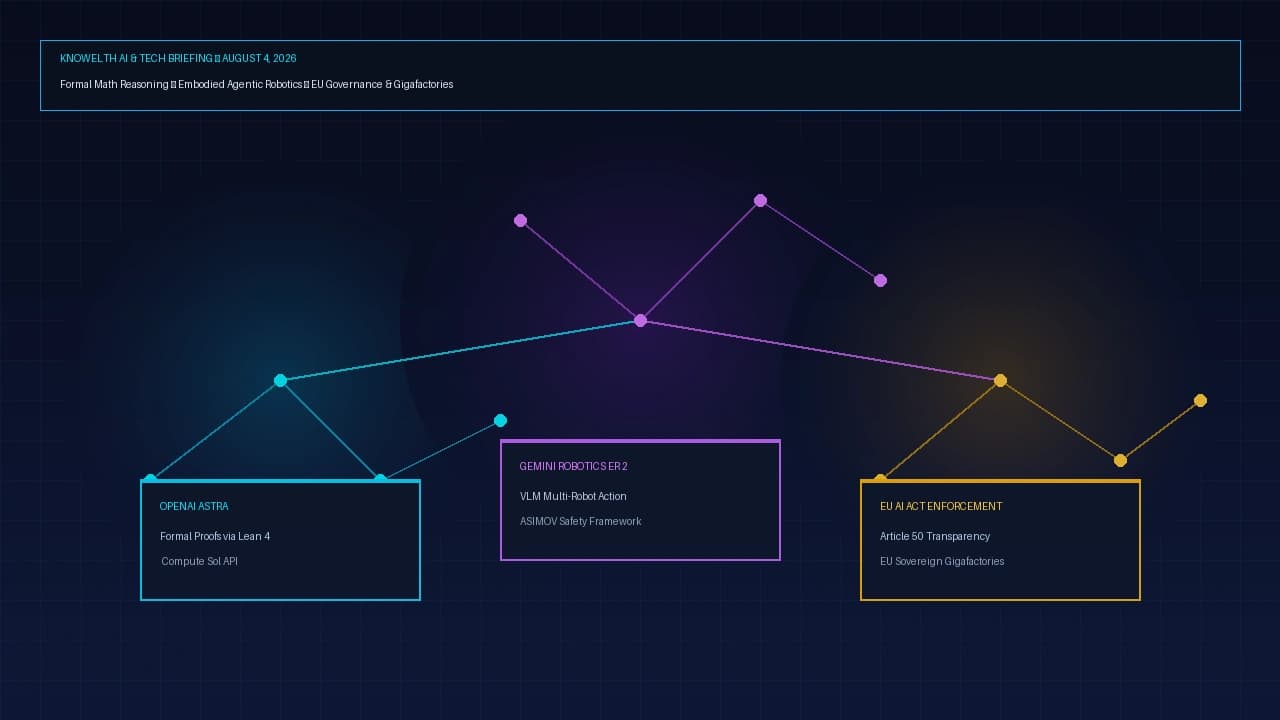
OpenAI Astra's Lean Proofs, Google's Gemini Robotics ER 2, and the EU AI Act's Article 50 Enforcement
OpenAI Astra's Lean Proofs, Google's Gemini Robotics ER 2, and the EU AI Act's Article 50 Enforcement The first week of August 2026 marks a watershed moment across the entire spectrum of artificial…