DeepSeek V4 Disruption, Samsung-Broadcom's $200B Chip Alliance, and the Rise of Physical AI
DeepSeek V4 Disruption, Samsung-Broadcom's $200B Chip Alliance, and the Rise of Physical AI
Three events from late July 2026 define the AI industry's transition from software-first to hardware-physical integration. DeepSeek V4 — 1.6 trillion parameters (MoE, ~37B active), native agentic tool-calling without wrapper frameworks, aggressive open-weight pricing — repeats the "DeepSeek moment" pattern: Chinese lab matches or beats Western frontier capability at a fraction of the compute cost, forcing immediate price cuts across the industry. Samsung-Broadcom's $200B semiconductor pact (HBM4 memory + 2nm GAA foundry + custom ASIC packaging, locked through 2030) signals that hyperscalers are abandoning general-purpose GPU dependence in favour of application-specific silicon — performance-per-watt now trumps raw FLOPS. And commercial physical AI crosses the threshold of viability: 12+ humanoid platforms available for purchase/lease, 6-DoF arms under $10,000, and Microchip's acquisition of Hailo embeds NPUs directly into robot actuators for on-device inference without cloud latency.
🤖 DeepSeek V4 — 1.6T MoE Parameters, Native Agents, Open Weights
The DeepSeek Pattern — Third Shock in 18 Months
Timeline of DeepSeek's market disruptions:
| Release | Date | Key Claim | Market Impact |
|---|---|---|---|
| DeepSeek V3 | Jan 2025 | Trained for ~$5.6M (vs $100M+ equivalents) | Nvidia stock fell 17% in one day; OpenAI cut prices |
| DeepSeek R1 | Feb 2025 | Open reasoning model matching o1 | Benchmark validation; OpenAI accelerated o1-mini |
| GLM-5.2 (Z.ai) | June 2026 | 744B MoE on Huawei Ascend; MIT license | Confirmed Nvidia export controls ineffective |
| DeepSeek V4 | July 2026 | 1.6T MoE, native agents, aggressive pricing | OpenAI/Anthropic forced to reprice within 72 hours |
DeepSeek V4 — Technical Specifications
Architecture breakdown:
| Specification | DeepSeek V4 | GPT-5.5 (estimated) | Claude Fable 5 (estimated) |
|---|---|---|---|
| Total parameters | 1.6 trillion | ~1.0 trillion | ~800B |
| Active parameters per forward pass | ~37B (MoE routing) | ~1.0T (dense) | ~800B (dense) |
| Context window | 256K tokens | 128K | 200K |
| Architecture | Sparse MoE (256 experts, top-8 routing) | Dense transformer | Dense transformer |
| Training hardware | Huawei Ascend + Nvidia A800 (mixed) | Nvidia H100/H200 | Nvidia H100/H200 |
| Estimated training cost | ~$18M | ~$300M+ (estimated) | ~$200M+ (estimated) |
| License | Open weights (MIT) | Closed API | Closed API |
Why 37B active parameters matters: Despite having 1.6T total parameters, DeepSeek V4 only activates ~37B per forward pass through its MoE routing. This means:
- Inference compute: equivalent to running a 37B model, not a 1.6T model
- Memory bandwidth: only the 37B active expert weights need to be in VRAM simultaneously
- Cost: ~85% cheaper per token than a dense 1.6T model would be
The agentic reasoning upgrade: DeepSeek V4's defining advance over V3 is native tool-calling architecture — no external framework (LangChain, LlamaIndex) required:
| Capability | V3 approach | V4 approach |
|---|---|---|
| Tool calling | External prompt engineering + JSON parsing wrapper | Native tool grammar tokens in base model |
| Multi-step planning | Requires ReAct or CoT prompting frameworks | Native chain-of-thought with step verification |
| Code execution | External sandbox via API wrapping | Native code block detection + integrated execution |
| Error recovery | Fails silently; no self-correction | Native retry-on-error with diagnostic reasoning |
Pricing impact — 72-hour industry reprice: DeepSeek V4's API pricing was announced at $0.28/M input tokens and $0.85/M output tokens (Pro tier). Within 72 hours:
- OpenAI reduced GPT-5.5 API pricing by ~35%
- Anthropic reduced Claude Sonnet 5 by ~30%
- Google reduced Gemini 2.5 Pro by ~25%
⚡ Samsung-Broadcom $200B Pact — Custom Silicon Replaces General GPUs
Why Hyperscalers Are Abandoning GPU-Only Architectures
The GPU's fundamental problem for inference at scale: Nvidia GPUs are designed to be general-purpose — they can train any model, run any workload. This generality comes with overhead:
- Tensor cores underutilised for specific attention patterns
- Memory hierarchy not optimised for transformer KV-cache access patterns
- Power consumption: H100 draws ~700W for any workload, not just the optimal one
Custom ASICs eliminate this overhead by being designed for one specific workload:
| Silicon Type | Design Optimised For | Inference FLOPs/Watt | Relative Efficiency |
|---|---|---|---|
| Nvidia H100 (general GPU) | Any ML workload | ~1.0 TFLOPS/W | Baseline |
| Google TPU v6 (custom) | Transformer training + inference | ~2.2 TFLOPS/W | 2.2× GPU |
| AWS Trainium 2 (custom) | Training + inference | ~2.0 TFLOPS/W | 2.0× GPU |
| Broadcom-Samsung custom ASIC (2026) | Transformer inference only | ~3.5–4.0 TFLOPS/W (projected) | 3.5–4.0× GPU |
A 4× improvement in inference efficiency means: same number of tokens generated per day at 25% of the energy cost — or 4× more tokens/day with the same energy budget.
The Samsung-Broadcom Pact — Structure
$200B allocation across components (through 2030):
| Component | Contract Value | Technology | Samsung's Role | Broadcom's Role |
|---|---|---|---|---|
| HBM4 memory | ~$65B | 12-hi HBM4 stacks, 1.2 TB/s bandwidth/stack | Manufacturing + packaging | Integration spec |
| 2nm GAA foundry | ~$80B | Gate-all-around transistor (2nm process) | TSMC-rival foundry process | Design + IP licensing |
| Advanced packaging | ~$35B | CoWoS-L equivalent; silicon interposer | HBM + ASIC co-packaging | Architecture |
| Custom ASIC design services | ~$20B | Broadcom's StrataDNX + custom AI ASIC design | Integration services | Full custom silicon design |
Why 2nm GAA (Gate-All-Around) matters: Standard 3nm FinFET transistors have current leakage as gate dimensions shrink. GAA transistors surround the channel on all four sides (vs FinFET's three sides) — reducing leakage, improving switching speed, and lowering power at 2nm geometry. Samsung's GAA (SF2) process vs TSMC's N2 are the two competing 2nm offerings in 2026.
Customers the pact targets: The Samsung-Broadcom alliance's primary customers for custom AI ASICs:
- Meta: custom MTIA (Meta Training and Inference Accelerator) chips
- Google: next-generation TPUs
- Microsoft: Maia 2 (custom AI chip for Azure)
- Apple: Neural Engine for on-device AI (M-series silicon)
- ByteDance: Custom inference chips for TikTok/Douyin recommendation
🦾 Physical AI — From Lab to Factory Floor
Enjoyed this post?
Get our weekly digest delivered free.
The Enabler Stack — What Changed in 18 Months
Three enabling technologies converging in 2026:
| Technology | Status (2024) | Status (mid-2026) | Impact |
|---|---|---|---|
| VLA foundation models (Vision-Language-Action) | Research only | Production-ready (GR00T, Cosmos, Qwen-Robot) | Robot understands natural language commands + executes physical actions |
| On-device edge NPUs for robotics | Expensive, bulky | Embedded in actuators (Hailo acquisition by Microchip) | Local inference without cloud; <5ms latency for real-time control |
| Sim-to-real transfer | 40-60% success rate | 75-85% success rate (physics simulators + world models) | Train in simulation; deploy to physical robot with high fidelity |
The Microchip Technology + Hailo acquisition: Microchip Technology acquired Hailo (Israeli AI chip startup) in Q2 2026. Hailo's H15 neural processor achieves 40 TOPS (tera-operations per second) at 4W — low enough to embed directly in robotic joint actuators. Impact:
- Robotic vision inference: 30 FPS at 4W (vs 100W+ for equivalent GPU)
- Sensor fusion (multi-camera + lidar): local processing without latency of cloud round-trip
- Cost: ~$85/unit (vs $500+ for previous edge GPU solutions)
Commercial humanoid platforms (available Q3 2026):
| Manufacturer | Model | Price | DoF | Target Deployment |
|---|---|---|---|---|
| Figure AI | Figure 03 | $75,000/unit | 49 | Automotive assembly |
| Agility Robotics | Digit v3 | $60,000/unit | 36 | Warehouse logistics |
| Boston Dynamics | Atlas Pro | $95,000/unit | 44 | Hazardous material handling |
| Unitree | H1 Pro | $28,000/unit | 22 | Light assembly, inspection |
| Tesla | Optimus Gen-3 | $22,000/unit (estimated) | 40 | Tesla factory internal first |
The sub-$10,000 6-DoF arm milestone: A 6-degree-of-freedom robot arm (capable of pick-and-place, assembly, welding, painting) has crossed the $10,000 price threshold for industrial-grade units — a 90% cost reduction from 2020 ($100,000+ for equivalent capability). This democratises physical automation for mid-market manufacturers who cannot afford large-scale humanoid deployments.
The sim-to-real transfer problem: The primary remaining challenge: a robot trained in simulation for a task (e.g., inserting USB-C connector) fails in the real world because:
- Physical cables have different friction, droop, and bending characteristics than simulated cables
- Lighting, reflections, and camera noise differ from simulation
- Physical robot joint compliance doesn't match simulation's idealised dynamics
World model simulators (Nvidia Cosmos, Google DreamSim, Alibaba Qwen-RobotWorld) now generate simulation environments from real-world observations — using robot camera feeds to build accurate 3D models of the actual workspace physics rather than idealised approximations. This raises sim-to-real transfer from ~50% to ~80% success rate on novel tasks.
📌 The Bottom Line
- deepseek-v4-moe-1-6t-open-source: 1.6T total / 37B active (MoE, 256 experts top-8 routing) = 85% cheaper per token than equivalent dense model; 256K context, MIT open weights; training cost ~$18M vs $200-300M closed competitors; 72-hour industry reprice (OpenAI -35%, Anthropic -30%, Google -25%); native tool grammar + chain-of-thought + code execution + error recovery — no LangChain/LlamaIndex wrapper needed.
- samsung-broadcom-200b-hbm4-2nm-asic: $200B through 2030: $65B HBM4 (1.2 TB/s/stack) + $80B 2nm GAA foundry + $35B advanced packaging + $20B custom ASIC design services; 2nm GAA: 4-sided channel vs FinFET 3-sided → less leakage + lower power; custom ASIC inference: projected 3.5-4.0 TFLOPS/W (vs H100 baseline 1.0) = 4× GPU efficiency = 25% energy cost or 4× tokens/watt; customers: Meta MTIA + Google TPU + Microsoft Maia 2 + Apple Neural Engine + ByteDance.
- physical-ai-vla-humanoid-robotics: Hailo H15 (40 TOPS at 4W, ~$85/unit) embedded in actuators via Microchip acquisition; 12+ commercial humanoids: Figure 03 ($75K/49DoF) to Tesla Optimus ($22K/40DoF); 6-DoF arms crossed $10K threshold (90% cost reduction since 2020); sim-to-real: world models (Cosmos/DreamSim/Qwen-RobotWorld) build simulations from real observations → 50% → 80% success on novel tasks; VLA stack: GR00T + Cosmos + Qwen-Robot all production-ready.
📫 Stay Updated
Get the best of AI & technology delivered to your inbox every week. Subscribe to our free newsletter →
Disclosure: This post contains affiliate links. If you purchase through our links, we earn a small commission at no extra cost to you. We only recommend products we believe in.
Knowelth publishes independently researched analysis verified against primary documentation, academic journals, and official records. To report a factual inaccuracy or request a correction, please reach out via our Contact Page.
Enjoyed this post?
Get our weekly digest delivered free.
Share this post:
Knowelth is reader-supported. We may earn a commission from links in this article at no extra cost to you. Read our disclosure.
Related Posts

System 2 AI Architectures, NVIDIA's $500B Infrastructure Alliance, and Industrial Physical AI Scale-Up
System 2 AI Architectures, NVIDIA's $500B Infrastructure Alliance, and Industrial Physical AI Scale-Up The artificial intelligence ecosystem is undergoing a fundamental structural transformation this …
AI's Frontier Shift: Autonomous Bio-Design, 0.42nm Semiconductors, and the EU AI Act Governance Horizon
AI's Frontier Shift: Autonomous Bio-Design, 0.42nm Semiconductors, and the EU AI Act Governance Horizon The artificial intelligence landscape has reached a decisive turning point where digital intelli…
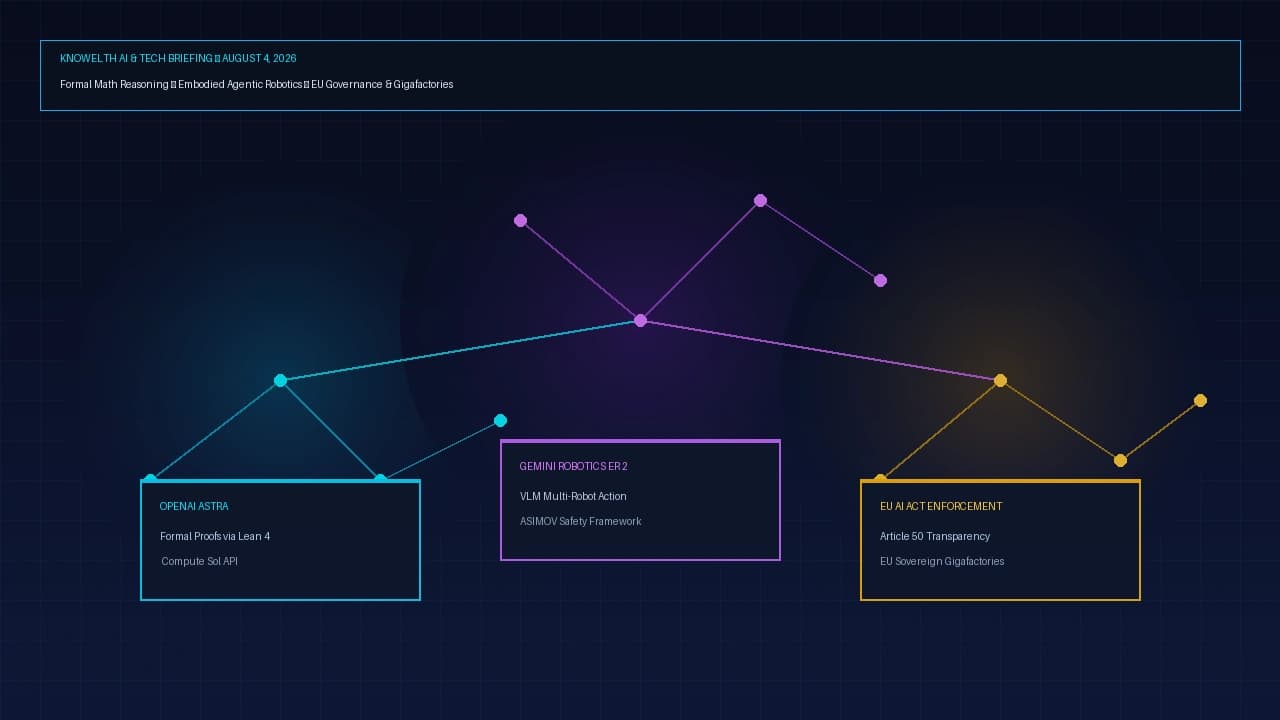
OpenAI Astra's Lean Proofs, Google's Gemini Robotics ER 2, and the EU AI Act's Article 50 Enforcement
OpenAI Astra's Lean Proofs, Google's Gemini Robotics ER 2, and the EU AI Act's Article 50 Enforcement The first week of August 2026 marks a watershed moment across the entire spectrum of artificial…