Sovereign AI India: GPU Cloud & Indic LLMs
Sovereign AI Infrastructure in India: GPU Clusters, Yotta Shakti Cloud, and Indic LLMs
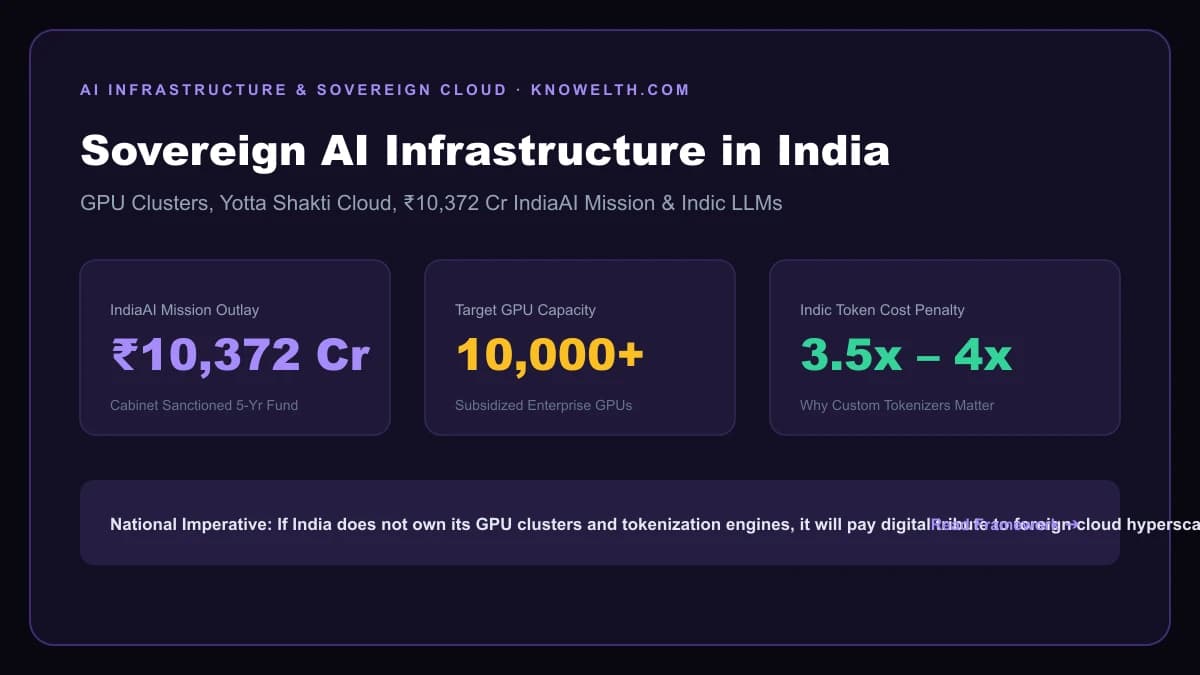
Quick Summary: In the global race for artificial intelligence hegemony, computing power has superseded crude oil as the primary geopolitical currency. Recognizing that complete reliance on Silicon Valley cloud hyperscalers (Microsoft Azure, AWS, Google Cloud) exposes India's sovereign data, judicial systems, and economic security to foreign embargoes and unilateral API pricing shocks, the Government of India sanctioned the landmark ₹10,372 Crore ($1.25 Billion) IndiaAI Mission. Anchored by the creation of a national subsidized public-private GPU compute grid exceeding 10,000 enterprise accelerators, the deployment of Yotta's Shakti Cloud (powered by massive Nvidia H100 and Blackwell clusters), and the engineering of native Indic tokenization architectures, India is constructing an independent full-stack sovereign intelligence engine designed to eliminate the crippling 4x "Indic tokenization tax" imposed by Western models.
The Crippling 4x Indic Tokenization Tax: The foundational architecture of Western Large Language Models (GPT-4o, Claude 3.5 Sonnet) was trained predominantly on English and Latin-script corpora using byte-pair encoding (BPE) tokenizers optimized for English morphology. In English, a 1,000-word corporate brief consumes approximately 1,250 tokens. In Devanagari (Hindi, Marathi, Sanskrit) or Dravidian scripts (Tamil, Telugu), the exact same semantic content fractures into 4,200 to 5,500 tokens because individual vowels, matras, and conjuncts are tokenized as fragmented byte sequences. As a consequence, Indian enterprises querying foreign LLMs pay 3.5x to 4.5x more compute dollars and endure 4x higher inference latency for identical intelligence. Building sovereign Indic foundation models with native tokenizers is an existential economic necessity.
+---------------------------------------------------------------------------------------------------+
|                        INDIA SOVEREIGN AI FULL-STACK ARCHITECTURAL ENGINE                         |
+---------------------------------------------------------------------------------------------------+
                                                  │
         ┌────────────────────────────────────────┼────────────────────────────────────────┐
         ▼                                        ▼                                        ▼
+──────────────────────────+             +──────────────────────────+             +──────────────────────────+
| COMPUTE HARDWARE LAYER   |             | INFRASTRUCTURE & CLOUD   |             | FOUNDATION MODEL LAYER   |
| • IndiaAI 10K+ GPU Pool  |             | • Yotta Shakti Cloud     |             | • Custom Indic Tokenizers|
| • Nvidia H100 / Blackwell|             | • Navi Mumbai NM1 & D1   |             | • Sarvam, Krutrim, Bhasha|
| • 50% Subsidized Vouchers|             | • Liquid Immersion Cool  |             | • 22 Official Languages  |
| • Zero Foreign Lock-In   |             | • Green Solar Backing    |             | • DPDP Act Data Custody  |
+──────────────────────────+             +──────────────────────────+             +──────────────────────────+
         │                                        │                                        │
         └────────────────────────────────────────┼────────────────────────────────────────┘
                                                  ▼
+---------------------------------------------------------------------------------------------------+
| SYNTHESIS: Autonomous Indian AI Stack Eliminating Digital Colonialism & Currency Outflow          |
+---------------------------------------------------------------------------------------------------+
🏛️ 1. The IndiaAI Mission: Sovereign Compute as a Public Utility
In March 2024, the Union Cabinet chaired by Prime Minister Narendra Modi approved the IndiaAI Mission with an overarching financial outlay of ₹10,372 Crore over five years. Rather than attempting to establish an inefficient state-run data center company, the mission designed a market-driven public-private partnership (PPP) model:
- The IndiaAI Compute Capacity Pillar: The central government established a transparent bidding framework where established data center operators (Yotta, Tata Communications, E2E Networks, Netweb) procure and house high-performance GPUs, while the government provides a 50% compute subsidy voucher directly to vetted Indian AI startups, researchers, and government departments.
- The IndiaAI Datasets Platform (IDP): A unified non-personal data governance architecture granting Indian LLM developers access to anonymized public datasets spanning healthcare records, geospatial terrain maps, agricultural soil telemetry, and parliamentary debates.
- The IndiaAI Innovation Centre: Formulating open-weight foundational Indic models (7B, 13B, and 70B parameter classes) licensed under permissive open-source frameworks to prevent private corporate rent-seeking.
+---------------------------------------------------------------------------------------------------+
|                          THE INDIAAI COMPUTE VOUCHER SUBSIDY FLYWHEEL                             |
+---------------------------------------------------------------------------------------------------+
 Indian AI Startup / Researcher Applies ──► Technical Merit & Indigenous Model Architecture Audit
                                                          │
                                          ┌───────────────┘
                                          ▼
 Issuance of IndiaAI Sovereign Voucher ──► Access to High-End GPU Cluster (Yotta / E2E Networks)
                                                          │
                                          ┌───────────────┘
                                          ▼
 Startup Pays 50% Commercial Cost ◄── Government Disburses 50% Subsidy Directly to Data Center
                                                          │
                                          ┌───────────────┘
                                          ▼
 [Result: Zero Startup Brain Drain to Silicon Valley; Intellectual Property Retained in India]
+---------------------------------------------------------------------------------------------------+
⚡ 2. Inside Yotta Shakti Cloud: Asia's Largest AI Supercluster
The commercial tip of the spear for Indian sovereign compute is Yotta Data Services (a subsidiary of the real estate conglomerate Hiranandani Group). Under CEO Sunil Gupta, Yotta executed an early multi-billion-dollar direct procurement partnership with Nvidia founder Jensen Huang, securing priority delivery of tens of thousands of enterprise AI GPUs.
Key Operational Metrics of Yotta Shakti Cloud:
- The Facilities: Anchored across the NM1 Hyperscale Facility in Panvel, Navi Mumbai, and the D1 Data Center in Greater Noida.
- GPU Deployment Scale: Over 16,000 Nvidia H100 and GH200 Grace Hopper Superchips scaled to an engineered cluster roadmap targeting 32,768 accelerators.
- InfiniBand Fabric: Connecting GPU nodes via Nvidia Quantum-2 800 Gb/s InfiniBand networking, enabling ultra-low-latency inter-GPU communication essential for training massive 100B+ parameter distributed models without gradient synchronization bottlenecks.
- Liquid Cooling in Tropical Climates: Engineering advanced direct-to-chip liquid cooling and enclosed cold-aisle containment, maintaining an industry-leading Power Usage Effectiveness (PUE) of sub-1.35 despite Mumbai's severe tropical ambient heat and humidity.
+---------------------------------------------------------------------------------------------------+
|                        SOVEREIGN COMPUTE BENCHMARK: YOTTA VS GLOBAL HYPERSCALERS                  |
+---------------------------------------------------------------------------------------------------+
| Metric / Parameter            | Yotta Shakti Cloud (India)       | AWS EC2 (P5 Instances, US)     | Microsoft Azure (NDv5, EU)    |
+-------------------------------+----------------------------------+--------------------------------+-------------------------------+
| Accelerator Hardware          | 🏆 Nvidia H100 / H200 / B200     | Nvidia H100 SXM5               | Nvidia H100 SXM5              |
| Hourly GPU On-Demand Cost     | 🏆 ~$2.80 – $3.20 / GPU Hour     | ~$4.10 – $4.60 / GPU Hour      | ~$3.95 – $4.40 / GPU Hour     |
| Post-IndiaAI Voucher Net Cost | 🏆 ~$1.40 – $1.60 / GPU Hour     | Full Price / Zero Subsidy      | Full Price / Zero Subsidy     |
| Data Jurisdiction & Law       | 🏆 Indian DPDP Act 2023 Compliant| US CLOUD Act Exposed           | EU GDPR / US CLOUD Act Bound  |
| Interconnect Speed            | 3.2 Tbps per node (Quantum-2)    | 3.2 Tbps per node (EFA v2)     | 3.2 Tbps per node (Infiniband)|
| Billing Currency              | 🏆 Indian Rupees (Zero FX Drag)  | US Dollars (USD/INR FX Risk)   | USD / Euros (FX Exposure)     |
+-------------------------------+----------------------------------+--------------------------------+-------------------------------+
🧠 3. The Tokenization War: Why English Models Fail Indian Reality
Enjoyed this post?
Get our weekly digest delivered free.
The technical barrier facing artificial intelligence in India is linguistic morphology. The Devanagari script (used by Hindi, Marathi, Nepali, and Sanskrit) and Dravidian scripts (Tamil, Telugu, Kannada, Malayalam) operate on syllabic alphabetic systems known as Abugidas, where vowels are written as diacritics (matras) attached to consonants.
+---------------------------------------------------------------------------------------------------+
|                        THE INDIC TOKENIZATION EFFICIENCY SHOWDOWN                                 |
+---------------------------------------------------------------------------------------------------+
 Input Sentence: "भारत को अपनी कृत्रिम बुद्धिमत्ता अवसंरचना का निर्माण स्वयं करना चाहिए।"
 Translation:   "India must build its own artificial intelligence infrastructure itself."
+---------------------------------------------------------------------------------------------------+
| Model / Tokenizer             | Token Count | Processing Ratio | Relative Inference API Cost      |
+-------------------------------+-------------+------------------+----------------------------------+
| Western LLM (OpenAI GPT-4o)   | 44 Tokens   | 3.66x Token Drag | 🏆 366% Cost Penalty             |
| Western LLM (Claude 3.5)      | 41 Tokens   | 3.41x Token Drag | 341% Cost Penalty                |
| Native Indic Tokenizer (Bhasha)| 🏆 12 Tokens| 1.00x (Baseline) | 🏆 100% (Baseline Minimum Cost)  |
+-------------------------------+-------------+------------------+----------------------------------+
When an Indian bank, healthcare provider, or state government deploys a citizen-facing AI customer agent processing 10 million queries a day, utilizing a Western model with a broken tokenizer results in millions of dollars wasted annually in redundant compute cycles.
Domestic startups like Sarvam AI (Sarvam-2B) and BharatGPT (Hanooman) have built proprietary tokenizers featuring vocabularies exceeding 128,000 to 256,000 sub-word tokens tailored specifically to the phonetic contours of Indian languages. This architectural correction slashes inference costs by 70% and accelerates generation speeds by 300%.
🔒 4. The Regulatory Shield: DPDP Act 2023 & Cross-Border Data Fences
Sovereign AI is not merely an economic calculation; it is enforced by statutory law. The enactment of the Digital Personal Data Protection (DPDP) Act 2023 fundamentally altered how enterprise data must be handled:
- Financial & Health Data Localization: The Reserve Bank of India (RBI) and National Health Authority (NHA) enforce strict mandates requiring financial payment logs, core banking ledgers, and electronic health records to remain exclusively within Indian territorial jurisdiction.
- Defense & Critical Infrastructure: The Ministry of Defence and public-sector utilities (power grids, railways, nuclear facilities) are legally prohibited from uploading telemetry into public clouds where servers reside in foreign jurisdictions subject to the US CLOUD Act (which empowers US law enforcement to seize data on servers owned by American corporations, regardless of physical location).
- The Captive Domestic Market: These statutory fences guarantee that Yotta, Tata, and indigenous AI providers operate with an impregnable domestic customer base that foreign cloud giants cannot legally capture without partnering with local infrastructure providers.
📌 Strategic Takeaways for Tech Executives & Investors
+---------------------------------------------------------------------------------------------------+
|                                  SOVEREIGN AI STRATEGIC PLAYBOOK                                  |
+---------------------------------------------------------------------------------------------------+
| Strategic Dimension            | Executive & Investor Directive                                   |
+--------------------------------+------------------------------------------------------------------+
| Compute Cost Arbitrage         | Leverage IndiaAI vouchers to train models at 50% international cost|
| Tokenizer Architecture Audit   | Never deploy an off-the-shelf Western LLM for Indic customer apps |
| Regulatory Immunity            | Build on domestic cloud stacks to permanently satisfy DPDP laws  |
| Currency Risk Shielding        | Lock in INR-denominated cloud billing to hedge against rupee depreciation|
+--------------------------------+------------------------------------------------------------------+
📫 Frontier AI Intelligence & Enterprise Systems
Subscribe to Knowelth for institutional-grade breakdowns of sovereign compute architectures, frontier AI economics, and enterprise digital moat strategies.
Subscribe to Knowelth Executive Intelligence →
Disclaimer: This report is compiled for institutional technology and corporate research purposes. It does not constitute investment advice or a financial endorsement.
Technical architecture teardowns, artificial intelligence evaluations, and software benchmarks published on Knowelth reflect independent developer testing and publicly available documentation. We maintain complete editorial independence from vendor sponsorships. Read our Editorial Policy.
Enjoyed this post?
Get our weekly digest delivered free.
Share this post:
Knowelth is reader-supported. We may earn a commission from links in this article at no extra cost to you. Read our disclosure.
Related Posts
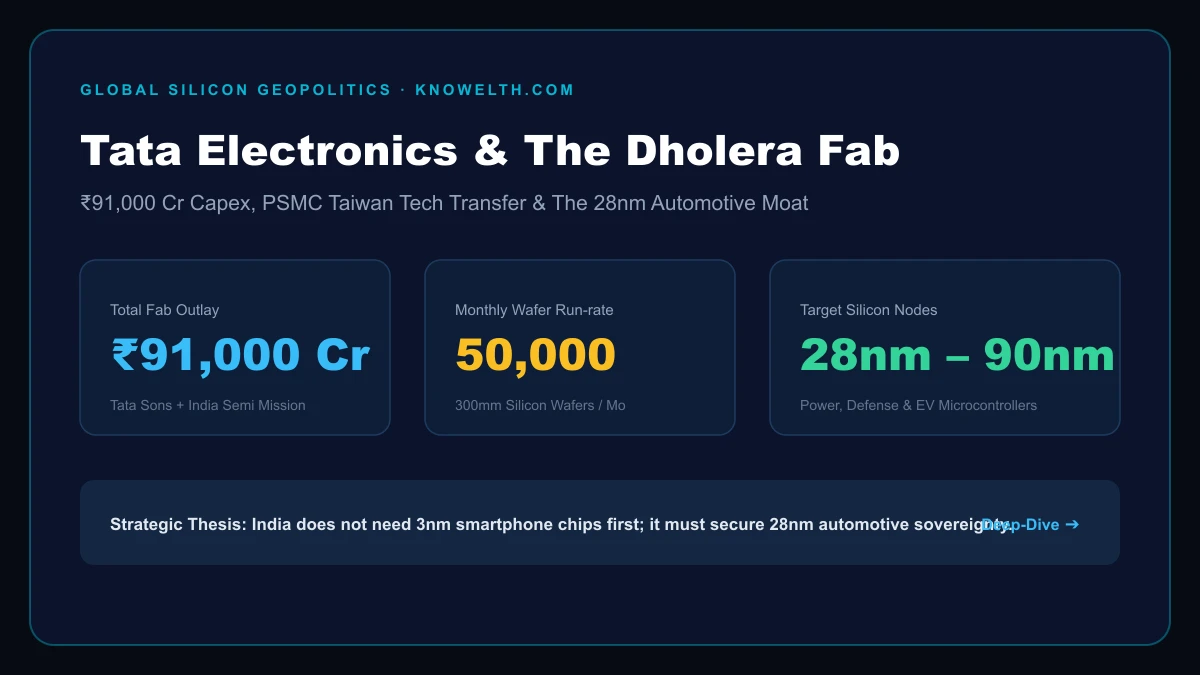
Tata Electronics & Dholera Fab: India's Chip Ambition
Tata Electronics & The Dholera Fab: Can India Break Taiwan's Semiconductor Monopoly? Quick Summary: In the arid plains of Dholera Special Investment Region (SIR) in Gujarat, Tata Electronics, in techn…
System 2 AI Architectures, NVIDIA's $500B Infrastructure Alliance, and Industrial Physical AI Scale-Up
System 2 AI Architectures, NVIDIA's $500B Infrastructure Alliance, and Industrial Physical AI Scale-Up The artificial intelligence ecosystem is undergoing a fundamental structural transformation th…
AI's Frontier Shift: Autonomous Bio-Design, 0.42nm Semiconductors, and the EU AI Act Governance Horizon
AI's Frontier Shift: Autonomous Bio-Design, 0.42nm Semiconductors, and the EU AI Act Governance Horizon The artificial intelligence landscape has reached a decisive turning point where digital inte…