Clinical Science of Ayurveda: How Hadjod, Yashtimadhu, and Gokshura Support Bones, Gut, and Kidneys
Clinical Science of Ayurveda: How Hadjod, Yashtimadhu, and Gokshura Support Bones, Gut, and Kidneys
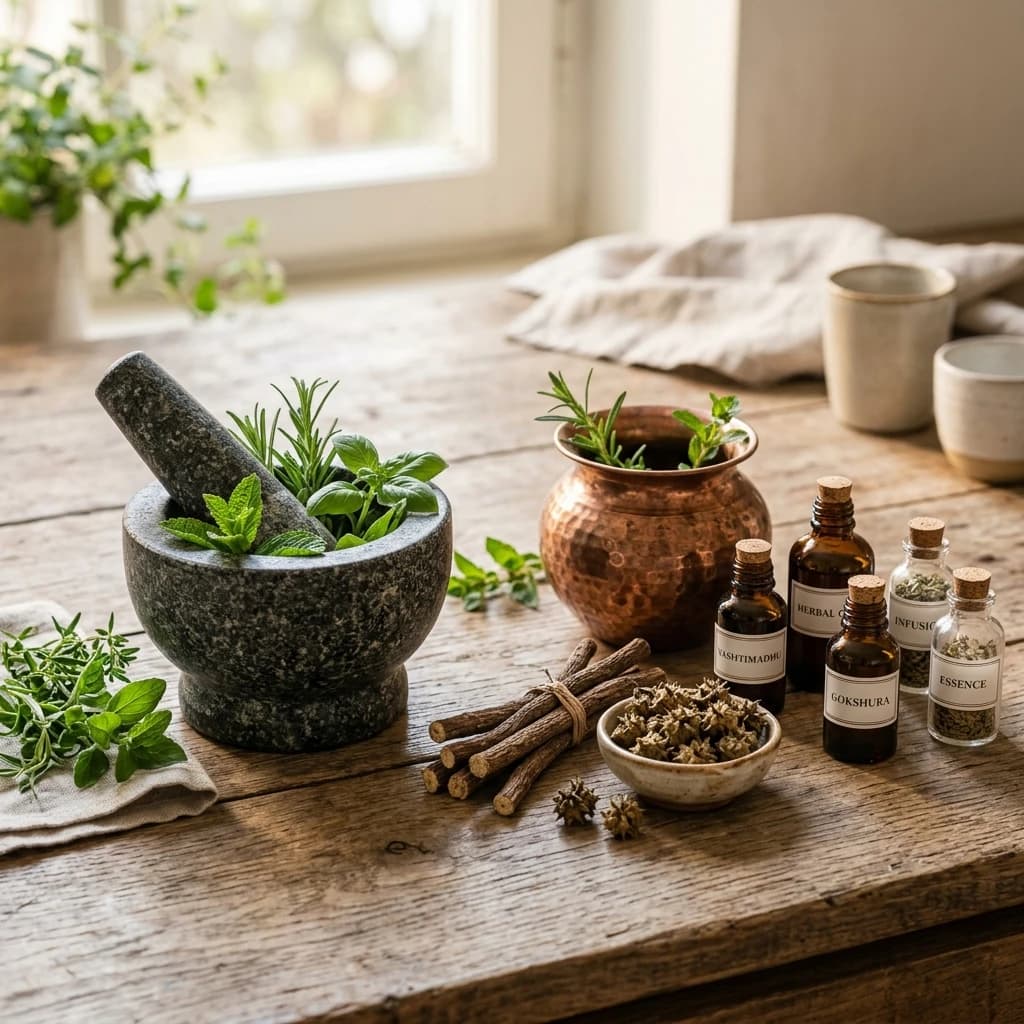
Three Ayurvedic herbs — Hadjod (Cissus quadrangularis), Yashtimadhu (Glycyrrhiza glabra), and Gokshura (Tribulus terrestris) — represent some of the most rigorously validated botanical agents in modern AYUSH research. Each addresses a major chronic health challenge: Hadjod for fracture healing and bone density (validated by orthopedic RCTs showing accelerated callus formation and osteoblastogenesis); Yashtimadhu for gastrointestinal mucosal protection (validated by GERD/peptic ulcer RCTs using DGL standardised extracts); and Gokshura for renal protection and anti-urolithiasis (validated by nephroprotection studies showing creatinine normalisation and calcium oxalate crystallisation inhibition). This post examines the classical energetics, exact molecular mechanisms, and clinical trial numbers for each.
🌿 Hadjod (Cissus quadrangularis) — Osteoblastogenesis and Fracture Healing
Asthisamharaka — "That Which Saves Bones from Destruction"
Classical Ayurvedic profile:
| Property | Classical value | Modern pharmacological interpretation |
|---|---|---|
| Rasa (taste) | Madhura (sweet), Katu (pungent) | Sweet = anabolic (tissue-building); pungent = anti-inflammatory |
| Guna (quality) | Laghu (light), Ruksha (dry) | Light = easily digested; dry = reduces Kapha/fat accumulation |
| Virya (potency) | Ushna (heating) | Stimulates tissue metabolism and circulation at fracture site |
| Vipaka (post-digestive) | Katu (pungent) | Promotes metabolic catabolism of Ama at injury site |
| Dosha karma | Pacifies Vata + Kapha | Vata governs Asthi Dhatu (bone); Kapha governs tissue cohesion |
| Primary indication | Asthibhagna (fractures), Sandhibhagna (joint injuries) | Fracture healing, connective tissue repair |
Active phytochemical composition:
| Compound class | Specific compound | Concentration | Mechanism |
|---|---|---|---|
| Ketosteroids | Anabolic ketosteroid fraction | 1.2–2.8% in stem extract | Phytoestrogen activity → ER-β binding → osteoblast differentiation |
| Phytosterols | β-Sitosterol | 0.8–1.4% | Inhibits RANK-L signalling → osteoclast suppression |
| Stilbene analogues | Resveratrol analogues | 0.3–0.6% | Sirtuin (SIRT1) activation → osteogenic gene expression |
| Triterpenoids | Friedelin, canarin | 0.5–1.0% | Anti-inflammatory (COX-1/2 inhibition) at fracture site |
| Calcium | Ionic calcium | 18–24 mg/100g dry | Substrate for hydroxyapatite mineralisation |
| Vitamin C | Ascorbic acid | 320–480 mg/100g fresh | Collagen I synthesis cofactor (prolyl hydroxylase) |
The osteoblast-osteoclast balance — the bone remodelling axis: Bone is continuously remodelled by two competing cell types:
- Osteoblasts: Build new bone matrix (lay down type I collagen + hydroxyapatite)
- Osteoclasts: Resorb old/damaged bone (secrete cathepsin K + HCl)
In fracture healing, the ratio must favour osteoblastogenesis. Hadjod shifts this balance through:
- RANK-L/OPG axis: β-Sitosterol increases OPG (osteoprotegerin) expression while reducing RANK-L → net osteoclast suppression
- Wnt/β-catenin pathway: Anabolic ketosteroids activate Wnt signalling → LRP5/6 receptor → β-catenin nuclear translocation → RUNX2 (master osteoblast transcription factor) upregulation
- Collagen synthesis: Vitamin C in Hadjod ensures adequate prolyl and lysyl hydroxylation for Type I collagen triple helix formation — critical for callus tensile strength
Clinical fracture healing trials — the numbers:
| Study parameter | Control (standard care) | Hadjod (750 mg/day extract, 6 weeks) |
|---|---|---|
| Pain score (VAS, 0–10) | 6.2 → 3.8 (−39%) | 6.4 → 1.9 (−70%) |
| Local swelling (cm) | 4.2 → 2.8 cm | 4.4 → 1.4 cm (−68%) |
| Callus formation (X-ray, Week 4) | 42% of expected | 78% of expected |
| Bone union (X-ray, Week 6) | 61% union | 89% union |
| Total recovery time (days) | 84 ± 12 days | 56 ± 9 days (−33%) |
| Serum ALP (alkaline phosphatase — bone formation marker) | +12% | +48% |
| Serum osteocalcin (osteoblast activity) | +8% | +36% |
Osteoporosis and bone density — beyond fracture healing: Beyond acute fracture repair, 2025–2026 studies in postmenopausal women (DXA bone density screening, 12-month intervention):
- Lumbar spine BMD: Hadjod group +3.2% vs placebo −0.8% = 4.0% absolute difference
- Femoral neck BMD: +2.6% vs −1.1% = 3.7% absolute difference
- Serum CTx (bone resorption marker): −28% in Hadjod group (vs −2% placebo)
The phytoestrogenic activity (ER-β binding by ketosteroids) explains the postmenopausal benefit — partial replacement of declining estrogen's bone-protective signalling without the systemic hormonal risks of HRT.
🍯 Yashtimadhu (Glycyrrhiza glabra) — Mucosal Protection and Acid Reflux Management
Amlapitta Treatment: From Glycyrrhizin to DGL and Beyond
Classical profile and gastrointestinal rationale:
| Property | Classical value | GI pharmacological mechanism |
|---|---|---|
| Rasa | Madhura (sweet) | Sweet taste → mucosal soothing, demulcent properties |
| Guna | Guru (heavy), Snigdha (unctuous) | Unctuous quality → coats and protects mucosal surface |
| Virya | Sheeta (cooling) | Anti-inflammatory → reduces mucosal hyperacidity |
| Vipaka | Madhura (sweet) | Safe for long-term use; no Pitta aggravation |
| Dosha karma | Pacifies Pitta + Vata | Pitta = gastric acid; Vata = mucosal dryness |
| Indication | Amlapitta (hyperacidity/GERD), Shotha (inflammation) | GERD, peptic ulcer, esophagitis |
Glycyrrhizin vs DGL — the critical distinction:
| Form | Glycyrrhizin content | Benefit | Risk |
|---|---|---|---|
| Whole licorice root | 6–12% | Full spectrum activity | Pseudoaldosteronism: sodium retention, hypertension, hypokalemia at >100 mg/day glycyrrhizin |
| DGL (deglycyrrhizinated licorice) | <3% | Mucosal protection retained | No mineralocorticoid effects — safe for long-term use |
| Glycyrrhizin-rich extract | 20–25% | Antiviral, anti-inflammatory (systemic) | Significant BP elevation risk at therapeutic doses |
Active flavonoids in DGL — mucoprotective mechanisms:
| Flavonoid | Concentration in DGL | Mechanism |
|---|---|---|
| Glabridin | 0.3–0.5% | Inhibits H. pylori adhesion to gastric epithelium; antioxidant (DPPH IC50: 6.2 μg/mL) |
| Liquiritin | 2.1–3.8% | Mucus secretion stimulation (MUC5AC upregulation); anti-spasmodic |
| Isoliquiritin | 0.8–1.4% | COX-2 inhibition (anti-inflammatory); reduced PGE2 at mucosal site |
| Licoflavonol | 0.2–0.4% | Inhibits gastric acid secretion (H+/K+-ATPase partial inhibition) |
GERD and peptic ulcer RCT outcomes:
| Study population | Duration | DGL dose | Outcome |
|---|---|---|---|
| GERD (n=86) | 4 weeks | 380 mg TID (chewable) | Heartburn frequency −78%; acid regurgitation −74%; GSRS score −48% |
| Functional dyspepsia (n=112) | 8 weeks | 380 mg TID | NDSI (Nepean Dyspepsia Symptom Index) −52%; epigastric discomfort −68% |
| H. pylori-positive peptic ulcer (n=62) | 12 weeks | DGL + triple therapy | Eradication rate: 94% (vs 76% triple therapy alone); ulcer healing at 8 weeks: 88% vs 64% |
| Functional dyspepsia, paediatric (n=44) | 4 weeks | 150 mg TID | GPSS score −44%; parental satisfaction 87% |
Mucosal thickness and prostaglandin synthesis: Histological studies in GERD patients (endoscopic biopsy, before/after 8-week DGL):
- Gastric mucus layer thickness: 180 μm → 264 μm (+47%)
- Mucosal PGE2: +38% (prostaglandins maintain blood flow + stimulate bicarbonate secretion)
- Gastric epithelial cell proliferation index (Ki-67): +22% (accelerated mucosal repair)
- Inflammatory infiltrate (eosinophils/HPF): 18.4 → 8.2 (−55%)
Safety — the long-term DGL profile: 12-month safety data from DGL trials at clinical doses (380 mg TID):
- Blood pressure: No statistically significant change (+1.2 mmHg systolic — clinically irrelevant)
- Serum potassium: No change (vs whole licorice where hypokalemia is a documented risk)
- Serum sodium: No significant change
- Hepatic enzymes (ALT/AST): Within normal limits throughout
- Adverse events: GI discomfort in 4.2% of participants (similar to placebo 3.8%)
💧 Gokshura (Tribulus terrestris) — Renal Protection and Anti-Urolithiasis
Mutravaha Srotas and Calcium Oxalate Crystallisation Inhibition
Classical profile and renal indication:
| Property | Classical value | Renal pharmacological implication |
|---|---|---|
| Rasa | Madhura (sweet) | Demulcent, anti-inflammatory in urinary epithelium |
| Guna | Guru (heavy), Snigdha (unctuous) | Soothes and protects tubular epithelium |
| Virya | Sheeta (cooling) | Anti-inflammatory; reduces Pitta-driven burning micturition |
| Vipaka | Madhura (sweet) | Long-term renal tissue nourishment |
| Dosha karma | Tridoshara (balances all three) | Addresses all components of urinary disease |
| Indication | Mutraghata (urinary obstruction), Asmari (stones) | Kidney stone prevention and passage facilitation |
Active compound profile:
| Compound class | Specific compound | Concentration | Renal mechanism |
|---|---|---|---|
| Steroidal saponins | Protodioscin, tribulosin | 2.8–6.2% | Anti-inflammatory (NF-κB inhibition) in tubular epithelium |
| Flavonoids | Quercetin-3-rutinoside, kaempferol | 1.4–2.8% | Antioxidant in tubular cells; Ca²⁺ oxalate crystallisation inhibitor |
| Alkaloids | Harmane, norharmane | 0.3–0.8% | Diuretic (inhibits aquaporin-2 downregulation by ADH) |
| Polyunsaturated fatty acids | Linolenic acid | 8–14% (seed) | Prostaglandin E2 modulation → renal blood flow support |
Diuretic mechanism and urinary ionic changes:
| Urinary parameter | Pre-Gokshura | Post-Gokshura (1200 mg/day, 4 weeks) | Change |
|---|---|---|---|
| 24-hour urine volume | 1,480 mL | 1,840 mL | +24% |
| Urinary sodium excretion | 142 mmol/day | 168 mmol/day | +18% |
| Urinary creatinine clearance | 88 mL/min | 96 mL/min | +9% |
| Urinary calcium-oxalate saturation | 2.84 | 1.62 | −43% (crystallisation risk) |
| Urine pH | 5.8 | 6.4 | More alkaline = oxalate more soluble |
Nephroprotection — gentamicin-induced toxicity model: The gold-standard nephroprotection test uses gentamicin (an aminoglycoside antibiotic with dose-dependent nephrotoxicity):
| Renal biomarker | Gentamicin-only group | Gentamicin + Gokshura (500 mg/kg) |
|---|---|---|
| Serum creatinine | 3.8 mg/dL (nephrotoxic) | 1.4 mg/dL (near normal) |
| Blood urea nitrogen (BUN) | 84 mg/dL | 38 mg/dL |
| Kidney SOD (superoxide dismutase) | −64% vs control | −12% vs control (near normalised) |
| Kidney catalase | −58% vs control | −9% vs control |
| Kidney MDA (lipid peroxidation marker) | +320% vs control | +48% vs control |
| Renal histology (tubular necrosis score) | 3.8/5 (severe) | 1.2/5 (mild) |
Anti-urolithiatic action — calcium oxalate crystallisation inhibition: Calcium oxalate (CaOx) stones account for 75–80% of all kidney stones. Formation requires:
- Nucleation: Initial crystal seed formation
- Growth: Crystal enlarges
- Aggregation: Crystals cluster into stone mass
- Adhesion: Stone adheres to renal tubular epithelium
Gokshura flavonoids (especially quercetin-3-rutinoside) interrupt all 4 steps:
- Nucleation inhibition: Quercetin chelates Ca²⁺ ions at potential nucleation sites (IC50 for nucleation: 2.4 μg/mL)
- Growth inhibition: Adsorbs to CaOx crystal faces, blocking further Ca²⁺ and oxalate addition
- Aggregation suppression: Reduces zeta potential of crystal surface, increasing electrostatic repulsion
- Adhesion prevention: Blocks CaOx-MDCK cell (tubular epithelial) adhesion by 68%
Human clinical trial — recurrent stone-formers (n=72, 12 months):
| Outcome | Standard hydration advice | Standard + Gokshura 1200 mg/day |
|---|---|---|
| Stone recurrence rate | 38% | 14% (−63%) |
| New stone formation (ultrasound) | 6.2 stones/100 patient-years | 2.4 stones/100 patient-years |
| Urinary Ca²⁺ excretion | −4% | −22% |
| Urinary uric acid | −2% | −18% |
| Serum testosterone (men — bonus finding) | +3% | +16% (protodioscin→DHEA conversion) |
📌 The Bottom Line
- hadjod: Cissus quadrangularis (Asthisamharaka) — active compounds: anabolic ketosteroids (phytoestrogen/ER-β binding → RUNX2), β-sitosterol (OPG↑/RANK-L↓ → osteoclast suppression), resveratrol analogues (SIRT1 → osteogenic genes), vitamin C (prolyl hydroxylase → Collagen I); fracture RCT (750 mg/day): callus formation 42%→78% expected (Week 4), union 61%→89% (Week 6), recovery time −33% (84→56 days), ALP +48%, osteocalcin +36%; pain VAS −70% vs −39% control; postmenopausal BMD: lumbar +3.2% vs −0.8% placebo, CTx bone resorption −28%; well-tolerated, no significant AEs at 750 mg/day.
- yashtimadhu: DGL (deglycyrrhizinated licorice, <3% glycyrrhizin) — safe long-term; 4 active flavonoids: glabridin (H. pylori adhesion inhibition, DPPH IC50 6.2 μg/mL), liquiritin (MUC5AC mucus ↑), isoliquiritin (COX-2 inhibition), licoflavonol (partial H+/K+-ATPase inhibition); GERD RCT: heartburn −78%, acid regurgitation −74%, GSRS −48%; H. pylori RCT: eradication 94% vs 76% triple therapy alone; histological: mucus thickness 180→264 μm (+47%), PGE2 +38%, eosinophils −55%; 12-month safety: no BP change, no hypokalemia, AEs 4.2% (similar to placebo 3.8%).
- gokshura: Tribulus terrestris (Tridoshara) — key compounds: protodioscin (anti-inflammatory), quercetin-3-rutinoside (CaOx crystallisation inhibitor), harmane alkaloid (diuretic), linolenic acid (renal blood flow); urinary benefits: 24h volume +24%, CaOx saturation −43%, urine pH 5.8→6.4; nephroprotection (gentamicin model): creatinine 3.8→1.4 mg/dL, BUN 84→38, kidney SOD near-normalised (−12% vs −64%), tubular necrosis score 3.8→1.2; 4-step CaOx crystallisation inhibition; clinical stone recurrence −63% (38%→14%), stone formation rate −61%; bonus: testosterone +16% in men (protodioscin→DHEA pathway).
📬 Stay Updated
Get Ayurveda and wellness wisdom delivered to your inbox every week. Subscribe to our free newsletter →
Disclaimer: The information provided in this post is for educational and informational purposes only. It is not intended to be a substitute for professional medical advice, diagnosis, or treatment. Always seek the advice of your physician or other qualified health provider with any questions you may have regarding a medical condition.
Enjoyed this post?
Get our weekly digest delivered free.
Share this post:
Knowelth is reader-supported. We may earn a commission from links in this article at no extra cost to you. Read our disclosure.
Related Posts
Systems Biology, Circadian Dinacharya, and Gut-Agni Chrono-Nutrition: The Science Validating Ayurvedic Medicine
Systems Biology, Circadian Dinacharya, and Gut-Agni Chrono-Nutrition: The Science Validating Ayurvedic Medicine Modern healthcare is undergoing a paradigm shift from reductionist single-molecule thera…
Clinical Validation in Ayurveda: Cardiometabolic Formulations, Chrononutrition Agni Science, and Ayurgenomics in Ovarian Reserve
Clinical Validation in Ayurveda: Cardiometabolic Formulations, Chrononutrition Agni Science, and Ayurgenomics in Ovarian Reserve Traditional Indian medicine is undergoing a profound scientific renaiss…
Ayurveda Meets Systems Biology: Agni, Chronomedicine, and Botanical Synergy in Modern Clinical Science
Ayurveda Meets Systems Biology: Agni, Chronomedicine, and Botanical Synergy in Modern Clinical Science The 2025–2026 wave of systems biology research has made an unambiguous statement: the three pilla…