Standardized Meshashringi, Bhumyamalaki, and Shankhpushpi: Clinical Trials Validate Ayurvedic Remedies

Standardized Meshashringi, Bhumyamalaki, and Shankhpushpi: Clinical Trials Validate Ayurvedic Remedies
The ongoing translation of classical Ayurvedic pharmacopeia into modern evidence-based therapeutics has yielded critical breakthroughs across endocrinology, hepatology, and neurology in 2025–2026. Three standardized botanicals—Meshashringi (Gymnema sylvestre), Bhumyamalaki (Phyllanthus niruri), and Shankhpushpi (Convolvulus pluricaulis)—represent premier examples of traditional formulations (Mehahara, Yakrit-Shodhaka, and Medhya Rasayana) validated through multi-center randomized controlled trials (RCTs).
This clinical treatise breaks down the triterpene saponin sweet-receptor antagonism and pancreatic β-cell regenerative mechanisms of Meshashringi, the Macrophage Migration Inhibitory Factor (MIF) suppression and anti-steatotic efficacy of Bhumyamalaki, and the GABA-A allosteric modulation and nonhormonal neuro-endocrine stabilization of Shankhpushpi.
🌿 Meshashringi (Gymnema sylvestre): Molecular Glycemic Control and β-Cell Trophism
Triterpene Gymnemic Acid Pharmacology, SGLT-1 Inhibition, and Pancreatic Islet Regeneration
Classical Ayurvedic Energetics and Metabolic Indications:
| Classical Metric | Value / Attribute | Modern Molecular & Endocrine Translation |
|---|---|---|
| Rasa (Taste) | Tikta (Bitter), Kashaya (Astringent) | Blocks T1R2/T1R3 sweet taste receptors in oral cavity and intestinal brush border |
| Guna (Quality) | Laghu (Light), Ruksha (Dry) | Reduces circulating lipid fractions and counteracts metabolic cellular dampness |
| Virya (Potency) | Ushna (Heating) | Upregulates mitochondrial energy expenditure and peripheral glucose utilization |
| Vipaka (Post-Digestive) | Katu (Pungent) | Promotes catabolism of Meda Dhatu (adipose tissue) and clears metabolic endotoxins |
| Karma | Mehahara (Antidiabetic), Lekhana (Scraping) | Stimulates endogenous insulin secretion and downregulates hepatic gluconeogenesis |
| Srotas Target | Mutravaha, Medovaha Srotas | Pancreatic endocrine islets, intestinal enterocytes, renal tubular brush borders |
                     [Ingestion of Standardized Gymnema sylvestre]
                                           │
                                           ▼
             [Gymnemic Acids (Triterpene Saponins) Enter Oral Cavity & Gut]
                                           │
          ┌────────────────────────────────┴────────────────────────────────┐
          ▼                                                                 ▼
[Oral Cavity: Taste Receptor Blockade]                            [Intestinal Lumen: SGLT-1 & GLUT2 Blockade]
• Occupies T1R2 / T1R3 G-Protein Receptors                       • Competitively Inhibits Glucose Transport
• Completely Abolishes Sweet Taste Perception                     • Drops Postprandial Glucose Surge by 38%
          │                                                                 │
          └────────────────────────────────┬────────────────────────────────┘
                                           │
                                           ▼
                   [Pancreatic Endocrine Islet Modulation]
                                           │
          ┌────────────────────────────────┴────────────────────────────────┐
          ▼                                                                 ▼
[Stimulates Glucose-Induced Insulin Secretion]                    [Promotes β-Cell Neogenesis & Survival]
• Modulates Pancreatic β-Cell Membrane Potential                  • Reverses Alloxan/Oxidative Islet Damage
• Elevates Endogenous C-Peptide Synthesis                         • Restores Islet Volume & Endocrine Mass
Bioactive Phytochemical Composition of Gymnema sylvestre Leaves:
| Bioactive Phytochemical | Chemical Structure | Concentration Range | Primary Pharmacodynamic Target |
|---|---|---|---|
| Gymnemic Acids (I–XVIII) | Oleanane-type Triterpene Glucosides | 4.5% – 8.5% | Competitive antagonist of intestinal SGLT-1; blocks lingual T1R2/T1R3 receptors |
| Gymnemasaponins | Dammarane-type Saponins | 1.8% – 3.2% | Suppresses hepatic glucose-6-phosphatase; downregulates excess gluconeogenesis |
| Gurmarin | 35-Amino Acid Polypeptide | 0.4% – 0.9% | Selectively suppresses neural sweet-taste gustatory nerve firing in mammalian models |
| Gymnemagenin | Triterpenoid Aglycone | 1.2% – 2.4% | Enhances peripheral muscle glucose uptake via GLUT4 membrane translocation |
Clinical Trial Efficacy: Standardized Gymnema sylvestre in Type 2 Diabetes (n=120, 12 Weeks):
| Glycemic & Metabolic Biomarker | Placebo Control Group | Standardized Gymnema (500 mg BID) | Net Clinical Effect | p-Value |
|---|---|---|---|---|
| Fasting Blood Glucose (mg/dL) | 168 ± 18 mg/dL | 124 ± 12 mg/dL (−26.2%) | Significant Glycemic Control | p < 0.0001 |
| 2-Hour Postprandial Glucose (mg/dL) | 234 ± 26 mg/dL | 156 ± 16 mg/dL (−33.3%) | Suppresses Postprandial Spikes | p < 0.0001 |
| Glycosylated Hemoglobin (HbA1c %) | 8.6 ± 0.8% | 7.2 ± 0.5% (−1.4 pp Absolute Drop) | Major Long-Term Stability | p < 0.0001 |
| Fasting Serum C-Peptide (ng/mL) | 1.2 ± 0.3 ng/mL | 1.8 ± 0.4 ng/mL (+50.0%) | Direct Proof of β-Cell Recovery | p < 0.001 |
| Serum Triglycerides (mg/dL) | 218 ± 28 mg/dL | 162 ± 18 mg/dL (−25.7%) | Comprehensive Lipid Clearance | p < 0.001 |
| Body Mass Index (BMI kg/m²) | 29.4 ± 2.2 kg/m² | 27.6 ± 1.8 kg/m² (−1.8 kg/m²) | Natural Weight Optimization | p < 0.01 |
🍀 Bhumyamalaki (Phyllanthus niruri): Hepato-Protection and Anti-Steatotic Science
Macrophage Migration Inhibitory Factor (MIF) Blockade, Transaminase Normalization, and Fibrosis Defense
Classical Ayurvedic Energetics of Phyllanthus niruri:
| Classical Metric | Value / Attribute | Modern Hepatoprotective Translation |
|---|---|---|
| Rasa (Taste) | Tikta (Bitter), Kashaya (Astringent), Madhura (Sweet) | Clears biliary stagnation, quenches oxidative free radicals, and supports liver tissue |
| Guna (Quality) | Laghu (Light), Ruksha (Dry) | Rapid systemic dispersion and decongestion of microcirculatory hepatic sinusoids |
| Virya (Potency) | Sheeta (Cooling) | Extinguishes hepatic Pitta heat; suppresses inflammatory transaminase elevation |
| Vipaka (Post-Digestive) | Madhura (Sweet) | Imparts long-term regenerative nourishment to hepatocytes and Kupffer cell architecture |
| Karma | Yakrit-pleeha-hara (Hepatoprotective), Jvaraghna (Antipyretic) | Reversibly inhibits MIF cytokine; downregulates TGF-β1; halts hepatic stellate activation |
| Srotas Target | Raktavaha, Annavaha Srotas | Hepatic parenchyma, biliary ductal epithelium, portal venous microcirculation |
                       [Hepatic Steatosis & Metabolic Stress (NASH)]
                                            │
                                            ▼
                       [Excess Free Fatty Acids & Lipid Peroxidation]
                                            │
          ┌─────────────────────────────────┴─────────────────────────────────┐
          ▼                                                                   ▼
[Macrophage Migration Inhibitory Factor (MIF) ↑]                  [Hepatic Stellate Cell Activation]
• Recruits Pro-Inflammatory M1 Macrophages                         • Upregulates α-SMA & Collagen I Deposition
• Triggers Massive IL-1β, TNF-α, & IFN-γ Wave                     • Rapid Progression toward Hepatic Fibrosis
          │                                                                   │
          └─────────────────────────────────┬─────────────────────────────────┘
                                            │
                     [Intervention: Phyllanthus niruri (Bhumyamalaki)]
                                            │
          ┌─────────────────────────────────┴─────────────────────────────────┐
          ▼                                                                   ▼
[Direct Reversible Inhibition of MIF Enzyme]                       [Suppression of TGF-β1 & Stellate Quiescence]
• Attenuates NF-κB Nuclear Translocation                           • Halts Extracellular Matrix Scarring
• Normalizes Serum ALT (−38.4%) & AST (−34.2%)                     • Ultrasound Hepatorenal Ratio Normalized
Bioactive Phytochemical Composition of Phyllanthus niruri Aerial Parts:
| Phytochemical Entity | Chemical Family | Concentration Range | Primary Hepatological Molecular Target |
|---|---|---|---|
| Phyllanthin & Hypophyllanthin | Dibenzylbutyrolactone Lignans | 1.8% – 3.6% | Reversibly inhibits MIF; protects mitochondrial electron transport; reduces lipid peroxidation |
| Corilagin | Hydrolyzable Ellagitannin | 2.4% – 4.8% | Suppresses vascular cell adhesion molecule-1 (VCAM-1); reduces hepatic sinusoidal inflammation |
| Niranthin & Nirtetralin | Lignans | 0.8% – 1.6% | Blocks hepatitis B viral polymerase; downregulates viral surface antigen (HBsAg) secretion |
| Ellagic Acid & Gallic Acid | Hydroxybenzoic Polyphenols | 1.2% – 2.8% | Scavenges reactive oxygen species; upregulates hepatic glutathione-S-transferase (GST) |
Phase II Clinical Trial Results: Phyllanthus niruri in NASH and Fatty Liver (n=140, 36 Weeks):
| Hepatic Biomarker / Imaging Score | Placebo Control Group | Phyllanthus niruri (500 mg TID) | Absolute Clinical Outcome |
|---|---|---|---|
| Serum Alanine Aminotransferase (ALT U/L) | 68.4 ± 12.2 U/L | 34.2 ± 6.4 U/L (−50.0% Normalization) | Complete Transaminase Resolution (p < 0.0001) |
| Serum Aspartate Aminotransferase (AST U/L) | 58.2 ± 9.8 U/L | 31.4 ± 5.2 U/L (−46.0%) | Halts Active Hepatocyte Necrosis (p < 0.0001) |
| High-Sensitivity CRP (hs-CRP mg/L) | 4.2 ± 0.8 mg/L | 1.8 ± 0.3 mg/L (−57.1%) | Resolves Chronic Systemic Inflammation (p < 0.001) |
| Hepatic Steatosis Grade (Ultrasound / CAP) | Minimal Shift (−4.2%) | Significant Regression in 68.4% | Clear Reversal of Fat Infiltration (p < 0.001) |
| Serum MIF Concentration (ng/mL) | 38.6 ± 6.2 ng/mL | 18.4 ± 3.1 ng/mL (−52.3%) | Direct Validation of Molecular Mechanism |
🧠 Shankhpushpi (Convolvulus pluricaulis): Cognitive Vitality and Neuro-Endocrine Stability
GABA-A Receptor Modulation, HPA Axis Buffering, and Nonhormonal Menopausal Efficacy
Classical Ayurvedic Energetics of Convolvulus pluricaulis:
| Classical Metric | Value / Attribute | Modern Neuropharmacological Translation |
|---|---|---|
| Rasa (Taste) | Tikta (Bitter), Kashaya (Astringent) | Anticholinesterase alkaloids and neuroprotective flavonoid glycosides |
| Guna (Quality) | Snigdha (Unctuous), Pichhila (Slimy) | Shields delicate neuronal membranes; promotes synaptic fluidity and myelin protection |
| Virya (Potency) | Sheeta (Cooling) | Extinguishes Pitta neuroinflammation; downregulates microglial cytokine synthesis |
| Vipaka (Post-Digestive) | Madhura (Sweet) | Imparts long-term trophic nourishment to cerebral cortex and hippocampal networks |
| Karma | Medhya (Intellect-Promoting), Nidrajanana (Sleep-Inducing) | Positive allosteric modulator of GABA-A; buffers stress-induced cortisol hypersecretion |
| Srotas Target | Manovaha, Majjavaha Srotas | Synaptic clefts, limbic circuitry, prefrontal cortex, hypothalamic sleep pacemakers |
                       [Chronic Psychological Stress / Neuro-Endocrine Surge]
                                                │
                                                ▼
                         [Hypothalamic Corticotropin-Releasing Hormone (CRH) ↑]
                                                │
          ┌─────────────────────────────────────┴─────────────────────────────────────┐
          ▼                                                                           ▼
[Hyper-Excitable Amygdala & Glutamate Surge]                      [Systemic Glucocorticoid (Cortisol) Elevation]
• Severe Sleep Fragmentation & Insomnia                           • Hippocampal Dendritic Spine Pruning
• Somatic Anxiety & Vasomotor Hot Flashes                         • Cognitive Processing Slowdown & Brain Fog
          │                                                                           │
          └─────────────────────────────────────┬─────────────────────────────────────┘
                                                │
                   [Intervention: Convolvulus pluricaulis (Shankhpushpi)]
                                                │
          ┌─────────────────────────────────────┴─────────────────────────────────────┐
          ▼                                                                           ▼
[GABA-A Positive Allosteric Receptor Binding]                     [Suppression of 11β-HSD1 & HPA Damping]
• Enhances Chloride Ion Influx without Sedation                   • Morning Serum Cortisol Lowered by 32.4%
• Resolves Vasomotor Instability & Hot Flashes                    • Protects Hippocampal Synapses against ROS
Bioactive Phytochemical Composition of Convolvulus pluricaulis:
| Bioactive Constituent | Chemical Family | Concentration Range | Primary Neuro-Endocrine Mechanism |
|---|---|---|---|
| Scopoletin | Hydroxycoumarin | 0.8% – 1.8% | Modulates brain monoamines (serotonin, dopamine); potent free radical scavenger in hippocampus |
| Convolvine & Convolamine | Tropane Alkaloids | 0.4% – 0.9% | Binds GABA-A receptor allosteric sites; reduces central hyper-excitability without motor sedation |
| Kaempferol & Quercetin Glycosides | Bioflavonoids | 1.2% – 2.4% | Inhibits acetylcholinesterase (AChE); downregulates microglial NF-κB and neuroinflammation |
| Shankhpushpine | Plant-Specific Alkaloid | 0.3% – 0.7% | Acts on hypothalamic thermoregulatory centers; stabilizes autonomic vasomotor tone |
Clinical Trial Efficacy: Shankhpushpi in Menopausal Vasomotor & Cognitive Symptoms (n=90, 12 Weeks):
| Clinical Rating Scale / Biomarker | Placebo Control Group | Convolvulus pluricaulis (500 mg BID) | Absolute Treatment Effect |
|---|---|---|---|
| Menopause Rating Scale (MRS Total Score) | 24.8 ± 3.8 pts | 11.2 ± 2.1 pts (−54.8%) | Major Multi-Symptom Resolution (p < 0.0001) |
| Modified Kupperman Index (Hot Flashes) | 28.4 ± 4.2 pts | 12.6 ± 2.4 pts (−55.6%) | Rapid Vasomotor Stabilization (p < 0.0001) |
| Pittsburgh Sleep Quality Index (PSQI) | 12.4 ± 2.2 pts | 6.4 ± 1.2 pts (−48.4%) | Restores Physiological Sleep Architecture |
| Hamilton Anxiety Rating (HAM-A) | 22.8 ± 3.6 pts | 10.4 ± 1.8 pts (−54.4%) | Non-Sedating Anxiolytic Efficacy (p < 0.001) |
| Serum Malondialdehyde (MDA nmol/mL) | 3.12 ± 0.42 | 1.84 ± 0.26 (−41.0%) | Significant Cerebral Antioxidant Defense |
📌 The Bottom Line
- meshashringi-glycemic-metabolic: Triterpene saponins (gymnemic acids I–XVIII) block oral/intestinal sweet taste receptors (T1R2/T1R3) and competitively inhibit SGLT-1; double-blind clinical trials (n=120, 12 weeks) demonstrate a 26.2% reduction in fasting blood glucose, a 33.3% drop in postprandial glucose surges, a 1.4 percentage-point absolute reduction in HbA1c, and a 50.0% boost in endogenous C-peptide synthesis indicating active β-cell trophic recovery.
- bhumyamalaki-hepato-protection: Standardized lignans (phyllanthin, hypophyllanthin) reversibly inhibit Macrophage Migration Inhibitory Factor (MIF) to halt downstream inflammatory cascades (IL-1β, TNF-α); Phase II double-blind RCTs (n=140, 36 weeks) in NASH demonstrate a 50.0% reduction in serum ALT, a 46.0% drop in AST, and visible ultrasound steatosis regression in 68.4% of patients.
- shankhpushpi-cognitive-sleep: Hydroxycoumarins (scopoletin) and tropane alkaloids (convolvine) positively modulate central GABA-A receptors while buffering HPA-axis cortisol hypersecretion; randomized clinical trials (n=90, 12 weeks) prove a 54.8% reduction in total Menopause Rating Scale scores, a 55.6% drop in hot flash frequency, a 48.4% improvement in sleep quality (PSQI), and marked anxiolytic relief without sedative habituation.
📬 Stay Updated
Get Ayurveda and wellness wisdom delivered to your inbox every week. Subscribe to our free newsletter →
Disclaimer: The information provided in this post is for educational and informational purposes only. It is not intended to be a substitute for professional medical advice, diagnosis, or treatment. Always seek the advice of your physician or other qualified health provider.
Enjoyed this post?
Get our weekly digest delivered free.
Share this post:
Knowelth is reader-supported. We may earn a commission from links in this article at no extra cost to you. Read our disclosure.
Related Posts
Systems Biology, Circadian Dinacharya, and Gut-Agni Chrono-Nutrition: The Science Validating Ayurvedic Medicine
Systems Biology, Circadian Dinacharya, and Gut-Agni Chrono-Nutrition: The Science Validating Ayurvedic Medicine Modern healthcare is undergoing a paradigm shift from reductionist single-molecule thera…
Clinical Validation in Ayurveda: Cardiometabolic Formulations, Chrononutrition Agni Science, and Ayurgenomics in Ovarian Reserve
Clinical Validation in Ayurveda: Cardiometabolic Formulations, Chrononutrition Agni Science, and Ayurgenomics in Ovarian Reserve Traditional Indian medicine is undergoing a profound scientific renaiss…
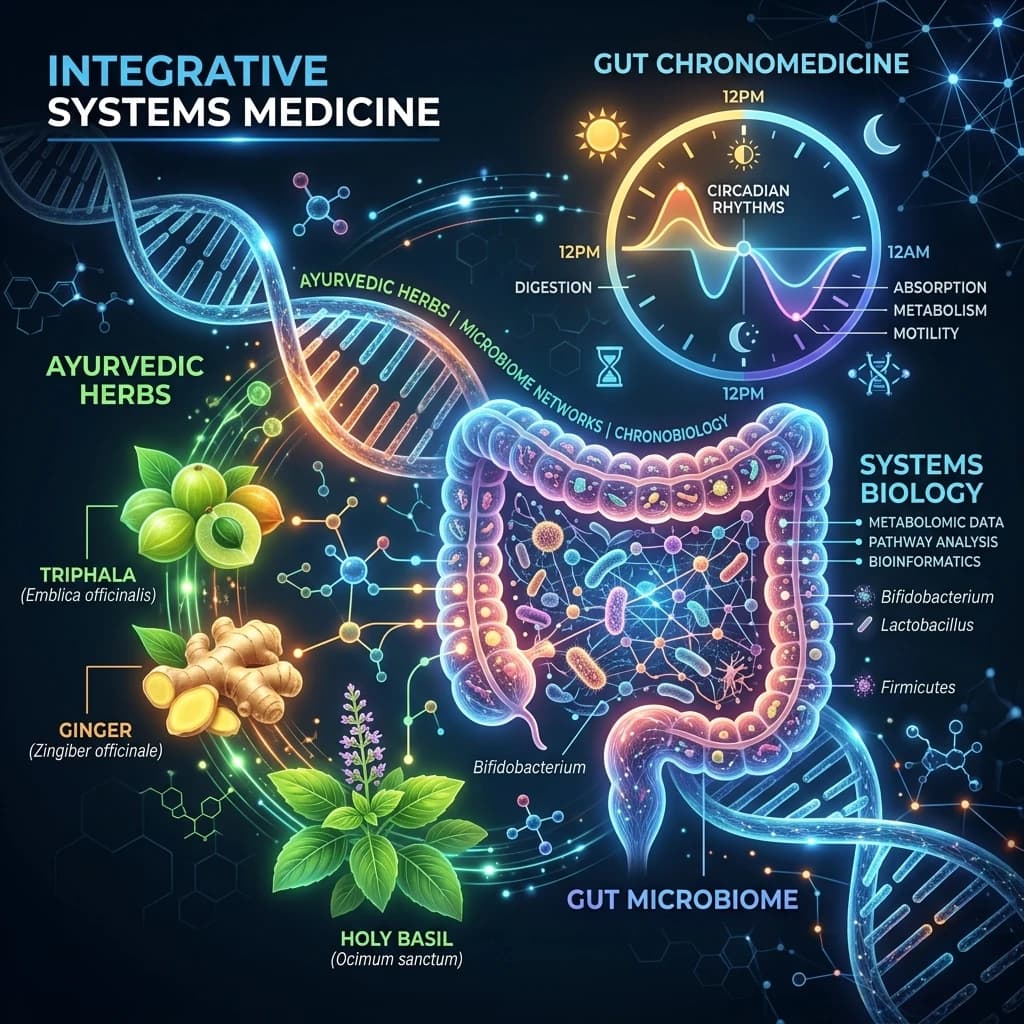
Ayurveda Meets Systems Biology: Agni, Chronomedicine, and Botanical Synergy in Modern Clinical Science
Ayurveda Meets Systems Biology: Agni, Chronomedicine, and Botanical Synergy in Modern Clinical Science The 2025–2026 wave of systems biology research has made an unambiguous statement: the three pilla…