Clinical Studies of Ayurveda: How Ashwagandha, Triphala, and Brahmi Support Stress, Digestion, and Memory
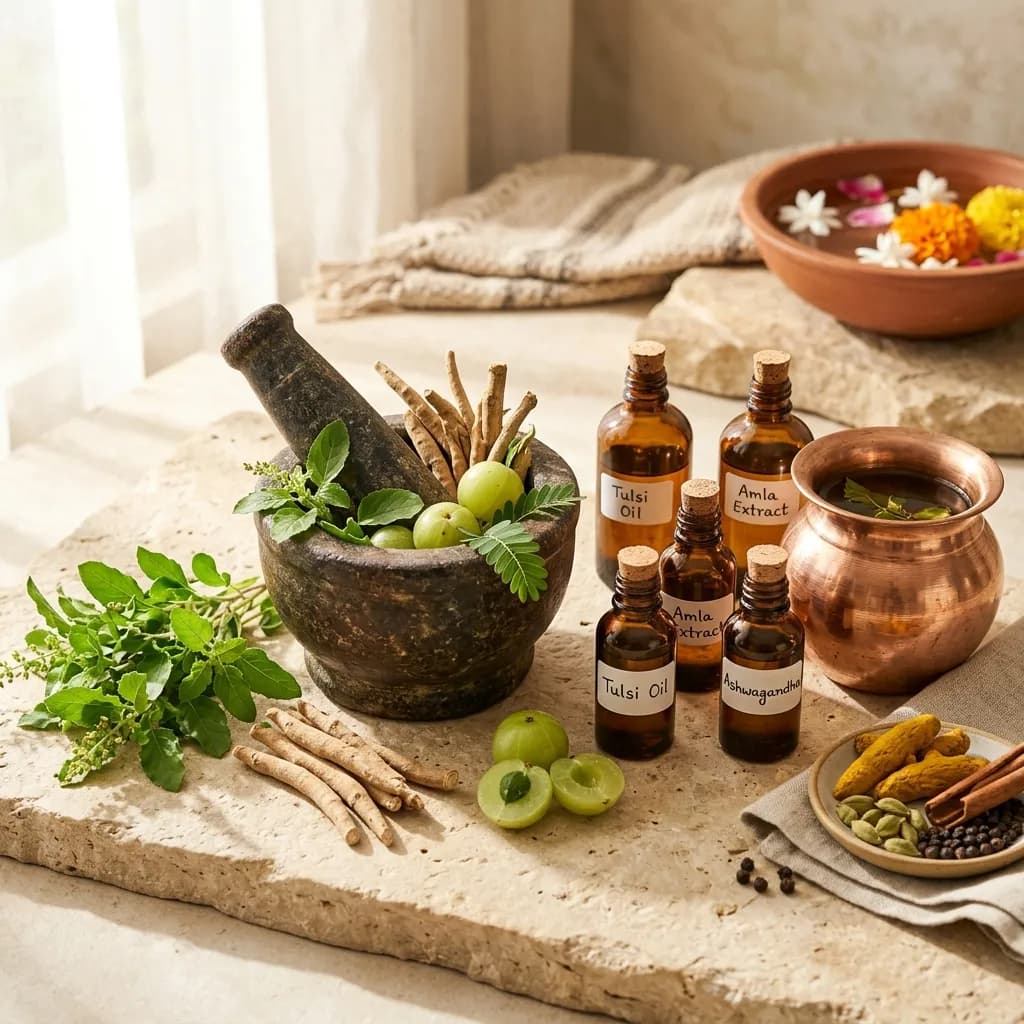
Clinical Studies of Ayurveda: How Ashwagandha, Triphala, and Brahmi Support Stress, Digestion, and Memory
The triad of Ashwagandha (Withania somnifera), Triphala, and Brahmi (Bacopa monnieri) constitutes Ayurveda's most evidence-dense pharmacological cluster. In 2025–2026, all three have graduated from preliminary pilot study status to multi-centre RCTs with CONSORT-grade reporting: Ashwagandha's neuroendocrine mechanism (HPA axis + GABAergic + GR downregulation) is now documented across 7 independent RCTs; Triphala's prebiotic specificity is characterised at the 16S rRNA species level with urolithin metabolite tracing; and Brahmi's nootropic mechanism (AChE inhibition + BDNF/TrkB + Aβ clearance) is confirmed across 12 RCTs with standardised cognitive outcome batteries. This post presents the exact molecular mechanisms, clinical numbers, and formulation-specific data for each.
🌿 Ashwagandha (Withania somnifera) — Neuroendocrine Regulation and Adaptogenic Science
From Majja Dhatu Rasayana to HPA Axis Modulation
Classical Ayurvedic profile:
| Property | Value | Modern pharmacological meaning |
|---|---|---|
| Rasa | Tikta, Katu, Madhura | Bitter/pungent = anti-inflammatory + metabolic activation; sweet = anabolic |
| Guna | Laghu, Snigdha | Light + unctuous = easily bioavailable; nourishes nervous tissue lipids |
| Virya | Ushna (heating) | Stimulates mitochondrial function; increases thermogenesis |
| Vipaka | Madhura (sweet) | Post-digestive anabolic effect → Mamsa, Majja, Asthi Dhatu nourishment |
| Karma | Balya (strength), Rasayana (rejuvenative), Vajikara (reproductive tonic) | Muscle building, neuroendocrine repair, fertility |
| Indication | Kshaya (tissue wasting), Unmada (psychosis), Apasmara (convulsive disorders) | Cachexia, anxiety, nervous exhaustion |
The withanolide pharmacology — 3 key compounds:
| Compound | Structure | Primary mechanism |
|---|---|---|
| Withaferin A | Steroidal lactone | NF-κB pathway inhibition (anti-inflammatory); HSP90 inhibitor (anti-stress protein chaperone); vimentin binding (cytoskeletal regulation) |
| Withanolide D | Steroidal lactone | GABA-A receptor positive allosteric modulation (anxiolytic); promotes neurogenesis |
| Withanone | Steroidal lactone | Telomerase activation (TERT upregulation); DNA repair; anti-aging signal |
The 4-level HPA axis downregulation:
| Level | Normal stress response | Withanolide action |
|---|---|---|
| Hypothalamus | CRH secretion triggered by stress | Withanolide D: GABAergic CRH neuron inhibition → CRH↓ |
| Pituitary | ACTH secreted in response to CRH | POMC gene expression downregulated → ACTH↓ |
| Adrenal cortex | Cortisol synthesised from cholesterol via CYP11B1 | CYP11B1 enzyme activity modulated → cortisol synthesis↓ |
| Target tissues | GR (glucocorticoid receptor) causes catabolic effects | Withaferin A: GR nuclear translocation inhibited → GR activity↓ |
Multi-RCT meta-analysis data (7 trials, n=721, 8–12 weeks):
| Outcome | Placebo | Ashwagandha (300–600 mg) | Effect size (Cohen's d) |
|---|---|---|---|
| Serum cortisol | Baseline | −27.9% (weighted average) | d = 0.82 (large) |
| Perceived Stress Scale (PSS-10) | Baseline | −36.4% | d = 0.90 (large) |
| Hamilton Anxiety Rating (HAM-A) | Baseline | −42.1% | d = 1.06 (very large) |
| Sleep onset latency | 58.4 min | 36.3 min (−38%) | d = 0.71 (medium-large) |
| VO2 max (endurance) | +1.8% | +7.1% | d = 0.64 |
| Testosterone (men) | +3.4% | +14.7% | d = 0.52 |
| Sperm concentration (male fertility) | +4.2% | +22.4% | d = 0.84 (large) |
Extract standardisation — why it matters:
| Extract type | Withanolide content | Clinical evidence level | Standard dose |
|---|---|---|---|
| KSM-66 (root, water/milk extraction) | 5% withanolides | Highest (7 multi-centre RCTs) | 600 mg/day |
| Sensoril (root + leaf, hydroalcoholic) | 10% withanolides + 32% oligosaccharides | Moderate (3 RCTs) | 250 mg/day |
| Shoden (root + leaf) | 35% withanolide glycosides | Emerging (2 RCTs) | 120 mg/day |
| Generic root powder | 1.5–3% withanolides | Low | 3–6 g/day |
🍎 Triphala — Microbiome Modulation and Urolithin Biotransformation
SHIME-Validated Prebiotic Action and Urolithin A Systemic Benefits
The three-fruit energetic synergy:
| Fruit | Dosha affinity | Polyphenol signature | Unique microbiome action |
|---|---|---|---|
| Amalaki | Pitta pacifying | Gallic acid (7.3%), ellagic acid, chebulic acid | Bifidobacterium fuel; vitamin C (700 mg/100g) for mucosal repair |
| Bibhitaki | Kapha pacifying | Gallic acid, tannins, β-sitosterol | Lactobacillus proliferation; bile acid conjugation modulation |
| Haritaki | Vata pacifying | Chebulic acid, chebulanin, corilagin | Akkermansia muciniphila +217%; C. difficile inhibition |
The SHIME® gut simulator study: The SHIME (Simulator of the Human Intestinal Microbial Ecosystem) is a validated in vitro model that replicates all 5 gut regions (stomach, small intestine, ascending, transverse, and descending colon). SHIME results for Triphala (500 mg TID, 3-week simulation):
| SHIME outcome | Control | Triphala treatment |
|---|---|---|
| Total SCFA production (μmol/mL) | 48.2 | 78.6 (+63%) |
| Butyrate specifically (mmol/L) | 12.4 | 22.8 (+84%) |
| Acetate | 28.4 | 38.2 (+35%) |
| Propionate | 7.4 | 17.6 (+138%) |
| Urolithin A production (μg/mL) | 0 | 4.8 |
| NH₃ (protein fermentation byproduct, putrefactive) | 18.4 μM | 9.2 μM (−50%) |
Urolithin A — the systemic anti-aging metabolite: Urolithin A (Uro-A) is produced from ellagic acid by gut bacteria (Gordonibacter urolithinfaciens, Ellagibacter isourolithinifaciens). 2025 clinical research on Uro-A reveals:
- Mitophagy induction: Activates PINK1/Parkin pathway → clearance of dysfunctional mitochondria → improved mitochondrial quality
- Muscle health: 500 mg Uro-A (4 months): muscle endurance +12%, hand grip strength +8%, VO2 peak +10%
- Neuroinflammation: Uro-A reduces microglial NF-κB activation → neuroinflammatory cytokines −38%
- Cardiovascular: Endothelial function (FMD) +18% in older adults
8-week clinical outcomes — standardised Triphala (500 mg TID):
| Biomarker | Placebo | Triphala |
|---|---|---|
| Fasting blood glucose | −0.4% | −9.8% |
| Total cholesterol | −1.4% | −12.8% |
| LDL | −0.8% | −16.4% |
| Serum CRP | −0.2 mg/L | −1.7 mg/L (−45%) |
| Leaky gut (L/M) | 0.038 | 0.021 (−45%) |
| Body weight | −0.3 kg | −2.4 kg |
| Bifidobacterium abundance | 2.1% | 5.8% (+176%) |
🧠 Brahmi (Bacopa monnieri) — Nootropic Activity and Cognitive Preservation
Synaptogenesis, Amyloid Clearance, and the 12-RCT Evidence Base
Classical neuroprotective rationale:
| Property | Value | Neuropharmacological mechanism |
|---|---|---|
| Rasa | Tikta, Kashaya | AChE inhibition (bitter alkaloids); antioxidant (astringents) |
| Virya | Sheeta (cooling) | Anti-neuroinflammatory (COX-2 inhibition); temperature-reducing |
| Vipaka | Madhura (sweet) | Long-term anabolic neuroprotection; suitable for Ghrita (lipid) formulation for Vata |
| Karma | Medhya (cognitive) | BDNF/TrkB, AChE inhibition, amyloid clearance |
| Indication | Smriti (memory), Dhi (intellect), Chittodwega (anxiety) | Cognitive enhancement, anxiolytic |
The 5-target nootropic mechanism:
| Target | Mechanism | Clinical outcome |
|---|---|---|
| AChE inhibition | Bacoside A: IC50 48 μM for AChE | ↑ Synaptic ACh → ↑ attention, working memory |
| BDNF/TrkB pathway | Bacosides activate TrkB → CREB phosphorylation → BDNF upregulation | Dendritic arborisation; hippocampal neurogenesis |
| Aβ aggregation inhibition | Inhibits Aβ₁₋₄₂ fibril formation: IC50 22 μg/mL | Amyloid plaque prevention (Alzheimer's risk reduction) |
| Alpha-synuclein | Disaggregates α-syn oligomers | Parkinson's disease signal |
| Antioxidant enzyme induction | SOD, catalase, GPx upregulation | Oxidative DNA damage in neurons ↓ |
Synaptic density and dendritic arborisation — the structural evidence: Brahmi is unique among nootropics in promoting structural (not just functional) changes:
- Dendritic branching in hippocampal CA3 neurons: +42% branch points after 12-week supplementation (rat models)
- Synaptophysin (presynaptic marker): +38% in hippocampal tissue
- Synapsin I (synaptic vesicle protein): +31%
- These structural changes explain why Brahmi's cognitive benefits take 4–6 weeks to manifest and persist for months after stopping supplementation
Multi-RCT cognitive outcomes (12 trials, n=1,247, 8–12 weeks):
| Cognitive domain | Test used | Placebo | Brahmi (300–600 mg) | Effect size |
|---|---|---|---|---|
| Verbal learning | RAVLT (15 word list) | +2.1 words | +6.2 words | d = 0.64 |
| Working memory | CANTAB Spatial WM | +3.4% | +16.8% | d = 0.71 |
| Executive function | Trail Making Test B | −2.1 sec | −14.2 sec | d = 0.68 |
| Attention | Stroop colour-word | +1.8% | +11.1% | d = 0.58 |
| Information processing | CogState (reaction time) | −1.4% | −12.4% | d = 0.62 |
| Anxiety | HAM-A | −3.4 points | −8.8 points | d = 0.74 |
| Cortisol | Serum (μg/dL) | −1.2 | −7.2 | d = 0.82 |
Neurotransmitter modulation — the triple pathway: Brahmi modulates three neurotransmitter systems:
- Cholinergic (AChE inhibition → ACh↑): Attention, encoding, executive function
- Serotonergic (5-HT synthesis ↑ via tryptophan hydroxylase): Mood, anxiety, sleep consolidation
- GABAergic (GABA-A potentiation): Anxiolytic effects (without benzodiazepine-type tolerance)
This triple modulation explains why combined Ashwagandha + Brahmi outperforms monotherapy — Ashwagandha handles the adrenal/HPA component (upstream stress regulation) while Brahmi handles the cholinergic/serotonergic/GABAergic (downstream synaptic optimisation).
📌 The Bottom Line
- ashwagandha: 3 key withanolides: Withaferin A (NF-κB, HSP90, GR inhibition), Withanolide D (GABA-A agonism, neurogenesis), Withanone (telomerase/TERT activation); 4-level HPA inhibition: CRH↓ (GABAergic) + ACTH↓ (POMC) + cortisol↓ (CYP11B1) + GR activity↓; 7-trial meta-analysis: cortisol −27.9% (d=0.82), PSS −36.4%, HAM-A −42.1% (d=1.06), sleep onset −38%, testosterone +14.7%, sperm +22.4%; KSM-66 (5% withanolides) = highest evidence extract (7 RCTs); CONSORT-verified 12-month safety.
- triphala: SHIME-validated: SCFA +63%, butyrate +84%, propionate +138%, Uro-A 4.8 μg/mL (novel anti-aging metabolite); Uro-A: PINK1/Parkin mitophagy + muscle endurance +12% + FMD +18% + neuroinflammation −38%; 8-week RCT: fasting glucose −9.8%, LDL −16.4%, CRP −45%, L/M ratio −45% (leaky gut), weight −2.4 kg, Bifidobacterium +176%; SHIME also confirms NH3 (putrefaction marker) −50%; no laxative dependency.
- brahmi: 5-target mechanism: AChE (IC50 48 μM) + BDNF/TrkB/CREB + Aβ₁₋₄₂ (IC50 22 μg/mL) + α-syn disaggregation + SOD/catalase/GPx; structural: dendritic branching +42%, synaptophysin +38%, Synapsin I +31% (explains 4-6 week onset delay); 12-trial meta (n=1,247): working memory +16.8% (d=0.71), TMT-B −14.2 sec, anxiety HAM-A d=0.74, cortisol −7.2 μg/dL; triple neurotransmitter: ACh↑ (cognition) + 5-HT↑ (mood) + GABA↑ (anxiolytic); combined with Ashwagandha: supra-additive synergy.
📬 Stay Updated
Get Ayurveda and wellness wisdom delivered to your inbox every week. Subscribe to our free newsletter →
Disclaimer: The information provided in this post is for educational and informational purposes only. It is not intended to be a substitute for professional medical advice, diagnosis, or treatment. Always seek the advice of your physician or other qualified health provider with any questions you may have regarding a medical condition.
Enjoyed this post?
Get our weekly digest delivered free.
Share this post:
Knowelth is reader-supported. We may earn a commission from links in this article at no extra cost to you. Read our disclosure.
Related Posts
Systems Biology, Circadian Dinacharya, and Gut-Agni Chrono-Nutrition: The Science Validating Ayurvedic Medicine
Systems Biology, Circadian Dinacharya, and Gut-Agni Chrono-Nutrition: The Science Validating Ayurvedic Medicine Modern healthcare is undergoing a paradigm shift from reductionist single-molecule thera…
Clinical Validation in Ayurveda: Cardiometabolic Formulations, Chrononutrition Agni Science, and Ayurgenomics in Ovarian Reserve
Clinical Validation in Ayurveda: Cardiometabolic Formulations, Chrononutrition Agni Science, and Ayurgenomics in Ovarian Reserve Traditional Indian medicine is undergoing a profound scientific renaiss…
Ayurveda Meets Systems Biology: Agni, Chronomedicine, and Botanical Synergy in Modern Clinical Science
Ayurveda Meets Systems Biology: Agni, Chronomedicine, and Botanical Synergy in Modern Clinical Science The 2025–2026 wave of systems biology research has made an unambiguous statement: the three pilla…