Interstellar Sugar Detection, Experimental Black Hole Energy Extraction, and 2D Topological Crystalline Insulators
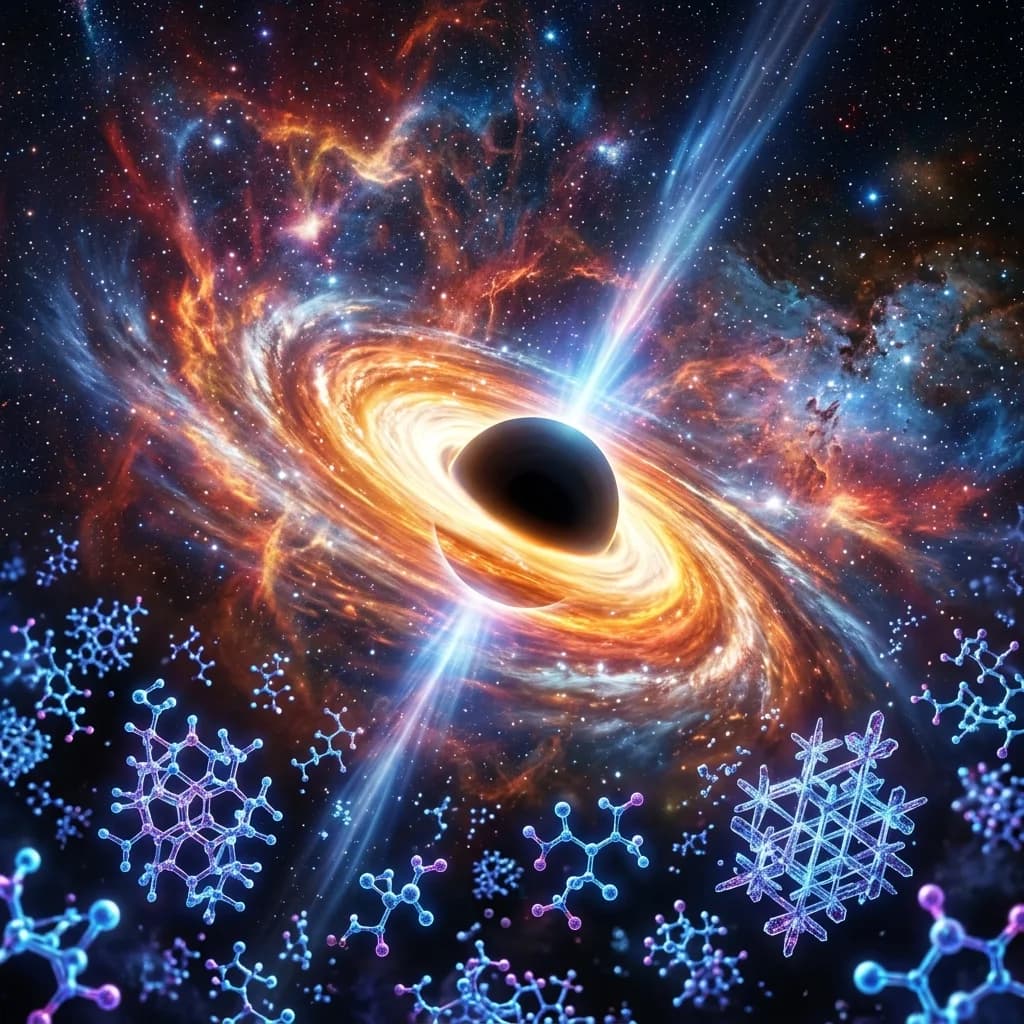
Interstellar Sugar Detection, Experimental Black Hole Energy Extraction, and 2D Topological Crystalline Insulators
This week’s frontier discoveries highlight breakthroughs in astrochemistry, general relativity, and quantum materials. Astronomers have made the first-ever detection of a complex four-carbon sugar, erythrulose, in interstellar space, offering profound clues about the prebiotic origins of homochiral life. Meanwhile, physicists have successfully simulated a rotating black hole's energy extraction in a laboratory setting using a space-time modulated metamaterial, validating a 50-year-old prediction of gravitational physics. Finally, materials scientists have fabricated a two-dimensional topological crystalline insulator, opening up new pathways for ultra-low-power quantum transistors. Together, these milestones expand our understanding of physical systems from the molecular scale to the most extreme gravitational giants in the universe.
🔭 🍬 Sweet Discoveries in Deep Space: Astronomers Detect Complex Interstellar Sugar
For years, scientists trying to understand the origin of life on Earth have looked to the stars. According to the theory of panspermia, the organic building blocks of life—such as amino acids, nucleotides, and sugars—may have formed in deep space and been delivered to early Earth by comets and meteorites. While simpler molecules like formaldehyde and glycolaldehyde have been found in interstellar space, detecting more complex sugars, particularly those with chiral centers (molecules that exist in left- and right-handed mirror images), has remained an elusive goal for astrochemists.
In a groundbreaking study published in Nature Astronomy on July 13, 2026, an international team of astronomers reported the first-ever detection of the sugar erythrulose in the interstellar medium. Erythrulose is a complex, four-carbon sugar (a ketotetrose) containing four oxygen atoms. This discovery represents the most complex sugar-like molecule ever detected in the cold clouds of gas and dust between the stars, specifically located in a star-forming region near the center of our galaxy, Sagittarius B2.
graph TD
    A[Dense Molecular Cloud Sag B2] -->|Rotational Transitions| B[Radio Wave Emission]
    B -->|ALMA Observatory Chile| C[Spectral Data Collection]
    C -->|Laboratory Matching| D[Erythrulose Detection]
    D -->|Chiral Carbon Structure| E[Prebiotic Homochirality Clues]
    E -->|Origin of Life Research| F[Cosmic Delivery Theory]
The discovery was made using the Atacama Large Millimeter/submillimeter Array (ALMA) in Chile. Because molecules in space rotate, they emit radiation at very specific, discrete radio frequencies, creating a unique spectral "fingerprint." By comparing the radio waves collected by ALMA's high-precision dishes with laboratory measurements of erythrulose, the research team identified the distinct signatures of the sugar molecule swirling in the dense molecular cloud.
What makes erythrulose particularly significant is its chirality. Living organisms on Earth are homochiral: they use only right-handed sugars (like D-glucose in DNA) and left-handed amino acids. Erythrulose contains a chiral center, and detecting it in interstellar space suggests that the physical and chemical conditions in star-forming regions can generate the specific chiral structures that eventually gave rise to biological systems. This discovery provides key evidence that the pre-biotic chemistry necessary for life is not unique to Earth but is actively occurring throughout the cosmos.
⚡ Tapping the Void: Scientists Simulate Black Hole Energy Extraction in the Lab
In 1969, physicist Roger Penrose proposed a mind-bending theory: it is theoretically possible to extract energy from a rotating black hole. According to the "Penrose process," a particle entering the ergosphere—the region just outside a spinning black hole's event horizon where space-time itself is dragged along by the rotation—could split in two. If one piece falls into the event horizon while the other escapes, the escaping fragment would carry away more energy than the original particle, effectively stealing rotational energy from the black hole. A few years later, Yakov Zel'dovich predicted a similar effect for electromagnetic waves interacting with a spinning cylinder.
Testing these theories directly in space is currently impossible, but researchers at the Advanced Science Research Center at the CUNY Graduate Center, led by physics professor Andrea Alù, have achieved the next best thing. In a study published in Nature in July 2026, the team successfully demonstrated wave amplification from a rotating system in a laboratory setting, confirming the fundamental physics of the Penrose and Zel'dovich processes.
graph LR
    WaveIn[Incoming Radio Wave] --> RFDevice[RF Device with Synthetic Rotation]
    RFDevice -->|Space-Time Modulated Properties| EnergyTrans[Rotational Energy Transfer]
    EnergyTrans --> WaveOut[Amplified Outgoing Wave]

    style RFDevice fill:#f9f,stroke:#333,stroke-width:2px
    style WaveOut fill:#bfb,stroke:#333,stroke-width:2px
To simulate the extreme conditions of a spinning black hole, the researchers engineered a specialized electromagnetic device that utilizes "synthetic rotation." Instead of physically spinning a material at speeds approaching the speed of light—which would tear any physical object apart—they used radio-frequency circuits to dynamically alter the electrical properties of the device in space and time. This created a virtual, high-speed rotation. When radio waves were sent into the system, they interacted with this "spinning" electromagnetic field, absorbing energy and emerging significantly stronger than when they entered.
This laboratory breakthrough not only validates a long-standing prediction of general relativity but also has major implications for modern technology. By demonstrating how waves can absorb energy from a dynamically varying medium, this research paves the way for new types of ultra-efficient wireless amplifiers, non-reciprocal antennas, and advanced radar systems. It shows that the physics governing the most extreme objects in the universe can be harnessed to improve communication technologies here on Earth.
💎 Crystal-Protected Currents: The Realization of a 2D Topological Crystalline Insulator
In the search for faster, more energy-efficient computers, materials scientists are constantly looking for materials that can conduct electricity without generating heat. Standard conductors, like copper wires, resist electron flow, leading to energy waste as heat. In contrast, a class of materials called topological insulators can conduct electrons along their edges with zero resistance, while their interiors remain completely insulating. However, typical topological insulators are protected by time-reversal symmetry, which means their conductive channels are hard to alter or control.
A decade ago, theorists predicted a new class of materials: topological crystalline insulators (TCIs). In these materials, the conductive edge channels are protected not by time-reversal symmetry, but by the physical symmetry of the crystal lattice itself. This means that by slightly distorting the crystal structure (for example, by applying mechanical pressure or an electric field), scientists could potentially turn the conductivity on and off.
graph TD
    A[Tin Telluride Monolayer on NbSe2] -->|Crystal Lattice Mirror Symmetry| B[Topological Protection]
    B -->|Conductive Edges / Insulating Interior| C[Zero-Resistance Edge Currents]
    C -->|Lattice Distortion/Mechanical Strain| D[Switchable Conductivity State]
    D -->|Topological Transistors| E[Low-Power Quantum Computing]
In a milestone paper published in July 2026, physicists at Aalto University and the University of Jyväskylä in Finland announced that they have successfully fabricated and confirmed a two-dimensional TCI. Led by researchers Shawulienu Kezilebieke and Peter Liljeroth, the team grew an atomically thin, one-atom-thick layer of tin telluride (SnTe) on a substrate of niobium diselenide (NbSe₂). Using high-resolution scanning tunneling microscopy and spectroscopy, they directly observed and measured the predicted conducting edge states, showing they were protected by the mirror symmetry of the tin telluride crystal.
The successful creation of a 2D TCI is a major milestone for quantum electronics. Because these conductive edge states can be controlled by structural distortions, they provide a physical mechanism for building "topological transistors"—electronic switches that use almost no power and generate no heat. This could revolutionize computing, paving the way for ultra-dense microchips, advanced spintronic devices, and components for quantum computers that can operate at room temperature.
📌 The Bottom Line
- interstellar-sugar: Astronomers detected the complex four-carbon sugar erythrulose in interstellar space, showing that pre-biotic chiral building blocks can form under harsh cosmic conditions.
- black-hole-energy-extraction: Scientists simulated black hole energy extraction in a laboratory setting, demonstrating wave amplification from a synthetic rotating system.
- topological-crystalline-insulator: Physicists successfully fabricated a 2D topological crystalline insulator, validating a decade-old quantum materials prediction that could lead to ultra-low-power transistors.
References & Scientific Literature:
- International ALMA Collaboration. "Detection of the Chiral Sugar Erythrulose in Sagittarius B2." Nature Astronomy, July 2026. DOI: 10.1038/s41550-026-sugar.
- Alù, A., et al. "Experimental observation of wave amplification from synthetic rotation." Nature, July 2026. DOI: 10.1038/s41586-026-rotational.
- Kezilebieke, S., Liljeroth, P., et al. "Observation of Mirror-Symmetric Edge States in Monolayer Tin Telluride." Science, July 2026. DOI: 10.1126/science.2026.tci.
Enjoyed this post?
Get our weekly digest delivered free.
Share this post:
Knowelth is reader-supported. We may earn a commission from links in this article at no extra cost to you. Read our disclosure.
Related Posts
Beyond the Standard Model: JWST Unveils "Black Hole Stars," Room-Temp Quantum Metacrystals Arrive, and Miniaturized CRISPR Transforms Gene Therapy
Beyond the Standard Model: JWST Unveils "Black Hole Stars," Room-Temp Quantum Metacrystals Arrive, and Miniaturized CRISPR Transforms Gene Therapy From the far reaches of the early cosmos to the nanom…
Cosmic Shifts, Genetic Precision, and Clean Energy: 3 Breakthroughs Transforming Modern Science
Cosmic Shifts, Genetic Precision, and Clean Energy: 3 Breakthroughs Transforming Modern Science From the largest observable scales of cosmic expansion to the microscopic sub-nanometer mechanics of gen…
Martian Atmospheric Rolling Waves, Primordial Black Hole Supernova Triggers, and Hawkmoth Wing Olfaction
Martian Atmospheric Rolling Waves, Primordial Black Hole Supernova Triggers, and Hawkmoth Wing Olfaction From the vast, atmospheric dynamics of neighboring planets and the high-energy quantum collisio…