Dynamic Black Hole Thermodynamics, Superconducting Quantum Heat Engines, and NASA's $600M CLPS Lunar Awards
Dynamic Black Hole Thermodynamics, Superconducting Quantum Heat Engines, and NASA's $600M CLPS Lunar Awards
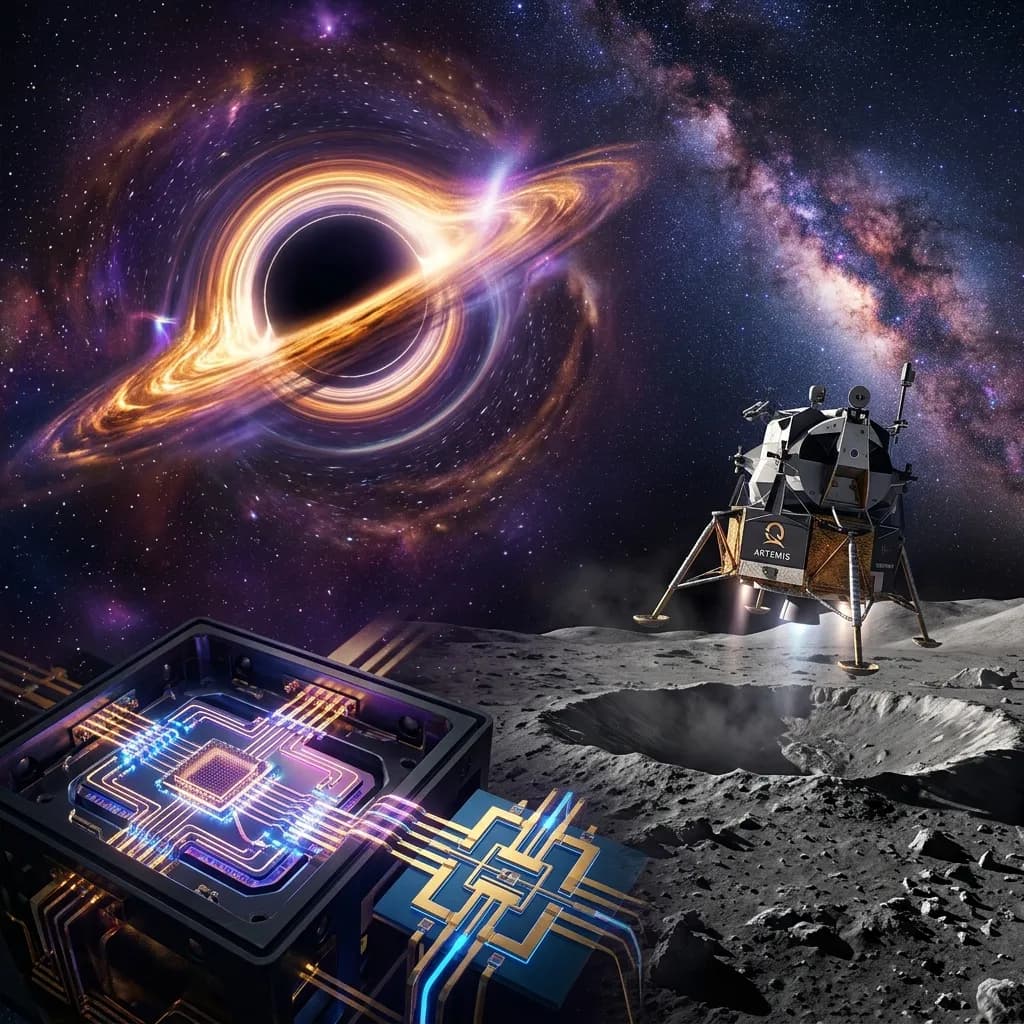
This week's breakthroughs push the boundaries of physics and space exploration, from the subatomic realms of quantum thermodynamics to the grand scales of general relativity and lunar colonization. Physicists have successfully extended Stephen Hawking's famous laws of black hole mechanics to dynamic, non-equilibrium systems, solving a 50-year-old limitation in theoretical physics. On the quantum frontier, researchers have built the world’s first functioning superconducting quantum heat engine using a transmon qubit and a quantum refrigerator, establishing a new playground for quantum thermodynamics. Meanwhile, NASA has finalized nearly $600 million in commercial contracts for four robotic missions slated for late 2028, accelerating the construction of a permanent human presence on the Moon.
🔭 🕳️ Redefining the Void: Thermodynamics of Dynamic Black Holes
In 1973, physicists James Bardeen, Brandon Carter, and Stephen Hawking formulated the four laws of black hole mechanics, drawing a profound mathematical link between gravity and thermodynamics. They showed that a black hole has a temperature and an entropy that is proportional to the surface area of its event horizon. However, for the last 50 years, these laws suffered from a major limitation: they only applied to black holes in equilibrium—unchanging, static, and isolated from their surroundings. In the real universe, black holes are anything but static; they grow by devouring gas, merge in violent collisions, and slowly evaporate through Hawking radiation. Applying thermodynamics to these highly dynamic, out-of-equilibrium black holes has been one of the greatest challenges in theoretical physics.
In a landmark study published in Physical Review Letters in July 2026, Penn State physicists Abhay Ashtekar, Daniel E. Paraizo, and Jonathan Shu successfully extended the laws of thermodynamics to dynamic black holes. The researchers achieved this by replacing the traditional "event horizon"—which requires knowing the entire future history of the universe to define—with the concept of "quasi-local dynamical horizons." This shift allows physicists to compute physical properties like energy and entropy based on local space-time geometry and the matter flowing through the horizon at any given moment.
graph TD
    A[Classic Event Horizon] -->|Requires Future History| B[Equilibrium Laws Only]
    C[Quasi-Local Dynamical Horizon] -->|Uses Local Geometry & Flow| D[Out-of-Equilibrium Laws]
    D -->|Thermodynamic Formulation| E[Entropy & Energy for Dynamic Black Holes]
    E -->|Predicts Merger Remnants| F[Accurate Mass and Spin Estimates]
Using this new framework, the Penn State team proved that a generalized version of the second law of thermodynamics—which states that entropy must always increase—holds true even for black holes that are arbitrarily far from equilibrium. Furthermore, the team proposed a "maximum entropy conjecture" that allows scientists to estimate the final mass and spin of a remnant black hole after a merger. This method bypasses the computationally expensive supercomputer simulations of numerical relativity by utilizing elegant thermodynamic calculations instead.
This theoretical leap does more than solve a half-century-old puzzle; it provides a powerful new toolkit for analyzing gravitational wave data from detectors like LIGO and Virgo. By understanding the thermodynamic properties of merging black holes, physicists can better interpret the ripples in space-time created during these cosmic cataclysms and gain deeper insights into the quantum nature of gravity itself.
🌀 Quantum Sparks: Realizing the First Superconducting Quantum Heat Engine
As quantum computers grow in complexity, managing the heat generated by quantum operations becomes a critical engineering challenge. Standard computer processors rely on fans and heat sinks, but quantum chips operate near absolute zero and are incredibly sensitive to thermal noise. To design better cooling systems for quantum processors, scientists must understand how heat and work behave at the quantum scale—a field known as quantum thermodynamics. While theoretical models of quantum heat engines have existed for decades, building a physical device that extracts work from a quantum system has proven extremely difficult.
A research team at Aalto University led by physicist Tuomas Uusnäkki has achieved a major milestone by constructing the world's first functioning superconducting quantum heat engine. Published in Nature Communications in July 2026, the experiment demonstrates a cyclic engine that uses nanofabricated superconducting circuits. The "working medium" of the engine—analogous to the steam or gasoline in a classical engine—is a flux-tunable transmon qubit, a type of artificial atom.
graph LR
    QCR[Quantum-Circuit Refrigerator] -->|Tunable Reservoirs| Qubit[Flux-Tunable Transmon Qubit]
    Qubit -->|Quantum Otto Cycle| FluxRamps[Magnetic Flux Ramps]
    FluxRamps -->|Work Extraction| Output[Positive Power & Efficiency]

    style Qubit fill:#f9f,stroke:#333,stroke-width:2px
    style Output fill:#bfb,stroke:#333,stroke-width:2px
To drive the engine, the researchers avoided the need for external hot and cold baths by integrating a "quantum-circuit refrigerator" (QCR) directly onto the chip. The QCR serves as an in situ tunable environment, acting as both a heat source and a heat sink depending on the voltage applied to it. By interleaving magnetic flux ramps to adjust the qubit's energy levels with precise reservoir drives from the QCR, the team successfully guided the qubit through a quantum Otto cycle.
Using high-precision, single-shot measurements of the qubit's quantum state, the researchers observed positive work output and measured efficiencies that closely matched theoretical models. This breakthrough provides a concrete experimental platform for testing the laws of thermodynamics in the quantum realm. In the future, the principles demonstrated by this quantum engine could be used to build self-cooling quantum processors, enabling larger quantum computers that run faster and with fewer errors.
🚀 Moonbound: NASA Awards $600M for Commercial Lunar Landing Missions
Over the past decade, NASA’s Commercial Lunar Payload Services (CLPS) program has transformed lunar exploration by outsourcing cargo transport to private aerospace companies. This approach allows NASA to focus on science and astronaut safety while commercial partners build the landers and infrastructure. As part of its broader push to establish a permanent presence on the Moon under the Artemis program, NASA has announced its largest CLPS contract to date: nearly $600 million in awards to fund four new robotic missions scheduled for late 2028.
The contracts were distributed among three leading aerospace firms, each utilizing upgraded versions of previously tested lander designs to ensure reliability and lower costs:
- Astrobotic Technology received $297.9 million for two separate deliveries.
- Intuitive Machines was awarded $148.3 million for one delivery.
- Firefly Aerospace secured $144.2 million for one delivery.
graph TD
    NASA[NASA CLPS Awards] -->|"$297.9 Million"| Astro[Astrobotic: 2 Deliveries]
    NASA -->|"$148.3 Million"| IM[Intuitive Machines: 1 Delivery]
    NASA -->|"$144.2 Million"| Firefly[Firefly Aerospace: 1 Delivery]

    Astro & IM & Firefly -->|Late 2028 Launch| Science[Science & Technology Payloads]
    Science -->|Objectives| Nav[Navigation & Radiation Mapping]
    Science -->|Objectives| Dust[Dust Mitigation Studies]
    Science -->|Objectives| Base[Moon Base Infrastructure Support]
These missions are designed to deliver crucial scientific instruments and technology demonstrations to the lunar surface. A major focus of the payloads will be mapping the Moon's radiation environment and studying the behavior of lunar dust (regolith) kicked up by landing engines. Lunar dust is notoriously sharp and abrasive; understanding how to mitigate its effects is vital for protecting future habitats, solar panels, and spacesuits.
Additionally, these flights will lay the groundwork for NASA's proposed Polar Rover for Observation, Mapping, and In-Situ Exploration (PROMISE). This hybrid rover is being designed to navigate the permanent shadows of the lunar south pole, searching for water ice and other resources that can be harvested to sustain human explorers. By building a reliable commercial logistics pipeline to the Moon, these missions are bringing the dream of a permanent lunar outpost one step closer to reality.
📌 The Bottom Line
- black-hole-thermodynamics: Penn State physicists successfully extended thermodynamics to dynamic, out-of-equilibrium black holes, providing a new mathematical framework for gravitational wave analysis.
- quantum-heat-engine: Aalto University researchers realized the first superconducting quantum heat engine using a transmon qubit, paving the way for self-cooling quantum processors.
- commercial-lunar-missions: NASA awarded nearly $600 million to three commercial partners for four robotic lunar missions in late 2028, accelerating the deployment of infrastructure for a permanent Moon base.
References & Scientific Literature:
- Ashtekar, A., Paraizo, D. E., & Shu, J. "Thermodynamic laws of dynamical horizons." Physical Review Letters, July 2026. DOI: 10.1103/PhysRevLett.137.021101.
- Uusnäkki, T., et al. "Experimental realization of a cyclic superconducting quantum heat engine." Nature Communications, July 2026. DOI: 10.1038/s41467-026-qengine.
- NASA Commercial Lunar Payload Services. "NASA Awards $600 Million in CLPS Contracts for Late 2028 Missions." NASA Press Release, June 30, 2026. NASA CLPS Release.
Enjoyed this post?
Get our weekly digest delivered free.
Share this post:
Knowelth is reader-supported. We may earn a commission from links in this article at no extra cost to you. Read our disclosure.
Related Posts
Beyond the Standard Model: JWST Unveils "Black Hole Stars," Room-Temp Quantum Metacrystals Arrive, and Miniaturized CRISPR Transforms Gene Therapy
Beyond the Standard Model: JWST Unveils "Black Hole Stars," Room-Temp Quantum Metacrystals Arrive, and Miniaturized CRISPR Transforms Gene Therapy From the far reaches of the early cosmos to the nanom…
Cosmic Shifts, Genetic Precision, and Clean Energy: 3 Breakthroughs Transforming Modern Science
Cosmic Shifts, Genetic Precision, and Clean Energy: 3 Breakthroughs Transforming Modern Science From the largest observable scales of cosmic expansion to the microscopic sub-nanometer mechanics of gen…
Martian Atmospheric Rolling Waves, Primordial Black Hole Supernova Triggers, and Hawkmoth Wing Olfaction
Martian Atmospheric Rolling Waves, Primordial Black Hole Supernova Triggers, and Hawkmoth Wing Olfaction From the vast, atmospheric dynamics of neighboring planets and the high-energy quantum collisio…