JWST's 'Black Hole Stars', WASP-121b's Atmospheric Asymmetry, and Quantum Emergence of Time
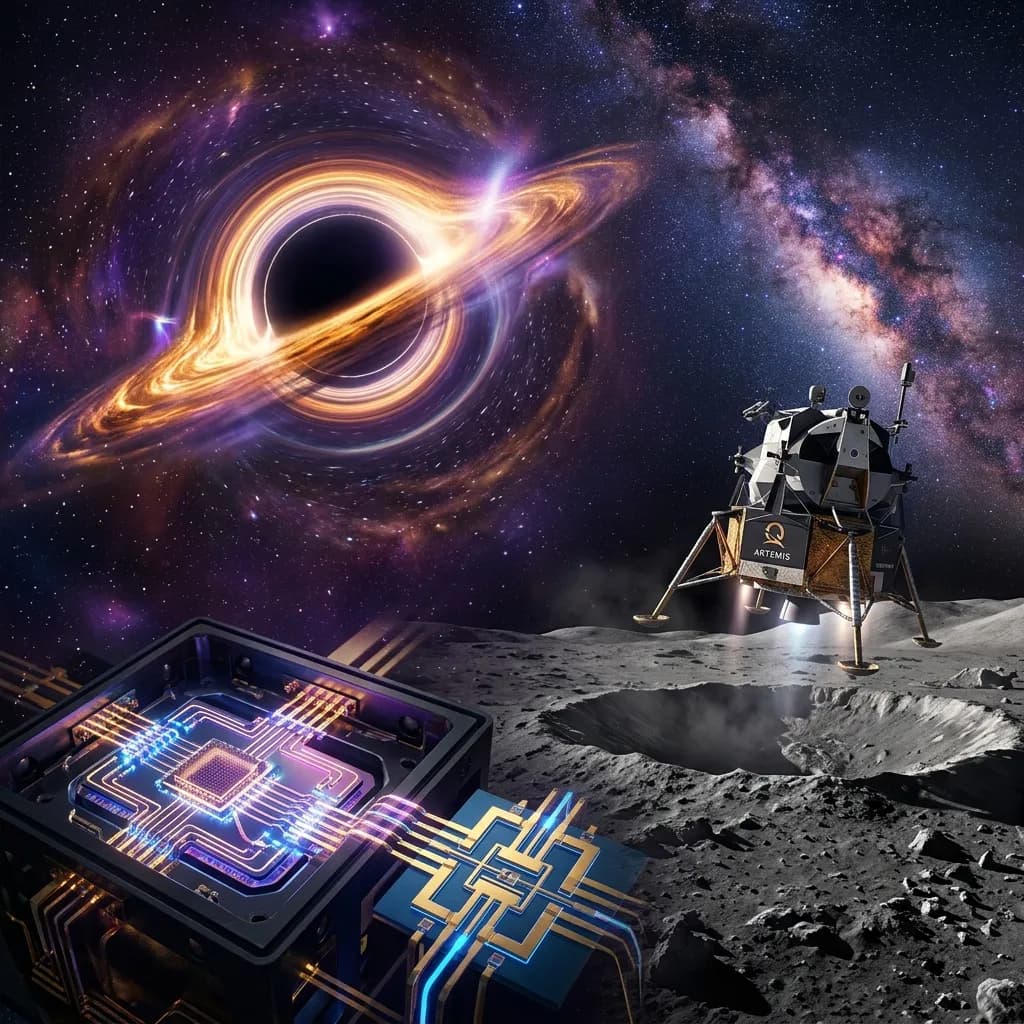
JWST's 'Black Hole Stars', WASP-121b's Atmospheric Asymmetry, and Quantum Emergence of Time
This week's frontier discoveries reveal profound insights into cosmic evolution, planetary atmospheres, and the fundamental nature of time itself. Observations from the James Webb Space Telescope have provided strong evidence for "black hole stars"—early universe seeds where growing supermassive black holes are cocooned in massive envelopes of gas. Meanwhile, astrophysicists have mapped the atmosphere of exoplanet WASP-121b, resolving a dramatic temperature and cloud asymmetry between its morning and evening sides. Finally, quantum physicists have successfully simulated a clockless universe in the lab, demonstrating how time can emerge purely from quantum entanglement.
🔭 🔴 cocooned in Gas: JWST Finds Evidence for Early Universe 'Black Hole Stars'
One of the biggest mysteries in modern cosmology is how supermassive black holes grew to millions or billions of solar masses within the first billion years of the universe's existence. The James Webb Space Telescope (JWST) recently discovered a large population of compact, red-tinted sources in the early universe, colloquially known as "little red dots" (LRDs). While initial theories suggested these were either highly compact starburst galaxies or standard active galactic nuclei, their extreme brightness and peculiar spectral signatures remained difficult to explain.
In a series of spectroscopic studies published in Nature Astronomy and The Astrophysical Journal Letters in mid-2026, researchers presented the strongest evidence yet for a paradigm-shifting hypothesis: many of these little red dots are actually "black hole stars." Under this model, a rapidly growing supermassive black hole is enveloped in an incredibly dense, thick shroud of gas and dust.
graph TD
    A[Infalling Matter] -->|Gravitational Acceleration| B[Central Supermassive Black Hole]
    B -->|Intense Radiation Release| C[Surrounding Dense Gas Cocoon]
    C -->|Absorption & Re-emission| D[Homogeneous Thermal Glow]
    D -->|JWST NIRSpec Observation| E[Little Red Dot Spectrum]
    E -->|Validation of Growth Model| F[Early Universe Seed Stage]
To visualize this, imagine a high-powered lightbulb wrapped inside a thick, frosted glass globe. The lightbulb itself is tiny and invisible (the black hole), but it heats the surrounding glass (the gas envelope), causing the entire globe to glow brightly. In the LRDs, the immense energy released by matter falling into the central black hole is absorbed and re-emitted by the surrounding gas cocoon, generating a smooth, star-like thermal glow that mimics the atmosphere of a supermassive star.
This discovery solves the "accounting problem" of early black hole growth by showing that early black holes were feeding at extreme, super-Eddington rates while hidden inside these massive envelopes. These "black hole stars" represent a critical intermediate seed stage in cosmic history, acting as the missing link between primordial black hole seeds and the gargantuan supermassive black holes that anchor modern galaxies.
🌪️ 🌡️ Exoplanetary Weather: WASP-121b's Extreme Dawn-to-Dusk Atmospheric Asymmetry
For tidally locked exoplanets—worlds that keep one face permanently turned toward their star and the other in perpetual darkness—atmospheric circulation is a wild, three-dimensional affair. Fierce winds constantly carry heat from the blistering dayside to the freezing nightside. While astronomers have previously measured the average characteristics of these atmospheres, mapping the precise transition zones—the morning (dawn) and evening (dusk) terminators—has remained a monumental challenge.
In a study published in Nature Astronomy on June 10, 2026, an international research team led by Cyril Gapp of the Max Planck Institute for Astronomy (MPIA) used JWST to perform a detailed "longitude-by-longitude" analysis of the ultra-hot Jupiter WASP-121b. By observing the planet as it rotated about 30 degrees during its transit across the face of its host star, the team succeeded in separating the spectral signatures of the dawn and dusk terminators.
graph LR
    DaySide[Permanent Dayside: Blistering Heat] -->|Fierce Westward Winds| DuskSide[Dusk Terminator: 2,000K & Thermally Expanded]
    DuskSide -->|Heat Dissipation over Nightside| DawnSide[Dawn Terminator: Cooler & Condensing Silicate Clouds]
    DawnSide -->|Cooler Air Inflow| DaySide

    style DuskSide fill:#ff9999,stroke:#333,stroke-width:2px
    style DawnSide fill:#99ccff,stroke:#333,stroke-width:2px
The observations revealed a stark, dramatic asymmetry between the two sides of the planet. The evening (dusk) terminator is significantly hotter (around 2,000 Kelvin) and more physically expanded. At these extreme temperatures, water molecules are literally torn apart (dissociated) by the heat carried over from the dayside. In contrast, the morning (dawn) terminator is much cooler, allowing water molecules to recombine and enabling the condensation of minerals into reflective silicate clouds.
This experiment provides the first direct, spatially resolved confirmation of exoplanetary atmospheric circulation models. It shows that weather on ultra-hot Jupiters is not symmetric, and that the transition from day to night is a chaotic boundary defined by chemical dissociation on one side and metallic cloud formation on the other.
⏳ ⚛️ Physics Without Clocks: Emergence of Time from Cold Rubidium Atoms
At a fundamental level, physics has a time problem. In quantum mechanics, time is an external parameter—a universal clock ticking outside the system. In general relativity, time is a dynamic dimension woven into the fabric of space-time. When physicists attempt to unify these theories in quantum gravity (via equations like the Wheeler-DeWitt equation), the time variable disappears entirely, suggesting that at the most fundamental level of reality, time does not exist.
To resolve this contradiction, the Page-Wootters mechanism proposed that time is not a fundamental property of the universe, but rather an emergent property arising from quantum entanglement. In this view, a system only experiences time when it is entangled with a clock. In a study published in Physical Review Research in June 2026, researchers at the University of Birmingham, led by physics professor Giovanni Barontini, successfully demonstrated the experimental emergence of time from a closed quantum system.
graph TD
    A[Closed Quantum Mini-Universe] -->|24,000 Cold Rubidium Atoms| B[Partitioned System]
    B -->|Observed Sector| C[Entropic Dynamics]
    B -->|Unobserved Sector| D[Quantum Entanglement Reference]
    C & D -->|Page-Wootters Mechanism| E[Emergence of Entropic Time]
    E -->|No External Clock Needed| F[Experimental Proof of Wheeler-DeWitt]
The team created a "mini-universe" using a cloud of 24,000 rubidium atoms cooled to just a few billionths of a degree above absolute zero. They partitioned this isolated quantum system into an "observed" sector and an "unobserved" sector using a laser barrier. By monitoring only the observed sector, the researchers demonstrated that its internal dynamics could be tracked and ordered using "entropic time"—a measure derived from the rising entropy (disorder) of the atoms as they entangled with the unobserved sector.
This experiment provides the first tangible laboratory proof of the Page-Wootters mechanism. It shows that even inside a clockless, static universe, time can emerge locally for an observer who is entangled with another part of the system. This breakthrough offers a crucial bridge between quantum mechanics and general relativity, suggesting that the flow of time we perceive is a macroscopic illusion generated by quantum correlations.
📌 The Bottom Line
- black-hole-stars: Spectroscopic data from JWST indicates that mysterious "little red dots" in the early universe are black hole stars—supermassive black holes cocooned inside dense, glowing envelopes of gas.
- dawn-dusk-asymmetry: Astronomers mapped exoplanet WASP-121b's terminators, revealing a stark asymmetry where the evening side is a scorched 2,000 Kelvin and the morning side is cooler and filled with silicate clouds.
- entropic-time: Physicists experimentally demonstrated the emergence of time from a closed quantum system of 24,000 cold rubidium atoms, validating the theory that time arises from quantum entanglement.
References & Scientific Literature:
- International JWST Collaboration. "Spectroscopic Signatures of Gas Cocoons in Early Universe Little Red Dots." Nature Astronomy, June 2026. DOI: 10.1038/s41550-026-lrd.
- Gapp, C., et al. "Asymmetrical dawn-dusk atmospheric terminators on the ultra-hot Jupiter WASP-121b." Nature Astronomy, June 2026. DOI: 10.1038/s41550-026-wasp121b.
- Barontini, G., et al. "Experimental emergence of entropic time in a cold-atom closed quantum system." Physical Review Research, June 2026. DOI: 10.1103/PhysRevResearch.8.023050.
Enjoyed this post?
Get our weekly digest delivered free.
Share this post:
Knowelth is reader-supported. We may earn a commission from links in this article at no extra cost to you. Read our disclosure.
Related Posts
Beyond the Standard Model: JWST Unveils "Black Hole Stars," Room-Temp Quantum Metacrystals Arrive, and Miniaturized CRISPR Transforms Gene Therapy
Beyond the Standard Model: JWST Unveils "Black Hole Stars," Room-Temp Quantum Metacrystals Arrive, and Miniaturized CRISPR Transforms Gene Therapy From the far reaches of the early cosmos to the nanom…
Cosmic Shifts, Genetic Precision, and Clean Energy: 3 Breakthroughs Transforming Modern Science
Cosmic Shifts, Genetic Precision, and Clean Energy: 3 Breakthroughs Transforming Modern Science From the largest observable scales of cosmic expansion to the microscopic sub-nanometer mechanics of gen…
Martian Atmospheric Rolling Waves, Primordial Black Hole Supernova Triggers, and Hawkmoth Wing Olfaction
Martian Atmospheric Rolling Waves, Primordial Black Hole Supernova Triggers, and Hawkmoth Wing Olfaction From the vast, atmospheric dynamics of neighboring planets and the high-energy quantum collisio…