Discovery of Beta Pictoris d, Earth's Phosphate Climate Thermostat, and Optical Skyrmions
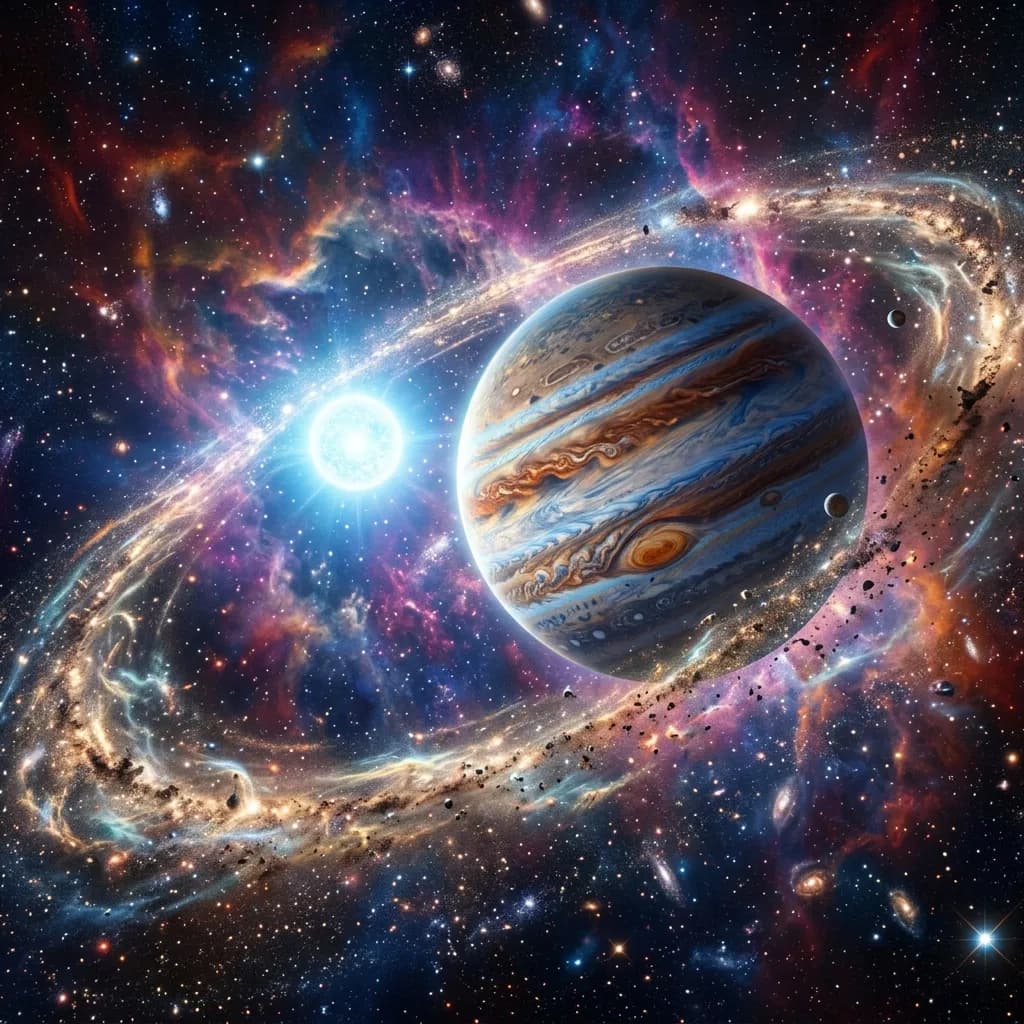
Discovery of Beta Pictoris d, Earth's Phosphate Climate Thermostat, and Optical Skyrmions
This week's frontier discoveries highlight breakthroughs in exoplanetary exploration, planetary-scale biogeochemical feedback loops, and wave optics. Astronomers have confirmed the existence of a third giant exoplanet, Beta Pictoris d, using both space-based spectroscopy and ground-based direct imaging. Meanwhile, a groundbreaking climate study has uncovered a long-sought feedback loop linking sea-level changes, phosphate availability, and organic carbon burial that acts as Earth's natural thermostat. Finally, physicists have successfully generated stable optical skyrmions using the 200-year-old Poisson spot experiment, democratizing the study of topological light for future optical technologies.
🔭 🪐 Mapping the Unseen: The Discovery of Beta Pictoris d
Beta Pictoris, a young planetary system located approximately 63 light-years from Earth, has long served as a cosmic laboratory for astronomers studying the birth and evolution of planets. Home to a massive debris disk of dust and gas, the system was previously known to host two giant gas giants: Beta Pictoris b and c. In mid-July 2026, researchers announced the discovery of a third planet, Beta Pictoris d, making this one of the few planetary systems known to contain at least three directly imaged or spectroscopically confirmed worlds.
graph TD
    A[Beta Pictoris Star] -->|Inner Orbit| B[Beta Pictoris c]
    A -->|Intermediate Orbit| C[Beta Pictoris b]
    A -->|Outer Orbit| D["Beta Pictoris d (2.4 Jupiter Masses)"]
    D -->|Gravitational Influence| E[Surrounding Debris Disk Structure]
    F[JWST Spectroscopy] -->|Atmospheric Fingerprint| D
    G[VLT Direct Imaging & Archive] -->|Visual Confirmation| D
The discovery was achieved through the complementary efforts of two independent research teams. One team utilized the space-based infrared capabilities of the James Webb Space Telescope (JWST), identifying the planet's presence by detecting the unique chemical fingerprint of its atmosphere via high-resolution spectroscopy. Simultaneously, a second team using the European Southern Observatory’s Very Large Telescope (VLT) directly imaged the planet. They verified its existence by tracing its orbit through more than a decade of archived observation data, showing it to be roughly 100 times fainter than its sibling Beta Pictoris b.
Beta Pictoris d is a massive gas giant, estimated at 2.4 times the mass of Jupiter. It occupies a wide orbit in the outer regions of the planetary system. This outer orbit is highly significant; its gravitational pull helps explain the warped shapes, gaps, and asymmetric clumps observed in the system's surrounding debris disk. By analyzing the interaction between Beta Pictoris d and the dust disk, scientists can now refine their models of planetary migration and dust dynamics, providing a clearer window into how giant planets sculpt their environments.
🌊 🌡️ Planetary Regulation: Earth's Phosphate Climate Thermostat
For billions of years, Earth's climate has remained hospitable to life despite massive changes in solar luminosity and volcanic activity. While long-term silicate weathering is known to regulate carbon dioxide over hundreds of millions of years, faster feedback loops have remained partially mysterious. A study published in the Proceedings of the National Academy of Sciences (PNAS) in July 2026 has identified a powerful, previously overlooked climate feedback loop: a natural thermostat governed by sea levels, ocean phosphates, and carbon burial.
graph TD
    Warm[Warm Climate / Melted Ice] -->|Sea Levels Rise| ShelfFlood[Flooded Continental Shelves]
    ShelfFlood -->|Phosphate Trapped on Shelves| NutDrop[Open Ocean Nutrient Starvation]
    NutDrop -->|Reduced Marine Productivity| CarbonReduce[Less Carbon Buried in Sediments]
    CarbonReduce -->|Higher Atmospheric CO2| Warm

    Cool[Cool Climate / Glaciation] -->|Sea Levels Fall| ShelfExpose[Exposed Continental Shelves]
    ShelfExpose -->|Phosphate Released to Open Ocean| NutRise[Ocean Nutrient Influx]
    NutRise -->|Massive Marine Plankton Blooms| CarbonBurial[Increased Carbon Burial on Seafloor]
    CarbonBurial -->|Drawdown of Atmospheric CO2| Cool
Phosphate is a primary limiting nutrient in the global ocean, meaning its availability controls the growth rate of marine organisms like phytoplankton. The PNAS study demonstrates that during warm intervals, rising sea levels flood continental shelves. These shallow shelves act as highly efficient sediment traps, locking up phosphate and starving the open ocean of nutrients. As ocean productivity drops, less organic carbon is buried in deep-sea sediments. The carbon remains in the atmosphere as carbon dioxide, helping to maintain warm conditions.
When the climate cools and sea levels drop, the mechanism reverses. The exposed continental shelves undergo rapid weathering, flushing huge quantities of stored phosphate back into the open ocean. This nutrient influx triggers massive marine blooms. As billions of microscopic organisms die and sink to the seafloor, they bury organic carbon in deep-sea sediments, trapping it away from the atmosphere. This biological pump draws down atmospheric carbon dioxide, cooling the planet further. The research highlights how closely Earth's physical geography and biological productivity are coupled to regulate global temperatures.
🌀 💡 Topological Light: Generating Optical Skyrmions via the Poisson Spot
Skyrmions—stable, swirling topological patterns of field lines—were first proposed in nuclear physics but have since found extensive applications in solid-state physics and magnetism. Recently, scientists have succeeded in creating skyrmions out of light (optical skyrmions). However, generating these complex, stable structures of topological light has historically required extremely expensive metamaterials, specialized lasers, or complex nanofabrication in cleanrooms. A study published in Optica in June 2026 has bypassed these requirements by utilizing a 200-year-old optical phenomenon: the Poisson spot.
graph LR
    Laser[Laser Source] -->|Collimated Light Beam| Disk[Small Circular Obstacle]
    Disk -->|Diffraction around Edges| Shadow[Geometric Shadow Zone]
    Shadow -->|Constructive Interference| Spot[Central Poisson Spot]
    Spot -->|Swirling Polarization Patterns| Skyrmion[Stable Optical Skyrmions]
    Skyrmion -->|Four-in-One Classes| App[Data Storage & Optical Comm]
A research team at Nanyang Technological University (NTU), Singapore, led by Assistant Professor Shen Yijie, demonstrated that optical skyrmions can be generated by simply shining a laser at a small circular obstacle. The light diffracted around the obstacle constructively interferes in the center of the shadow, creating a bright spot known as the Poisson spot (or Arago spot). The team discovered that by manipulating the polarization of the incoming laser, the resulting Poisson spot naturally hosts stable, swirling topological fields.
Remarkably, the team showed that a single Poisson spot can simultaneously host four different classes of skyrmions: spin, Stokes, electric-field, and magnetic-field skyrmions. This "four-in-one" skyrmion spot represents a major democratization of topological optics. Researchers no longer need cleanroom fabrication to study topological light; they can do so using standard laboratory optical tables. Because optical skyrmions resist degradation and can be focused to sub-wavelength dimensions, they are prime candidates for high-density optical data storage, secure optical communications, and light-based quantum computing.
📌 The Bottom Line
- beta-pictoris-d: Astronomers discovered a third giant planet (2.4 Jupiter masses) in the Beta Pictoris system, identified through JWST atmospheric spectroscopy and VLT direct imaging of archival data.
- climate-thermostat: A PNAS study revealed a biogeochemical feedback loop where sea-level changes control ocean phosphate distribution, regulating long-term carbon burial and Earth's global climate.
- optical-skyrmions: Researchers generated stable, swirling optical skyrmions using the 200-year-old Poisson spot diffraction effect, bypassing expensive metamaterials to advance topological light applications.
📬 Stay Updated
Get the week's biggest science and space discoveries delivered to your inbox. Subscribe to our free newsletter →
Disclosure: This post contains affiliate links. If you purchase through our links, we earn a small commission at no extra cost to you. We only recommend products we believe in.
References & Scientific Literature:
- ESO / JWST Collaboration. "Atmospheric and spectroscopic characterization of the exoplanet Beta Pictoris d." Nature Astronomy, July 2026. DOI: 10.1038/s41550-026-betapicd.
- University of Oxford / PNAS. "Sea-level control on ocean phosphate availability and long-term carbon cycle feedbacks." Proceedings of the National Academy of Sciences, July 2026. DOI: 10.1073/pnas.2026.thermostat.
- Shen, Y., et al. "Democratizing topological light: Generating optical skyrmions via the Poisson spot." Optica, June 2026. DOI: 10.1364/OPTICA.591840.
Enjoyed this post?
Get our weekly digest delivered free.
Share this post:
Knowelth is reader-supported. We may earn a commission from links in this article at no extra cost to you. Read our disclosure.
Related Posts
Beyond the Standard Model: JWST Unveils "Black Hole Stars," Room-Temp Quantum Metacrystals Arrive, and Miniaturized CRISPR Transforms Gene Therapy
Beyond the Standard Model: JWST Unveils "Black Hole Stars," Room-Temp Quantum Metacrystals Arrive, and Miniaturized CRISPR Transforms Gene Therapy From the far reaches of the early cosmos to the nanom…

Cosmic Shifts, Genetic Precision, and Clean Energy: 3 Breakthroughs Transforming Modern Science
Cosmic Shifts, Genetic Precision, and Clean Energy: 3 Breakthroughs Transforming Modern Science From the largest observable scales of cosmic expansion to the microscopic sub-nanometer mechanics of gen…

Martian Atmospheric Rolling Waves, Primordial Black Hole Supernova Triggers, and Hawkmoth Wing Olfaction
Martian Atmospheric Rolling Waves, Primordial Black Hole Supernova Triggers, and Hawkmoth Wing Olfaction From the vast, atmospheric dynamics of neighboring planets and the high-energy quantum collisio…