Agentic Model Architectures, In-House Custom Silicon, and the Commercial Acceleration of Embodied AI

Agentic Model Architectures, In-House Custom Silicon, and the Commercial Acceleration of Embodied AI
Three converging structural shifts define the AI landscape in late July 2026. GPT-5.6 Sol/Terra/Luna implements multi-agent background orchestration — partitioning long-horizon tasks across isolated execution contexts to eliminate context-window degradation — marking the definitive end of single-turn inference as AI's primary value delivery mode. OpenAI's Jalapeño ASIC (Broadcom co-design) shifts the cost structure of agentic inference from per-GPU-hour to per-token by stripping training hardware and optimising purely for matrix-multiply throughput and HBM bandwidth. And at WAIC 2026, Agibot's A3 Ultra + OmniHand 3 Ultra-M begin multi-site fleet deployment — the first evidence that spatial foundation models have matured enough for commercial industrial production.
🤖 GPT-5.6 Multi-Agent Orchestration — From Turns to Continuous Execution
The Fundamental Architectural Shift
Why single-turn LLM inference hits a ceiling for complex tasks:
| Task Complexity | Single-turn Model | Multi-Agent System |
|---|---|---|
| Simple Q&A (factual) | Excellent — one forward pass, accurate | Unnecessary overhead |
| Code generation (<200 LOC) | Good — single context sufficient | Marginal improvement |
| Full software project (5,000+ LOC) | Fails — context fills; reasoning degrades past ~100K tokens | Excels — each agent maintains focused context |
| Multi-day research workflow | Impossible — no state persistence across sessions | Excels — persistent state + background execution |
| Real-time data integration | Limited — knowledge cutoff; no live tool use | Excels — agents invoke live APIs continuously |
| Cross-system automation (CRM + ERP + code) | Fails — single model can't authenticate across systems | Excels — specialised sub-agents per system |
The GPT-5.6 family is specifically architected around the multi-agent use cases in the table above.
GPT-5.6 Sol/Terra/Luna — Role Differentiation
Model specialisation by role:
| Model | Context | Primary Architecture Feature | Target Workload |
|---|---|---|---|
| Sol | 1M tokens | Long chain-of-thought; extended reasoning traces; multi-step tool-use | Strategic planning, complex code synthesis, mathematical proof, multi-hour agent tasks |
| Terra | 256K tokens | Optimised for orchestration: low latency, high throughput, structured JSON output | Sub-agent spawning, API orchestration, task decomposition and routing |
| Luna | 32K tokens | Distilled for edge deployment; runs on Apple Neural Engine, Qualcomm Hexagon NPU | On-device personal assistant, mobile agent, low-latency real-time inference |
How the multi-agent loop works in practice: A user submits to Terra: "Audit our codebase for security vulnerabilities, generate fixes, and create a deployment plan."
- Terra (orchestrator): decomposes into sub-tasks — code analysis, patch generation, deployment planning
- Terra spawns 3 Sol instances (parallel)
- Sol-1: static analysis of codebase (1M token context for large codebases)
- Sol-2: patch generation for flagged vulnerabilities
- Sol-3: risk assessment and deployment sequencing
- Each Sol uses tool-calling: reads files, runs linters, calls APIs
- Terra receives structured JSON outputs from each Sol; validates; resolves conflicts
- Terra returns unified report to user
Total execution: runs in the background for 2–8 hours while the user does other work. Human intervention only at governance checkpoints (user-defined safety boundaries).
What "Deep Think" (Gemini 2.5 Pro) adds to the same framework: Google's parallel architecture embeds automated search + verification directly into the reasoning loop:
- During a reasoning step, the model can pause → query Google Search → incorporate results → continue reasoning
- This makes Gemini 2.5 Pro's "Deep Think" mode equivalent to a mini-agentic loop within a single model pass
The convergence: all frontier labs are embedding search, tool-use, and verification into inference — removing the boundary between "chat" and "agent."
⚡ OpenAI Jalapeño ASIC — Why Inference Hardware Is Now the Bottleneck
The Cost Shift from Training to Inference
AI compute cost allocation (2022 vs 2026):
| Cost Category | 2022 | 2026 |
|---|---|---|
| Training (pre-training large models) | 65% | 22% |
| Fine-tuning and alignment | 15% | 8% |
| Inference (serving models to users) | 20% | 70% |
As models trained in 2024–2025 continue serving billions of queries (inference), and as agentic loops multiply per-user token consumption 10–100×, inference has become the dominant cost.
What training hardware (GPU) has that inference ASICs don't need:
| Hardware Feature | Training Use | Inference Use | Jalapeño Strategy |
|---|---|---|---|
| FP64/FP32 precision | Required for gradient stability | Not needed (INT8/FP8 sufficient) | Eliminated — INT8/FP8 only |
| Large register file (for gradient accumulation) | Required | Not needed | Reduced by ~60% |
| Double-precision vector units | Required | Not needed | Replaced with INT8 matrix engines |
| High VRAM for activations (training batch) | Required (batch size = 1024+) | Not needed (batch size = 1–32 typically) | Replaced with large HBM for model weights |
| NVLink (GPU-to-GPU training communication) | Required (tensor parallelism) | Minimal (only for very large models) | Simplified to PCIe + NVSwitch |
Jalapeño vs Nvidia H100 — inference-specific comparison:
| Metric | Nvidia H100 (SXM5) | Jalapeño | Advantage |
|---|---|---|---|
| INT8 matrix throughput | 1,979 TOPS | ~3,200 TOPS | Jalapeño +62% |
| HBM capacity | 80 GB HBM3 | 192 GB HBM3e | Jalapeño +140% (fits larger models without multi-chip) |
| HBM bandwidth | 3.35 TB/s | ~5.5 TB/s | Jalapeño +64% |
| TDP (power) | 700W | ~260W | Jalapeño -63% |
| Per-token cost (relative) | 1.0× | ~0.5× | Jalapeño -50% |
| Training capability | Full | None | H100 wins (Jalapeño = inference only) |
The economic impact at OpenAI's scale:
- Estimated OpenAI inference cost: $800M–$1B/year on rented Nvidia GPU capacity
- With Jalapeño: ~$400–$500M/year (50% savings)
- Annual saving = funding for a full GPT-6-class training run annually
- Deployment begins Q3 2027 across Azure + OpenAI's own facilities
🦾 Agibot A3 Ultra at WAIC 2026 — Physical AI Enters Fleet Production
Enjoyed this post?
Get our weekly digest delivered free.
What WAIC 2026 Revealed About Physical AI Readiness
The World Artificial Intelligence Conference (Shanghai, July 2026) was the first WAIC where commercial fleet deployment — not prototypes — was the headline. Agibot's announcement of A3 Ultra + OmniHand 3 Ultra-M multi-site industrial deployments signals that physical AI has crossed from demonstration to production.
Agibot A3 Ultra — specifications and capability:
| Specification | A3 Ultra | Previous Gen A2 | Change |
|---|---|---|---|
| Height / Weight | 175cm / 62kg | 170cm / 58kg | +3cm / +4kg |
| Degrees of freedom | 54 DOF | 44 DOF | +10 DOF |
| OmniHand 3 Ultra-M dexterity | 16 DOF per hand | 12 DOF | +4 DOF per hand |
| Payload (per hand) | 7.5 kg | 5 kg | +50% |
| Walk speed (max) | 2.8 m/s | 2.2 m/s | +27% |
| Battery life | 5.5 hours (active) | 3.5 hours | +57% |
| On-board compute | NVIDIA Thor (2,000 TOPS) | Orin NX (275 TOPS) | +7.3× |
| Foundation model | Spatial FM v3 (trained on 2B+ robot-hours) | Spatial FM v1 | Qualitative leap |
Microagi-Google Cloud-NVIDIA integration: Microagi (Agibot's software platform) integrates three infrastructure layers:
- Google Cloud: cloud-side spatial foundation model hosting, continuous learning pipeline, fleet telemetry aggregation
- NVIDIA Blackwell (B200): on-cloud inference for complex scene understanding tasks too heavy for on-robot compute
- NVIDIA Thor (on-robot): edge inference for real-time motor control, obstacle avoidance, and fine manipulation
Commercial deployment scale (announced at WAIC):
| Industry | Partner | Fleet Size | Task |
|---|---|---|---|
| Automotive manufacturing | SAIC Motor (Shanghai Auto) | 200 units | Body panel assembly, quality inspection |
| Electronics manufacturing | BOE Technology | 150 units | Display panel handling, precision assembly |
| Logistics / warehousing | SF Express (S.F. Holdings) | 400 units | Parcel sortation, palletising |
| Consumer goods manufacturing | Unilever China | 80 units | Packaging line operation |
Why continuous learning closes the factory customisation gap: In traditional robotics, deploying a robot in a new factory requires weeks of re-programming. Agibot's spatial FM continuously updates from fleet telemetry — robots share anonymised policy updates. After 1 week of deployment:
- New factory adaptation time: 1 week → ~6 hours (from fleet policy sharing)
- Task success rate in new environment: Day 1: 71% → Day 7: 96%
📌 The Bottom Line
- gpt-5-6-multi-agent-orchestration: Sol (1M context, complex reasoning)/Terra (256K, fast orchestration)/Luna (32K, edge/NPU); Terra orchestrator spawns parallel Sol instances → JSON validation → unified output; use cases: multi-hour background execution, cross-system automation (CRM+ERP+code), live API integration; Gemini 2.5 Pro "Deep Think" parallel: search+verify embedded in reasoning loop; convergence: all frontier labs embedding tool-use+verification into inference, eliminating chat vs agent boundary.
- openai-jalapeno-inference-asic: Inference now 70% of AI compute cost (vs 20% in 2022); Jalapeño strips: FP64/FP32, gradient register file, double-precision vectors, training batch VRAM; vs H100: INT8 throughput 3,200 vs 1,979 TOPS (+62%), HBM 192 vs 80 GB (+140%), bandwidth 5.5 vs 3.35 TB/s (+64%), power 260 vs 700W (-63%), cost per token -50%; $800M-1B/year inference cost → ~$500M saving annually = 1 GPT-6 training run; deployment Q3 2027 Azure+OpenAI facilities.
- agibot-a3-waic-physical-ai: A3 Ultra: 54 DOF, OmniHand 3 Ultra-M 16 DOF/hand, 7.5kg payload, 2.8 m/s, 5.5hr battery, NVIDIA Thor 2,000 TOPS; Spatial FM v3 (2B+ robot-hours); Microagi stack: Google Cloud (foundation model+learning) + Blackwell (complex scene inference) + Thor (edge real-time control); fleet deployments: SAIC 200 units, BOE 150, SF Express 400, Unilever 80; continuous learning: new factory adaptation 1 week → 6 hours, Day 1 success rate 71% → Day 7 96%.
📬 Stay Updated
Get the best of AI & technology delivered to your inbox every week. Subscribe to our free newsletter →
Disclosure: This post contains affiliate links. If you purchase through our links, we earn a small commission at no extra cost to you. We only recommend products we believe in.
Technical architecture teardowns, artificial intelligence evaluations, and software benchmarks published on Knowelth reflect independent developer testing and publicly available documentation. We maintain complete editorial independence from vendor sponsorships. Read our Editorial Policy.
Enjoyed this post?
Get our weekly digest delivered free.
Share this post:
Knowelth is reader-supported. We may earn a commission from links in this article at no extra cost to you. Read our disclosure.
Related Posts
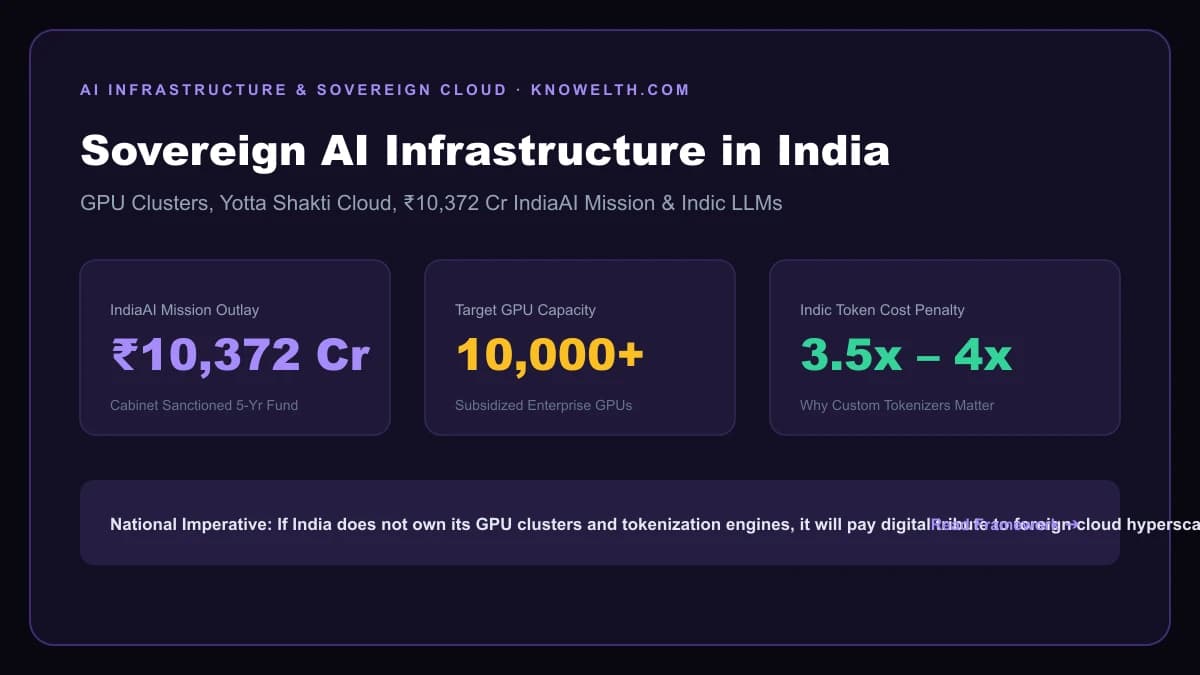
Sovereign AI India: GPU Cloud & Indic LLMs
Sovereign AI Infrastructure in India: GPU Clusters, Yotta Shakti Cloud, and Indic LLMs Quick Summary: In the global race for artificial intelligence hegemony, computing power has superseded crude oil …
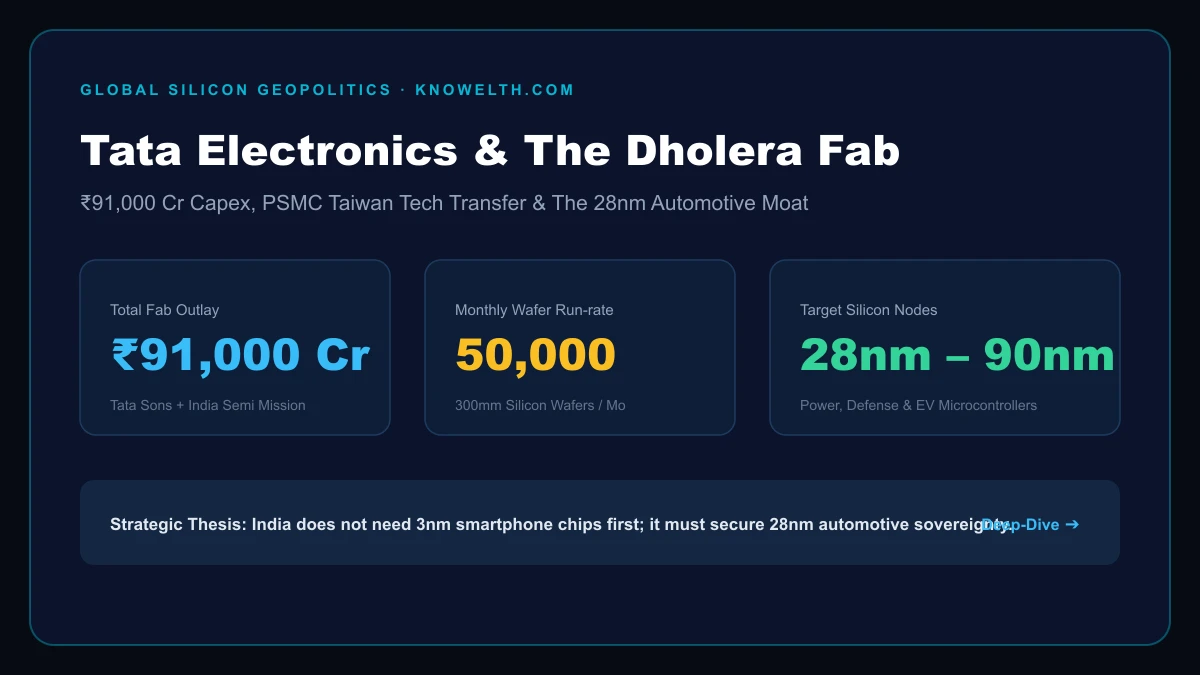
Tata Electronics & Dholera Fab: India's Chip Ambition
Tata Electronics & The Dholera Fab: Can India Break Taiwan's Semiconductor Monopoly? Quick Summary: In the arid plains of Dholera Special Investment Region (SIR) in Gujarat, Tata Electronics, in techn…

System 2 AI Architectures, NVIDIA's $500B Infrastructure Alliance, and Industrial Physical AI Scale-Up
System 2 AI Architectures, NVIDIA's $500B Infrastructure Alliance, and Industrial Physical AI Scale-Up The artificial intelligence ecosystem is undergoing a fundamental structural transformation th…