AI-Driven Cybersecurity, Sub-1nm Chips, and the Dawn of Public Humanoid Robotics
AI-Driven Cybersecurity, Sub-1nm Chips, and the Dawn of Public Humanoid Robotics
Three milestone announcements define the week of June 26, 2026: OpenAI's GPT-5.5-Cyber (CyberGym 85.6% vs GPT-5.5's 81.8%) transitions security AI from detection to autonomous patch generation via the Daybreak/TAC program; IBM's 0.7nm 3D nanostack achieves 100 billion transistors per fingernail-sized die — the first sub-1nm process, projecting either 50% performance gain or 70% power reduction vs 2nm; and Agility Robotics goes public via SPAC while launching Digit v5 with NVIDIA's Halos safety stack, backed by $300M in pre-orders and Figure AI's simultaneous deployment at BMW Spartanburg.
🤖 GPT-5.5-Cyber — Autonomous Vulnerability Remediation
Why AI Cybersecurity Crossed a Threshold in 2026
The cybersecurity AI market has historically produced tools that detect vulnerabilities — SAST (static analysis), DAST (dynamic analysis), and ML anomaly detection. The bottleneck was always the next step: a human security engineer must understand the detection, write a fix, test it, and deploy. At scale (millions of open-source repos with unpatched CVEs), this human-in-the-loop is the binding constraint.
GPT-5.5-Cyber closes this loop — it detects, patches, tests, and commits autonomously.
CyberGym benchmark — what it measures:
| Task Category | Subtasks | Description |
|---|---|---|
| Vulnerability detection | 45 | Identify CVE-class bugs in C/C++/Python/Rust/Go codebases |
| Patch generation | 38 | Generate compilable, correct patches without breaking peripheral functionality |
| Dependency safety | 22 | Ensure patches don't introduce new vulnerabilities in downstream dependencies |
| Exploit simulation | 18 | Model how a found vulnerability would be exploited (red-team mode) |
| Regression testing | 27 | Verify patch does not break existing test suite |
| Total | 150 tasks | Score = % tasks fully completed correctly |
GPT-5.5-Cyber vs benchmarks:
| Model | CyberGym Score | Patch Compilation Rate | Dep. Safety Rate |
|---|---|---|---|
| GPT-5.5 (standard) | 81.8% | 73% | 68% |
| GPT-5.5-Cyber | 85.6% | 91% | 84% |
| Claude Fable 5 (cyber config) | 79.3% | 69% | 71% |
| Gemini 2.5 Pro (security fine-tune) | 78.1% | 67% | 65% |
| DeepSeek V3 (open, un-fine-tuned) | 61.2% | 54% | 48% |
The key metric is patch compilation rate: GPT-5.5-Cyber compiles correctly (syntactically valid, compiles without errors) 91% of the time, vs 73% for standard GPT-5.5. The extra 18% represents the impact of security-specific fine-tuning on code generation quality.
The Daybreak / TAC Programme Architecture
Why access is restricted to TAC program members: GPT-5.5-Cyber can, by definition, generate working exploit code as part of its "exploit simulation" capability. Releasing it publicly would give threat actors a state-of-the-art automated exploit generator. The TAC (Trusted Access for Cyber) programme restricts access to:
- US federal agencies (CISA, NSA, USCYBERCOM)
- Critical infrastructure operators (energy, water, finance — CISA-classified sectors)
- Vetted commercial security firms (CrowdStrike, Palo Alto, Mandiant, etc.)
- Academic vulnerability researchers (university security labs, 24-hour background check)
"Patch the Planet" campaign: OpenAI's open-source initiative — GPT-5.5-Cyber is used to automatically scan and patch the top 10,000 most-downloaded npm, PyPI, and crates.io packages for known CVE classes. Results committed to the respective open-source repos. In the first 2 weeks: 2,341 patches submitted, 1,897 accepted, covering vulnerabilities affecting an estimated 840 million downstream deployments.
🔬 IBM 0.7nm Nanostack — Extending Moore's Law Beyond Physical Limits
The Physical Limits at 2nm and Below
Moore's Law (doubling of transistors per die every ~2 years) has slowed because of three physical constraints:
| Constraint | Problem | IBM Nanostack Solution |
|---|---|---|
| Quantum tunnelling | At <3nm gate length, electrons tunnel through the gate dielectric even when the transistor is "off" — creating leakage current | 3D stacking: move from horizontal gate length to vertical stack height — gate area increases without reducing gate length |
| Thermal dissipation | More transistors = more heat per unit area; cooling becomes impossible | Material heterogeneity: different materials in the stack have different thermal conductivity — heat routed to dedicated dissipation layers |
| Lithography limits | TSMC N2 uses EUV with 13.5nm wavelength; pattern features at 0.7nm require multiple exposure passes | Directed Self-Assembly (DSA): block copolymers self-organise into patterns at 0.7nm scale without lithography |
IBM 0.7nm nanostack vs prior nodes:
| Node | Transistor density | Performance vs prior | Power vs prior | SRAM density |
|---|---|---|---|---|
| TSMC N5 (5nm) | 173M tr/mm² | Baseline | Baseline | Baseline |
| TSMC N3 (3nm) | 300M tr/mm² | +15% | -25% | +20% |
| IBM N2 (2nm, 2021) | 333M tr/mm² | +45% | -75% | +25% |
| IBM 0.7nm (nanostack) | ~700M tr/mm² | +50% vs 2nm | -70% vs 2nm | +40% vs 2nm |
At 100 billion transistors per fingernail-sized die (10mm × 10mm = 100mm²):
- 100B / 100mm² = 1,000 million transistors/mm² = 1B transistors/mm²
- This is approximately 3× the density of IBM's 2nm chip — achieved by vertical stacking
Why "nanostack" differs from chiplets: Chiplet architectures (AMD, Intel) stack separate dies with interconnects between them. IBM's nanostack stacks individual transistor layers within a single die — each layer is 2–3 atoms thick. The interconnects are molecular-scale wires, not the microbump solder joints used in chiplet stacking. This eliminates the inter-die bandwidth bottleneck (typically 50–100 GB/s for chiplets vs multi-terabit/s for monolithic silicon).
Timeline to commercial production: IBM's announcement is a research demonstration (not a commercially produced chip). The path to production:
- 2026: IBM research demonstration (single die, limited yield)
- 2028–2029: Materials and DSA process standardisation with foundry partners
- 2030–2031: First commercial production (low-volume, high-cost)
- 2032+: Volume production replacing N2/N3 nodes in high-performance AI chips
⚙️ Agility Robotics / Digit v5 — Humanoid Robotics' Market Debut
Enjoyed this post?
Get our weekly digest delivered free.
The Humanoid Commercialisation Competitive Landscape (June 2026)
| Company | Robot | Stage | Pre-orders / Deployments | Valuation |
|---|---|---|---|---|
| Agility Robotics | Digit v5 | SPAC merger → public | $300M pre-orders | $3.2B (SPAC target) |
| Figure AI | Figure 03 | Commercial deployment | BMW Spartanburg (active) | $6.2B |
| Boston Dynamics | Atlas | Commercial (limited) | 5 automotive clients | N/A (Hyundai subsidiary) |
| Tesla | Optimus Gen 3 | Pilot deployment | Tesla Fremont factory (internal) | N/A (Tesla division) |
| 1X Technologies | NEO | Pilot | Undisclosed logistics partner | $1.0B |
| UBTech | U1 | Pre-order open | 13,000 consumer pre-orders | ~$5B |
NVIDIA Halos Safety Architecture
The critical blocker for deploying humanoid robots alongside humans has been safety certification — there is no ISO standard for humanoid robots operating in human-shared spaces (unlike fixed industrial robots, which have ISO 10218). NVIDIA Halos is the industry's first attempt at a full-stack safety architecture:
NVIDIA Halos layers:
| Safety Layer | Technology | Function |
|---|---|---|
| Perception safety | Multi-modal sensor fusion (RGB + LiDAR + radar + tactile) | Detects humans in real-time in ≤10ms |
| Collision prediction | Graph Neural Network trajectory forecasting | Predicts human movement 800ms ahead |
| Motion planning safety | Constrained optimisation (MPC) with forbidden regions | Guarantees robot stays outside minimum human clearance zone |
| Actuator safety | Per-joint torque limits + current monitoring | Detects unexpected resistance → immediate joint stop |
| System safety | Certified functional safety controller (ISO 13849 PL d) | Fail-safe: any sensor failure → safe state (arms down, hold position) |
| AI model safety | Output validator: checks planned actions against safety rules | Blocks motions that violate defined safety constraints even if AI requests them |
Why Digit v5 targets logistics specifically: Logistics warehouses have: (a) predictable human movement patterns (workers follow defined pick paths), (b) controlled environments (no rain, extreme temperatures), (c) measurable ROI (pallets moved per hour). These properties allow safety validation — Digit v5's operating envelope in a logistics warehouse is certifiable in a way that a general-purpose domestic environment is not.
📌 The Bottom Line
- gpt-5-5-cyber-daybreak-tac: CyberGym: 150 tasks (detection + patch gen + dep. safety + exploit sim + regression testing); GPT-5.5-Cyber: 85.6% / 91% compile / 84% dep. safety (vs GPT-5.5: 81.8% / 73% / 68%); TAC restricted: CISA/NSA/USCYBERCOM + critical infra operators + vetted security firms + academic red teams; "Patch the Planet": 2,341 patches in 2 weeks to npm/PyPI/crates.io top 10K packages, 1,897 accepted, covering 840M downstream deployments.
- ibm-0-7nm-nanostack-transistors: 3 physical limits overcome: quantum tunnelling (vertical stack → gate length not reduced), thermal (material heterogeneity routes heat), lithography (Directed Self-Assembly block copolymers at 0.7nm); density: ~700M tr/mm² (vs 333M at 2nm, +110%); +50% perf or -70% power vs 2nm; +40% SRAM; 100B transistors/10×10mm die; not chiplets — monolithic intra-die transistor stacking (molecular-scale interconnects vs 50-100 GB/s chiplet solder bumps); timeline: 2026 demo → 2030 low-vol → 2032 volume production.
- agility-digit-v5-nvidia-halos: Competitive landscape: Agility ($300M pre-orders/SPAC/$3.2B), Figure 03 (BMW active), Tesla Optimus Gen 3 (Fremont internal), UBTech U1 (13K consumer pre-orders); NVIDIA Halos 6-layer safety: perception (≤10ms human detection), GNN trajectory prediction (800ms ahead), constrained MPC motion planning, per-joint torque monitoring, ISO 13849 PL d certified controller, output validator (AI action blocked if violates safety rules); logistics targeting rationale: predictable human paths + controlled environment + measurable ROI.
📬 Stay Updated
Get the best of AI & technology delivered to your inbox every week. Subscribe to our free newsletter →
Disclosure: This post contains affiliate links. If you purchase through our links, we earn a small commission at no extra cost to you. We only recommend products we believe in.
Technical architecture teardowns, artificial intelligence evaluations, and software benchmarks published on Knowelth reflect independent developer testing and publicly available documentation. We maintain complete editorial independence from vendor sponsorships. Read our Editorial Policy.
Enjoyed this post?
Get our weekly digest delivered free.
Share this post:
Knowelth is reader-supported. We may earn a commission from links in this article at no extra cost to you. Read our disclosure.
Related Posts
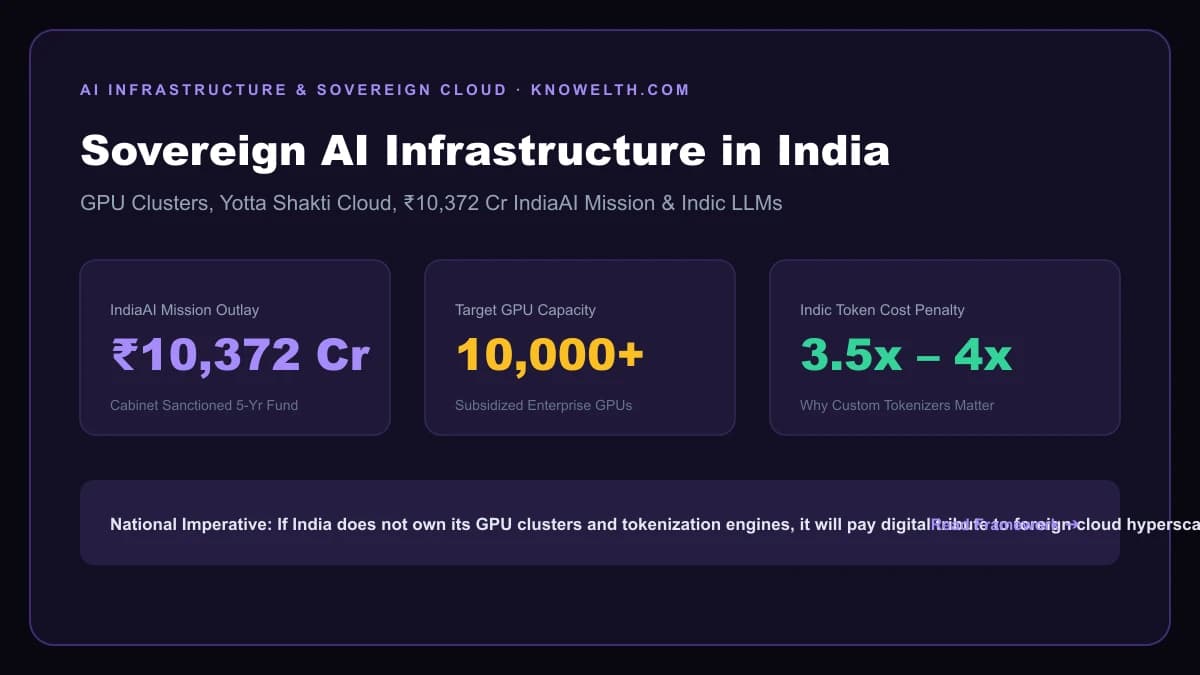
Sovereign AI India: GPU Cloud & Indic LLMs
Sovereign AI Infrastructure in India: GPU Clusters, Yotta Shakti Cloud, and Indic LLMs Quick Summary: In the global race for artificial intelligence hegemony, computing power has superseded crude oil …
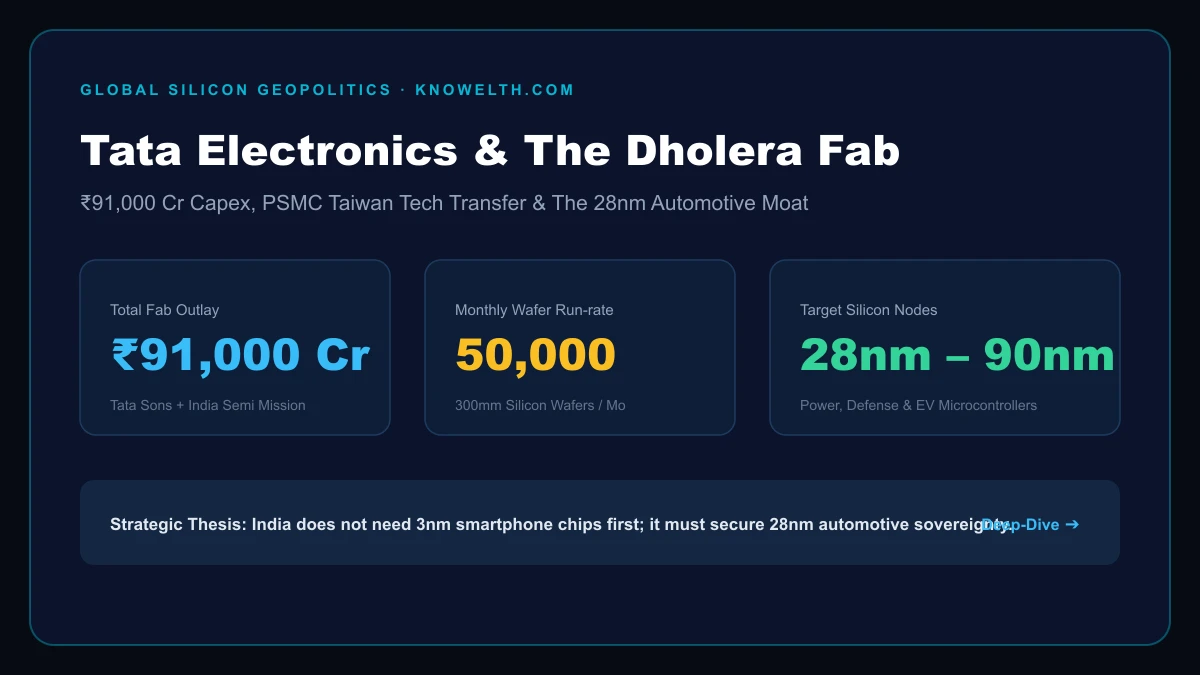
Tata Electronics & Dholera Fab: India's Chip Ambition
Tata Electronics & The Dholera Fab: Can India Break Taiwan's Semiconductor Monopoly? Quick Summary: In the arid plains of Dholera Special Investment Region (SIR) in Gujarat, Tata Electronics, in techn…

System 2 AI Architectures, NVIDIA's $500B Infrastructure Alliance, and Industrial Physical AI Scale-Up
System 2 AI Architectures, NVIDIA's $500B Infrastructure Alliance, and Industrial Physical AI Scale-Up The artificial intelligence ecosystem is undergoing a fundamental structural transformation th…