China's $295B AI Infrastructure Push, MiniMax's Open-Weight M3, and PwC's 2026 AI Jobs Barometer
China's $295B AI Infrastructure Push, MiniMax's Open-Weight M3, and PwC's 2026 AI Jobs Barometer
Three stories from the third week of June 2026 map AI's transition from software labs to national infrastructure and labor economics. China's 2 trillion yuan ($295B) five-year AI computing infrastructure blueprint is a direct response to US export controls on Nvidia H100/H200 chips — not just building datacenters, but developing unified software compilation layers that federate heterogeneous domestic chips (Huawei Ascend, Cambricon) into coherent training pools capable of frontier-scale model training. MiniMax M3 (permissive commercial license, 1M token context, MiniMax Sparse Attention architecture) demonstrates that open-weight models have operationally closed the gap with proprietary APIs on SWE-Bench Pro and long-context retrieval — the competitive pressure on closed models is now quantitative, not rhetorical. And PwC's 2026 AI Jobs Barometer documents the "two-track" labor market in precise terms: AI-skill-premium roles growing +34% in wages YoY; routine digital/administrative roles declining in both headcount and wages; and a new category of "AI orchestrator" role growing at the fastest pace of any job category — humans who govern, verify, and optimise AI systems rather than replacing them.
🇨🇳 China's $295B National Computing Grid — More Than Datacenters
Why Export Controls Created the Infrastructure Imperative
The US export control effect on China's AI compute:
| Control measure | Date | Chips affected | Impact on China |
|---|---|---|---|
| Initial H100 export restriction | Oct 2022 | H100, A100 | China labs stockpiled; Huawei Ascend 910A deployment |
| A800/H800 (downgraded) restriction | Oct 2023 | A800, H800 (custom low-bandwidth versions) | Even downgraded alternatives blocked |
| Updated entity list expansion | Jan 2025 | Comprehensive; also targets networking equipment | China must use entirely domestic chip ecosystem |
The domestic chip landscape China is working with:
| Chip | Maker | FP16 FLOPS | HBM | CUDA-equivalent? | Status |
|---|---|---|---|---|---|
| Ascend 910C | Huawei | ~310 TFLOPS | 96 GB | CANN (proprietary) | Production; GLM-5.2 trained on it |
| Ascend 910D (preview) | Huawei | ~380 TFLOPS | 128 GB | CANN | Limited production 2026 |
| MLU-570 | Cambricon | ~256 TFLOPS | 64 GB | Proprietary | Small-scale production |
| Biren BR100 | Biren | ~256 TFLOPS | 64 GB | Proprietary | Limited availability |
| DCU Z100L | Hygon | ~200 TFLOPS | 32 GB | Proprietary | Available |
The fragmentation problem — why software is the bottleneck: With 5 different chip architectures (each with proprietary software stacks), a training run across a heterogeneous cluster requires:
- A unified compilation layer that translates a single model definition (PyTorch/JAX) into code that runs on Ascend + Cambricon + Biren simultaneously
- A cluster orchestration layer that assigns computation to each chip type based on its strengths
- A synchronisation protocol that aggregates gradients from all chip types during distributed training
This is the primary technical challenge of the $295B plan — not the hardware itself.
The $295B plan structure:
| Element | Investment focus | Technical goal |
|---|---|---|
| Compute corridors | Energy-rich west → tech-hub east fibre + datacenter placement | Arbitrage cheap western hydro/wind power for eastern computing |
| Unified compiler | State-funded compiler for heterogeneous chip clusters | Train on Ascend + Cambricon + Biren simultaneously |
| Network backbone | National 400G+ dedicated AI data network | Reduce inter-datacenter latency to <5ms |
| Edge deployment | State-subsidised edge hardware for domestic robotics/IoT | 100M+ device ecosystem |
| Research funding | Priority: post-Transformer architectures; quantum-classical hybrid | Next-generation model architectures not dependent on CUDA |
The geopolitical consequence — AI supply chain bifurcation:
| Dimension | Western ecosystem | Chinese ecosystem |
|---|---|---|
| Primary training chip | Nvidia H100/H200/B200 | Huawei Ascend 910C/910D |
| Software framework | CUDA + PyTorch/JAX | CANN + MindSpore + Paddle |
| Cloud infrastructure | AWS/Azure/GCP | Alibaba Cloud/Tencent Cloud/Huawei Cloud |
| Model deployment standard | OpenAI API / Anthropic / HuggingFace | Baidu ERNIE / Alibaba Tongyi / MiniMax |
| Interconnect | NVLink (Nvidia) / InfiniBand | Ascend interconnect + state-funded optical backbone |
Two parallel AI ecosystems, increasingly interoperable only at the model-output level.
🔓 MiniMax M3 — Sparse Attention at 1 Million Token Scale
MiniMax Sparse Attention (MSA) — Why Standard Attention Fails at 1M Tokens
The quadratic attention scaling problem: Standard transformer attention scales as O(n²) with context length:
- At 128K tokens: 128K² = 16.4 billion attention pairs computed per layer
- At 1M tokens: 1M² = 1 trillion attention pairs computed per layer — 61× more compute
- At 1M tokens with 96 layers: 96 trillion operations per forward pass — infeasible even on H100s
How MSA solves the 1M-token problem:
| Mechanism | What it does | Memory + compute saving |
|---|---|---|
| Dynamic token selection | Identifies the most relevant K% of tokens in context; only computes attention to those tokens | ~90% reduction in attention pairs |
| Sparse attention mask | Only selected tokens are included in attention calculation — rest are masked | O(n × K) instead of O(n²) |
| Local sliding window | Always includes the last N tokens (recent context) regardless of relevance score | Maintains short-range coherence |
| Global token anchors | Always includes key "anchor" tokens (document start, section headers) regardless of relevance | Maintains document-level coherence |
M3 vs competitive 1M context models:
| Model | License | Context | Multimodal | SWE-Bench Pro | API cost (input) |
|---|---|---|---|---|---|
| MiniMax M3 | Permissive commercial | 1M tokens | ✅ Text+video+audio | ~67% | $1.5/M |
| Gemini 3.0 Pro | Closed | 1M tokens | ✅ | ~66% | $12/M |
| GLM-5.2 | MIT open | 1M tokens | ✅ | ~63% | $2/M |
| Kimi K3 | MIT open | 1M tokens | ✅ | ~68% | $3/M |
| GPT-5.5 | Closed | 128K tokens | ✅ | ~72% | $12/M |
M3's SWE-Bench Pro performance at $1.5/M input tokens makes it the most cost-effective frontier-adjacent model at 1M context.
Enterprise use cases enabled by 1M tokens that weren't possible at 128K:
| Use case | Why 128K insufficient | Why 1M enables it |
|---|---|---|
| Full codebase agentic review | 128K tokens ≈ ~50,000 lines of code (large but not entire enterprise codebase) | 1M tokens ≈ ~400,000 lines — most entire applications fit |
| Contract entire archive search | 128K = ~100 contracts | 1M = ~800 contracts in one context |
| Multi-hour video analysis | 128K ≈ ~2 hours of transcribed video | 1M ≈ ~16 hours — full workday audio/video |
| Medical record analysis | 128K covers most individual patient histories | 1M covers entire multi-year EHR including notes |
💼 PwC 2026 AI Jobs Barometer — The Two-Track Labor Reality
Enjoyed this post?
Get our weekly digest delivered free.
The Quantitative Picture
PwC 2026 AI Jobs Barometer key metrics:
| Metric | Finding |
|---|---|
| Wage premium in AI-exposed, human-judgment roles | +34% YoY average wage growth |
| Hiring volume decline in routine digital roles | -23% YoY hiring volume (not unemployment — reduced hiring into existing vacancies) |
| Fastest-growing new role | AI orchestrator (govern + verify + optimise AI workflows) |
| Lloyds Banking Group hires (AI governance) | 300 technology + risk AI governance specialists |
| Flat-rate AI coding tools → metered billing | Major providers (Copilot, Cursor) pivoting to credit-based billing |
| Enterprise AI usage treated as direct resource | Like electricity — metered, budgeted, optimised |
The two-track breakdown:
| Track | Role types | AI relationship | Wage trajectory |
|---|---|---|---|
| Track 1 (premium) | AI orchestrators, AI safety engineers, domain experts with AI tools, AI product managers | Humans directing and verifying AI | +20–40% wage growth |
| Track 2 (declining) | Data entry, routine coding, basic copywriting, standard administrative processing | AI doing the work; humans as backup | Flat or declining; hiring volume down |
The "AI orchestrator" role — what it actually is: The fastest-growing new job category, defined by PwC as:
- Workflow design: Designing multi-agent pipelines to accomplish business goals
- Verification: Reviewing AI outputs for errors, bias, hallucinations before they reach production
- Optimisation: Monitoring cost-per-task; adjusting routing logic to reduce token spend
- Governance: Enforcing compliance requirements (ensuring AI decisions can be explained/audited)
- Incident response: Diagnosing and fixing AI system failures in production
AI orchestrators are not replacing software engineers — they're a new category that didn't exist at scale before 2025.
The end of flat-rate AI coding subscriptions: Major AI coding tool providers (GitHub Copilot, Cursor, Codeium) are phasing out flat-rate subscriptions ($10–20/month unlimited) in favour of credit-based metered billing:
- Background compute for suggestions, test generation, code review, documentation now tracked as usage
- Enterprise teams at scale (1,000+ developers each using AI tools 8 hours/day) generate enormous background compute costs that flat-rate pricing couldn't sustain
- Result: enterprises now have an AI compute budget line item alongside cloud and software licences
Lloyds Banking Group case study: Lloyds (one of UK's largest banks) simultaneously:
- Automated legacy administrative systems (reducing headcount via attrition)
- Hired 300 new AI governance specialists (technology + risk)
This is the "two-track" in microcosm: routine administrative work automated away; new AI governance work hired to ensure the automation functions safely and compliantly within financial regulations (FCA rules, operational resilience standards).
📌 The Bottom Line
- china-295b-ai-computing-grid-heterogeneous: US export controls (H100/A100/H800 all blocked Jan 2025) force China onto domestic chips: Ascend 910C (~310 TFLOPS, GLM-5.2 trained on it), Ascend 910D (~380 TFLOPS), Cambricon MLU-570, Biren BR100 — 5 proprietary software stacks; $295B (¥2T) 5-year plan: unified compiler (heterogeneous chip federation), compute corridors (cheap western hydro/wind → eastern tech hubs), national 400G+ AI backbone (<5ms inter-DC latency), edge hardware for 100M+ devices; bifurcation: two parallel AI ecosystems (CUDA/NVLink/AWS vs CANN/Ascend interconnect/Alibaba Cloud) interoperable only at output level.
- minimax-m3-sparse-attention-1m-context: Standard attention at 1M tokens: 1 trillion pairs per layer × 96 layers = 96 trillion ops = infeasible; MSA: dynamic token selection (~90% reduction), sparse mask O(n×K) not O(n²), local sliding window (short-range coherence), global anchors (document-level coherence); M3 vs competitors: $1.5/M input (vs Gemini 3.0 Pro $12/M), SWE-Bench Pro ~67% (competitive with $12/M closed models); 1M context unlocks: full enterprise codebase (~400K lines), 800 contracts, 16-hour video, full multi-year EHR in single context.
- pwc-2026-jobs-barometer-two-track-labor: +34% wage growth in AI-directed human-judgment roles; -23% hiring volume in routine digital roles; fastest growing category: AI orchestrator (design pipelines + verify outputs + optimise cost + govern + incident response); flat-rate AI coding → credit-based metered (enterprises now have AI compute budget line alongside cloud); Lloyds case: automated legacy admin (attrition) + hired 300 AI governance specialists simultaneously = two-track in a single institution; AI compute now treated as metered resource like electricity.
📬 Stay Updated
Get the best of AI & technology delivered to your inbox every week. Subscribe to our free newsletter →
Disclosure: This post contains affiliate links. If you purchase through our links, we earn a small commission at no extra cost to you. We only recommend products we believe in.
Technical architecture teardowns, artificial intelligence evaluations, and software benchmarks published on Knowelth reflect independent developer testing and publicly available documentation. We maintain complete editorial independence from vendor sponsorships. Read our Editorial Policy.
Enjoyed this post?
Get our weekly digest delivered free.
Share this post:
Knowelth is reader-supported. We may earn a commission from links in this article at no extra cost to you. Read our disclosure.
Related Posts
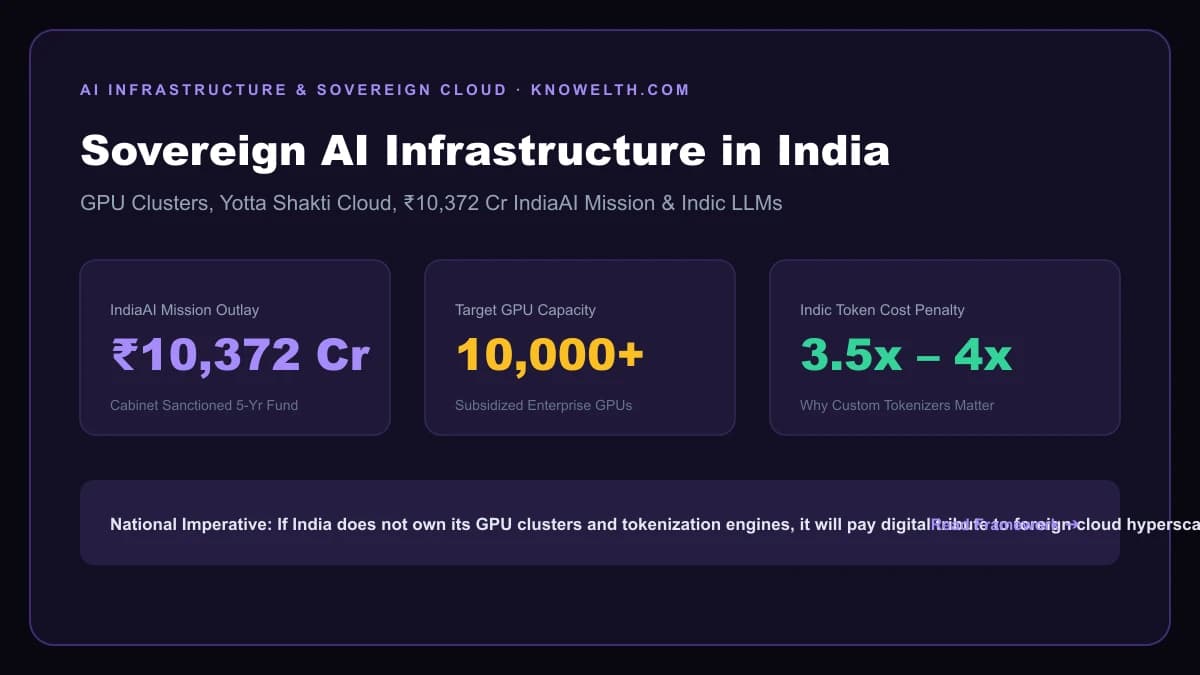
Sovereign AI India: GPU Cloud & Indic LLMs
Sovereign AI Infrastructure in India: GPU Clusters, Yotta Shakti Cloud, and Indic LLMs Quick Summary: In the global race for artificial intelligence hegemony, computing power has superseded crude oil …
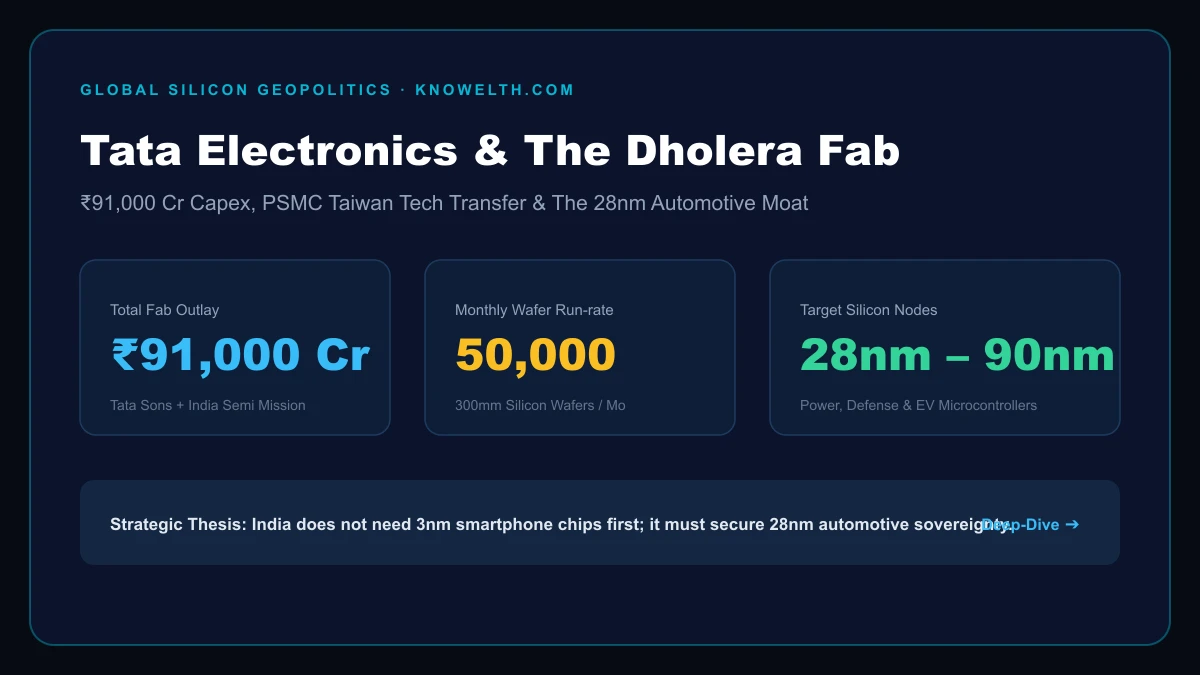
Tata Electronics & Dholera Fab: India's Chip Ambition
Tata Electronics & The Dholera Fab: Can India Break Taiwan's Semiconductor Monopoly? Quick Summary: In the arid plains of Dholera Special Investment Region (SIR) in Gujarat, Tata Electronics, in techn…

System 2 AI Architectures, NVIDIA's $500B Infrastructure Alliance, and Industrial Physical AI Scale-Up
System 2 AI Architectures, NVIDIA's $500B Infrastructure Alliance, and Industrial Physical AI Scale-Up The artificial intelligence ecosystem is undergoing a fundamental structural transformation th…