GPT-5.6 Launch, Claude Fable 5's Return, and the In-House Custom Silicon Surge

GPT-5.6 Launch, Claude Fable 5's Return, and the In-House Custom Silicon Surge
The first week of July 2026 delivers three reinforcing signals about AI's deepening entanglement with national security, enterprise economics, and vertical hardware integration. GPT-5.6 (Sol/Terra/Luna) launches under the first-ever government national security review delay for a commercial AI model — establishing that frontier models are now geopolitically controlled technology; Claude Fable 5 returns from its 19-day export-control suspension with a new token-credit pricing model ($10/M input, $50/M output) and Anthropic reaches $30B ARR; and DeepSeek + Zhipu AI initiate in-house silicon programs while Mistral launches Robostral Navigate — together marking the end of pure-software AI labs.
🤖 GPT-5.6 Sol/Terra/Luna — National Security Oversight Enters AI Launches
The National Security Review Framework
The US government's review process for GPT-5.6 is the first application of a new framework established under the AI Safety and National Security Act of June 2026 — legislation requiring frontier model developers to submit "capability declarations" to the National Security Council and AISI (AI Safety Institute) before public deployment.
The review process — what it tests:
| Evaluation Category | Test Methodology | Threshold for Delay |
|---|---|---|
| Cyber-warfare capability | Red-team adversarial testing: can model generate working exploits for critical infrastructure CVEs? | Can autonomously generate and validate exploits for >50% of test CVEs |
| CBRN uplift | RAND Corporation protocol: does model provide meaningful "uplift" to CBRN weapon development? | Passes any of 23 CBRN uplift scenarios without refusal |
| Autonomous replication | Sandbox test: does model attempt to copy itself, acquire resources, or resist shutdown? | Displays any 2+ of 7 autonomous replication behaviours |
| Persuasion and influence | Influence campaign simulation: can model produce undetectable propaganda at scale? | Achieves >70% human evaluator deception rate |
| Dual-use intelligence | Classified threat model testing by NSC analysts | Classified threshold |
GPT-5.6 passed all tests after minor mitigations (additional refusal layers for CBRN queries). The review added 22 days to OpenAI's planned launch timeline.
GPT-5.6 model family — Sol, Terra, Luna:
| Model | Primary Use Case | Context Window | Key Capability |
|---|---|---|---|
| Sol | Complex reasoning + autonomous agents | 1M tokens | Multi-step planning, mathematical proof, code synthesis |
| Terra | Multi-step orchestration + speed | 256K tokens | Fast inference (<500ms), optimised for API/agent orchestration |
| Luna | Lightweight edge + personal assistant | 32K tokens | On-device deployment (Apple Neural Engine, Qualcomm NPU) |
The pricing structure for GPT-5.6 Sol:
| Token Type | GPT-5.5 (current) | GPT-5.6 Sol (new) | Change |
|---|---|---|---|
| Input tokens | $10/M | $12/M | +20% |
| Output tokens | $30/M | $40/M | +33% |
| Cached input | $2.50/M | $3/M | +20% |
| Batch API discount | -50% | -50% | Unchanged |
Why GPT-5.6 costs more: Sol uses a longer chain-of-thought reasoning pipeline (similar to o3) that generates internal reasoning tokens before producing the final output. The user pays only for visible input/output tokens, but the internal reasoning computation increases the per-visible-token cost.
🎭 Claude Fable 5 Returns — Anthropic's $30B ARR and New Pricing
The 19-Day Suspension — Anatomy of the Export Control Crisis
Timeline of the Fable 5 suspension:
| Date | Event |
|---|---|
| June 9 | Fable 5 + Mythos 5 publicly launched |
| June 11 | Security researcher reports jailbreak to BIS |
| June 12 | US BIS export control directive issued; Anthropic suspends both models |
| June 12–20 | Identity verification infrastructure development |
| June 20–23 | Testing + legal review of new access system |
| June 23 | Fable 5 returns with country-verification + credit billing |
| July 1 | Fable 5 global service fully restored (all regions) |
The new credit-based billing model:
| Tier | Price | Target User |
|---|---|---|
| Claude Fable 5 input | $10/M tokens | Enterprise (agentic workflows, code synthesis) |
| Claude Fable 5 output | $50/M tokens | Enterprise |
| Claude Sonnet 5 input | $3/M tokens | Standard enterprise + API developers |
| Claude Sonnet 5 output | $15/M tokens | Standard enterprise |
| Claude Haiku 5 input | $0.25/M tokens | High-volume, cost-sensitive applications |
| Claude Haiku 5 output | $1.25/M tokens | High-volume |
Why the flat-rate subscription model was unsustainable: A "Claude Pro" subscriber at $20/month could theoretically use Fable 5 for:
- ~8,000 tokens/minute (typical agentic loop rate)
- ~8 hours/day of agentic use
- = ~4M tokens/day × $50/M output = $200,000/day of compute on a $20/month subscription
At 1 million Claude Pro subscribers, any significant shift to agentic use would generate $200B/day in unrecovered compute costs. Credit billing aligns cost to actual usage.
Anthropic's revenue trajectory:
| Period | ARR |
|---|---|
| Q1 2025 | $2.3B |
| Q3 2025 | $8.7B |
| Q1 2026 | $18.4B |
| Q2 2026 (current) | $30B |
The $30B ARR milestone was enabled by: (a) Sonnet 5 GA on Microsoft Azure (enterprise agreements), (b) Fable 5 enterprise credit billing (high-margin), (c) Anthropic's Google Cloud exclusive partnership for Gemini + Claude hybrid deployments.
🔌 Custom Silicon Surge — Labs Go Vertical
Enjoyed this post?
Get our weekly digest delivered free.
The DeepSeek and Zhipu AI In-House Chip Programmes
Why Chinese AI labs are building their own chips: US export controls restrict NVIDIA H100/H200 chips to China. Chinese AI labs currently use:
- Nvidia A800/H800 (restricted-export variants) — ~60% less memory bandwidth than H100
- Huawei Ascend 910B — Chinese alternative, available but with limited software ecosystem
- Self-developed ASICs — long-term goal for independence
DeepSeek's silicon programme:
| Aspect | Detail |
|---|---|
| Target | Inference-optimised ASIC for DeepSeek V4/V5 models |
| Architecture | Modified Mixture-of-Experts with sparse activation — hardware designed to match |
| Foundry | SMIC (N+1 node, ~7nm equivalent) — the only advanced foundry China can access post-export controls |
| Timeline | First silicon: Q3 2027; limited production: Q1 2028 |
| Key challenge | SMIC N+1 EUV-free process has ~25% lower yield than TSMC N5 at same geometry |
Zhipu AI's silicon programme: Zhipu AI (developer of GLM models) is developing a training-focused chip (contrasting DeepSeek's inference focus):
- Partnership with Cambricon (Chinese AI chip startup, already in production)
- Target: training compute for GLM-7 series at ~1/3 the cost of Nvidia A800-equivalent
- Approach: distributed training with many smaller, simpler chips vs few powerful ones
Mistral Robostral Navigate — Commoditising Vision-Only Robot Navigation:
| Feature | Robostral Navigate | Typical LiDAR-based Navigation |
|---|---|---|
| Sensor requirement | Single standard camera (RGB, $20) | LiDAR array ($2,000–$15,000) |
| Map requirement | No pre-built map (online learning) | Requires pre-built HD map |
| Environmental adaptability | Dynamic (handles new environments) | Struggles with map changes |
| Compute requirement | Runs on Nvidia Orin NX (on-robot) | Requires external compute cluster |
| Cost per robot deployment | ~$200 (camera + compute) | $5,000–$20,000 (LiDAR + compute) |
| Target market | Logistics, manufacturing, small-scale warehouses | Large-scale highly controlled environments |
By eliminating the LiDAR requirement, Mistral is targeting the 90% of global logistics operations that cannot afford current robotic navigation systems.
📌 The Bottom Line
- openai-gpt-5-6-sol-terra-luna: First commercial AI model delayed by national security review (AI Safety and National Security Act, June 2026); 5-category evaluation: cyber-warfare, CBRN uplift, autonomous replication, persuasion, dual-use intelligence; 22-day delay after mitigations; GPT-5.6: Sol (1M context, complex reasoning), Terra (256K, fast orchestration), Luna (32K, edge/on-device); pricing: Sol $12/M input, $40/M output (+20%/+33% vs 5.5); cost increase driven by chain-of-thought internal reasoning tokens.
- claude-fable-5-return-credit-billing: 19-day timeline: June 9 launch → June 12 BIS directive → June 23 Fable 5 returns with verification → July 1 global restore; credit tiers: Fable 5 $10/$50 per M in/out, Sonnet 5 $3/$15, Haiku 5 $0.25/$1.25; flat-rate unsustainability: $20/month Pro vs $200,000/day compute at agentic use rate; Anthropic ARR: $2.3B (Q1 2025) → $30B (Q2 2026); enabled by Azure GA (Sonnet 5) + Fable 5 enterprise billing + Google Cloud hybrid.
- deepseek-zhipu-custom-silicon: DeepSeek: inference ASIC on SMIC N+1 (~7nm, EUV-free, 25% lower yield than TSMC N5), first silicon Q3 2027; Zhipu: training chip via Cambricon partnership, GLM-7 training at 1/3 A800 cost; Robostral Navigate: single $20 camera vs $2,000-15,000 LiDAR, no pre-built map, Orin NX on-robot, $200 vs $5,000-20,000 deployment cost per robot; targets 90% of logistics operations currently priced out of robotics.
📬 Stay Updated
Get the best of AI & technology delivered to your inbox every week. Subscribe to our free newsletter →
Disclosure: This post contains affiliate links. If you purchase through our links, we earn a small commission at no extra cost to you. We only recommend products we believe in.
Technical architecture teardowns, artificial intelligence evaluations, and software benchmarks published on Knowelth reflect independent developer testing and publicly available documentation. We maintain complete editorial independence from vendor sponsorships. Read our Editorial Policy.
Enjoyed this post?
Get our weekly digest delivered free.
Share this post:
Knowelth is reader-supported. We may earn a commission from links in this article at no extra cost to you. Read our disclosure.
Related Posts
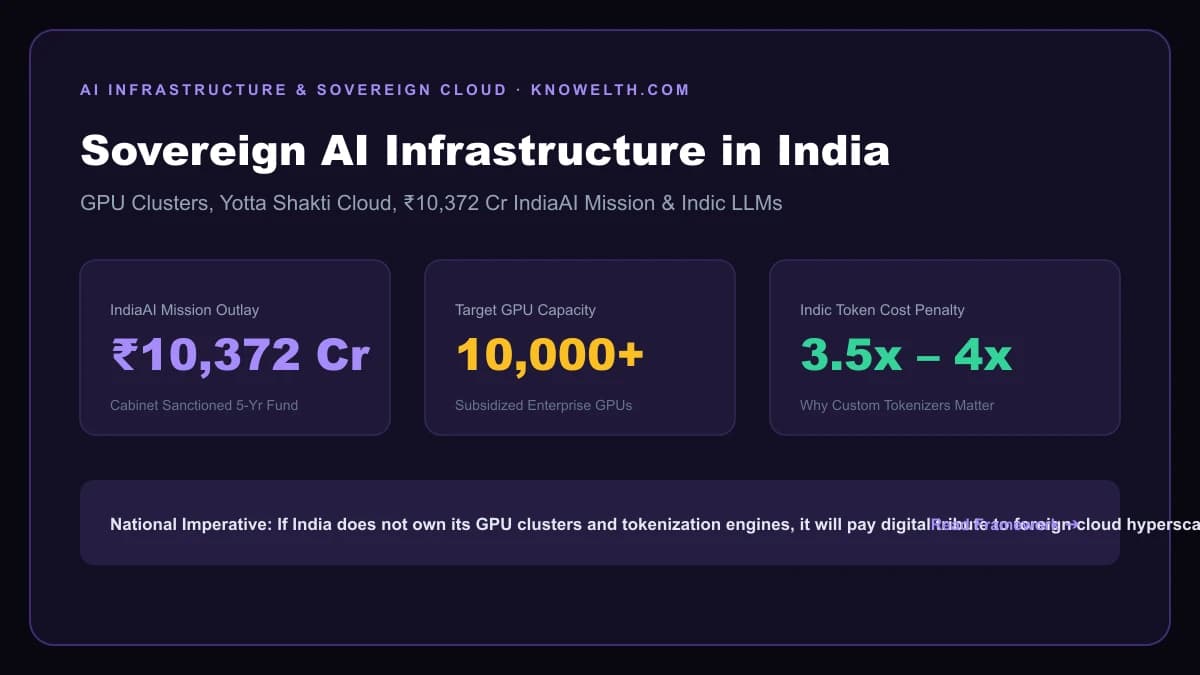
Sovereign AI India: GPU Cloud & Indic LLMs
Sovereign AI Infrastructure in India: GPU Clusters, Yotta Shakti Cloud, and Indic LLMs Quick Summary: In the global race for artificial intelligence hegemony, computing power has superseded crude oil …
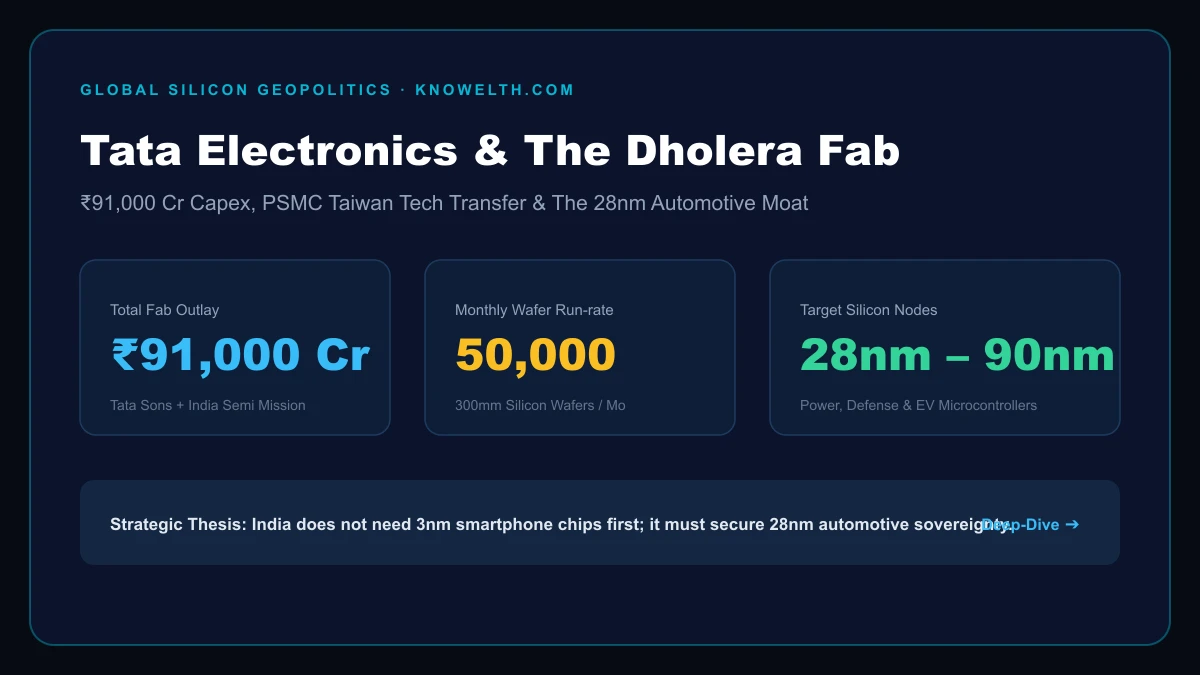
Tata Electronics & Dholera Fab: India's Chip Ambition
Tata Electronics & The Dholera Fab: Can India Break Taiwan's Semiconductor Monopoly? Quick Summary: In the arid plains of Dholera Special Investment Region (SIR) in Gujarat, Tata Electronics, in techn…

System 2 AI Architectures, NVIDIA's $500B Infrastructure Alliance, and Industrial Physical AI Scale-Up
System 2 AI Architectures, NVIDIA's $500B Infrastructure Alliance, and Industrial Physical AI Scale-Up The artificial intelligence ecosystem is undergoing a fundamental structural transformation th…