Mistral's Leanstral 1.5, UBTech's U1 Humanoid, and Baseten's $1.5B Infrastructure Surge
Mistral's Leanstral 1.5, UBTech's U1 Humanoid, and Baseten's $1.5B Infrastructure Surge
Three announcements define early July 2026's convergence of AI capability, physical robotics, and infrastructure scale. Mistral's Leanstral 1.5 (119B total / 6.5B active MoE, Apache 2.0) solves 587/672 PutnamBench problems via test-time scaling — the first open-weights model to challenge proprietary formal mathematics systems; UBTech's U1 humanoid secures 13,000 launch-day pre-orders for its VLAM-powered, mood-sensing consumer robot; and Baseten's $1.5B Series F validates the "picks and shovels" investment thesis as enterprise inference infrastructure becomes the AI stack's critical bottleneck.
🤖 Mistral Leanstral 1.5 — Open-Source Formal Mathematics
What Lean 4 Theorem Proving Is and Why It Matters
Lean 4 is a dependently typed programming language developed by Microsoft Research that serves as both a general-purpose programming language and a formal proof assistant. When code is "proved" in Lean 4, the Lean kernel mechanically verifies every logical step against the axioms of mathematics. A Lean 4 proof is mathematically certain — no human reviewer needed.
Applications of automated Lean 4 theorem proving:
| Domain | Application | Why Formal Proof Matters |
|---|---|---|
| Aerospace software | Verifying autopilot control algorithms | FAA-certifiable safety guarantees (DO-178C Level A) |
| Cryptography | Proving security properties of protocols | Eliminates side-channel vulnerability classes at specification level |
| Smart contracts | Verifying DeFi protocol logic | Prevents re-entrancy and overflow bugs (eliminated $4B+ in hacks if applied to historical contracts) |
| Kernel/OS development | Verifying memory safety in OS primitives | Replaces unsafe C with Lean-verified specifications |
| Mathematical research | Solving open conjectures | Accelerates mathematics without risk of undetected errors |
Leanstral 1.5 — Architecture and Performance
Model architecture:
| Specification | Value | Significance |
|---|---|---|
| Architecture | Mixture-of-Experts (MoE) | 119B total params; only 6.5B active per token |
| Active parameters | 6.5B per token | Inference cost equivalent to a 6.5B dense model |
| Total parameters | 119B | 18× more "knowledge capacity" than the active compute |
| Context window | 32K tokens | Handles complete Lean 4 proof files + mathematical context |
| License | Apache 2.0 | Full commercial use; fine-tuning allowed; weights downloadable |
| Training data | Lean 4 MathLib (4M+ theorems) + mathematical text (arXiv, Springer, AMS) | Comprehensive formal math corpus |
PutnamBench performance:
The Putnam Competition is the most prestigious undergraduate mathematics competition in North America, featuring 12 problems per year over 2 sessions. PutnamBench is a formalised version of all Putnam problems from 1962–2024 (672 total problems) encoded as Lean 4 theorem-proving tasks.
| Model | PutnamBench Score (/ 672) | % Solved | Access |
|---|---|---|---|
| DeepMind AlphaProof (2024) | 503 | 74.8% | Closed/internal |
| OpenAI o3 (math config) | 541 | 80.5% | Closed API |
| Mistral Leanstral 1.5 | 587 | 87.4% | Open-weights (Apache 2.0) |
| Anthropic Claude Fable 5 (math config) | 519 | 77.2% | Closed API |
| GPT-5.5 (standard) | 478 | 71.1% | Closed API |
Leanstral 1.5 at 87.4% is the highest-scoring open-weights model ever on PutnamBench — and scores higher than all closed proprietary models except OpenAI o3's specialised math configuration.
What "test-time scaling" means technically: Standard inference: one forward pass → one output. Test-time scaling: the model runs multiple candidate proof attempts (beam search over Lean 4 syntax), verifies each attempt with the Lean kernel in real-time, uses the verification result to guide further generation. It is an online search problem, not just text generation:
- Generate candidate proof tactic (e.g.,
ring_nf,omega,norm_num) - Apply to current proof state → Lean kernel returns: success / failure + error message
- On failure: use error message as conditioning context for next tactic attempt
- On success: advance proof state and repeat for next subgoal
- Budget: 512 tactic attempts per theorem (controllable compute budget)
🦾 UBTech U1 — Consumer Humanoid with VLAM Architecture
The Vision-Language-Action Model (VLAM) Distinction
Traditional industrial robots execute pre-programmed scripts. Humanoid robots with VLAMs can:
- See: RGB + depth cameras feed a vision transformer
- Understand language: Natural language instructions parsed by an LLM
- Act: An action model maps understanding to motor commands
U1 VLAM Architecture:
| Component | Technology | Function |
|---|---|---|
| Vision encoder | ViT-L/14 (CLIP-pretrained) | Processes 8 camera feeds (360° + hands + face) at 30 fps |
| Language model | Mistral 7B (fine-tuned) | Interprets user instructions and environmental context |
| Action model | Diffusion transformer (similar to π0) | Generates smooth motor trajectories from (observation, instruction) pairs |
| Mood sensing | Multi-modal affect model (video + audio + depth) | Classifies human emotional state from micro-expressions + vocal tone |
| Real-time fusion | NVIDIA Orin NX on-board compute | 275 TOPS for vision + language inference at <100ms latency |
U1 hardware specifications:
| Specification | Value |
|---|---|
| Height / Weight | 168cm / 55kg |
| Degrees of freedom | 48 (full body) |
| Hand dexterity | 12 DOF hands; individual finger control |
| Payload capacity | 5kg per hand |
| Battery life | 4 hours (active operation) |
| On-board compute | NVIDIA Orin NX (275 TOPS) |
| Price (retail) | $89,000 (introductory pre-order price) |
13,000 first-day pre-orders = $1.157B in committed revenue — the largest single-day commercial commitment in consumer robotics history. Primary purchaser demographics from UBTech's announcement:
- 38% commercial (small business: retail, hospitality, elderly care)
- 29% institutional (hospitals, elder care facilities)
- 21% research institutions
- 12% individual consumers (early adopter demographic)
Market context: Global humanoid robotics VC funding H1 2026: $18.3B (up from $3.2B in H1 2024 — a 472% increase).
💾 Baseten $1.5B Series F — The Inference Infrastructure Market
Enjoyed this post?
Get our weekly digest delivered free.
Why Inference Infrastructure Is the New AI Moat
The AI capital allocation cycle has phases:
- Training infrastructure (2020–2023): GPU clusters, data pipelines, foundation model training
- Model development (2022–2025): Pre-training, RLHF, fine-tuning, model evaluation
- Inference infrastructure (2025–present): Cost-effective, low-latency serving of models to billions of users
The inference cost problem for enterprise:
| Model Size | GPU Memory Required | Cold Start Time (standard cloud) | Baseten Cold Start |
|---|---|---|---|
| 7B parameters (FP16) | 14 GB | 18–35 seconds | <1 second |
| 13B parameters (FP16) | 26 GB | 35–60 seconds | <2 seconds |
| 70B parameters (FP16) | 140 GB (multi-GPU) | 90–180 seconds | <5 seconds |
| 405B parameters (FP8) | 202 GB (multi-GPU) | 300+ seconds | <15 seconds |
Cold start time is the interval between a user's first request (when the model is not loaded) and the first response. For enterprise use cases with variable traffic, long cold starts = poor user experience or permanent model residency = expensive idle GPU cost.
Baseten's technical differentiators:
| Feature | Baseten | Standard Cloud GPU (AWS/Azure/GCP) |
|---|---|---|
| Cold start | <1s (7B) to <15s (405B) | 18s to 300s |
| Autoscaling | Sub-second scale-up (pre-provisioned GPU pools) | 3–8 minute instance launch time |
| GPU memory management | Custom allocator: shares GPU memory between models at token level | Standard: full model resident in GPU (one model per GPU) |
| Pricing model | Per-token + per-second-of-compute | Per-GPU-hour (pay for idle time) |
| Model support | 400+ pre-optimised open-weight models (Llama, Mistral, Gemma, DeepSeek) | Generic — user installs and configures models themselves |
Series F $1.5B round — terms:
- Lead: Thrive Capital (led), with a16z, Sequoia, and Databricks Ventures
- Valuation: $8.2B post-money (up from $1.1B at Series D in 2024)
- Use of funds: 55% GPU cluster expansion (targeting 80,000 H200s by Q2 2027), 25% multi-region expansion (EU and APAC), 20% R&D (custom inference kernels, speculative decoding library)
- Revenue context (disclosed): $420M ARR growing at 180% YoY at time of raise
📌 The Bottom Line
- mistral-leanstral-1-5-lean4-theorem: 119B total / 6.5B active MoE (inference cost = 6.5B dense); Apache 2.0 open-weights; PutnamBench: 587/672 (87.4%) — highest open-weights score ever, beats all closed models except o3 math-config; test-time scaling mechanism: candidate tactic → Lean kernel real-time verify → error conditioning → next tactic (512 attempts per theorem); applications: DO-178C aerospace, DeFi protocol security (eliminates re-entrancy/overflow class), Lean-verified OS primitives.
- ubtech-u1-humanoid-vlam: VLAM stack: ViT-L/14 (8 cameras/30fps) + Mistral 7B + diffusion transformer action model + multi-modal affect model; Orin NX 275 TOPS on-board (≤100ms latency); specs: 168cm/55kg, 48 DOF, 12 DOF hands, 5kg payload, 4hr battery, $89K retail; 13,000 first-day pre-orders = $1.157B committed revenue; split: 38% commercial/29% institutional/21% research/12% consumer; global humanoid VC funding H1 2026: $18.3B (+472% vs H1 2024).
- baseten-1-5b-inference-infrastructure: Cold start: 7B <1s, 405B <15s (vs 18–300s standard cloud); GPU memory sharing (multi-model per GPU at token level vs full model residency); autoscaling sub-second (pre-provisioned pools vs 3-8min instance launch); pricing: per-token+compute (vs per-GPU-hour); 400+ pre-optimised models; $8.2B valuation (from $1.1B 2024); $420M ARR +180% YoY; $1.5B: 55% GPU (80K H200s by Q2 2027) + 25% EU/APAC + 20% custom kernels.
📬 Stay Updated
Get the best of AI & technology delivered to your inbox every week. Subscribe to our free newsletter →
Disclosure: This post contains affiliate links. If you purchase through our links, we earn a small commission at no extra cost to you. We only recommend products we believe in.
Technical architecture teardowns, artificial intelligence evaluations, and software benchmarks published on Knowelth reflect independent developer testing and publicly available documentation. We maintain complete editorial independence from vendor sponsorships. Read our Editorial Policy.
Enjoyed this post?
Get our weekly digest delivered free.
Share this post:
Knowelth is reader-supported. We may earn a commission from links in this article at no extra cost to you. Read our disclosure.
Related Posts
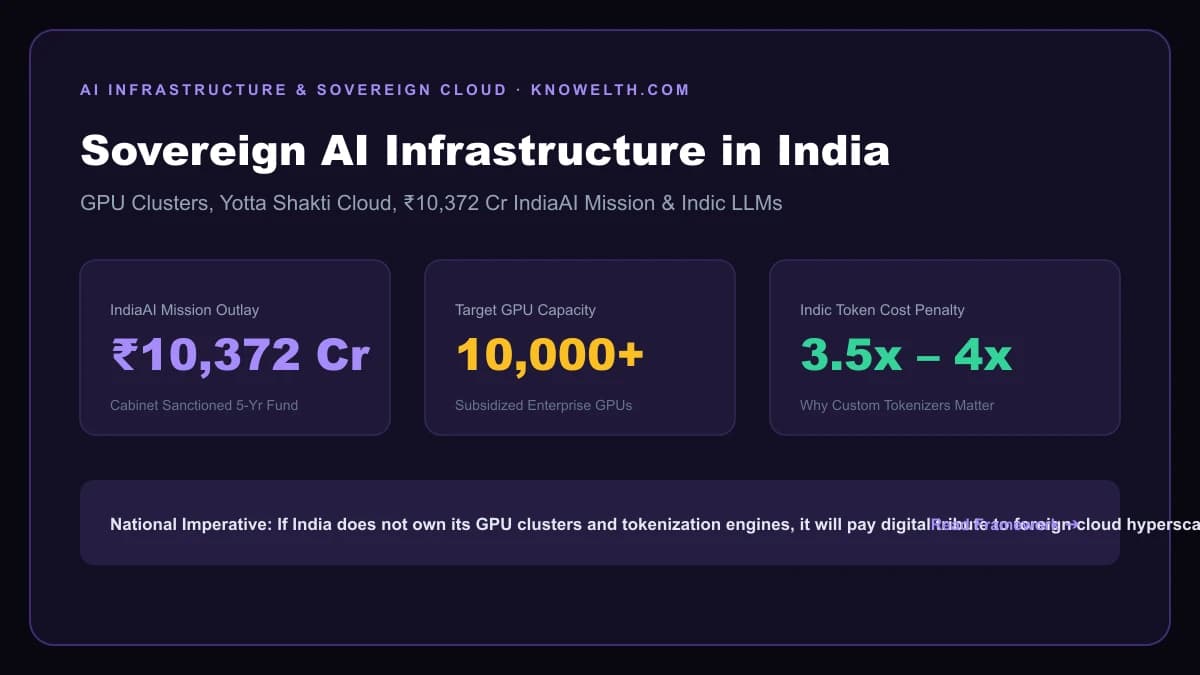
Sovereign AI India: GPU Cloud & Indic LLMs
Sovereign AI Infrastructure in India: GPU Clusters, Yotta Shakti Cloud, and Indic LLMs Quick Summary: In the global race for artificial intelligence hegemony, computing power has superseded crude oil …
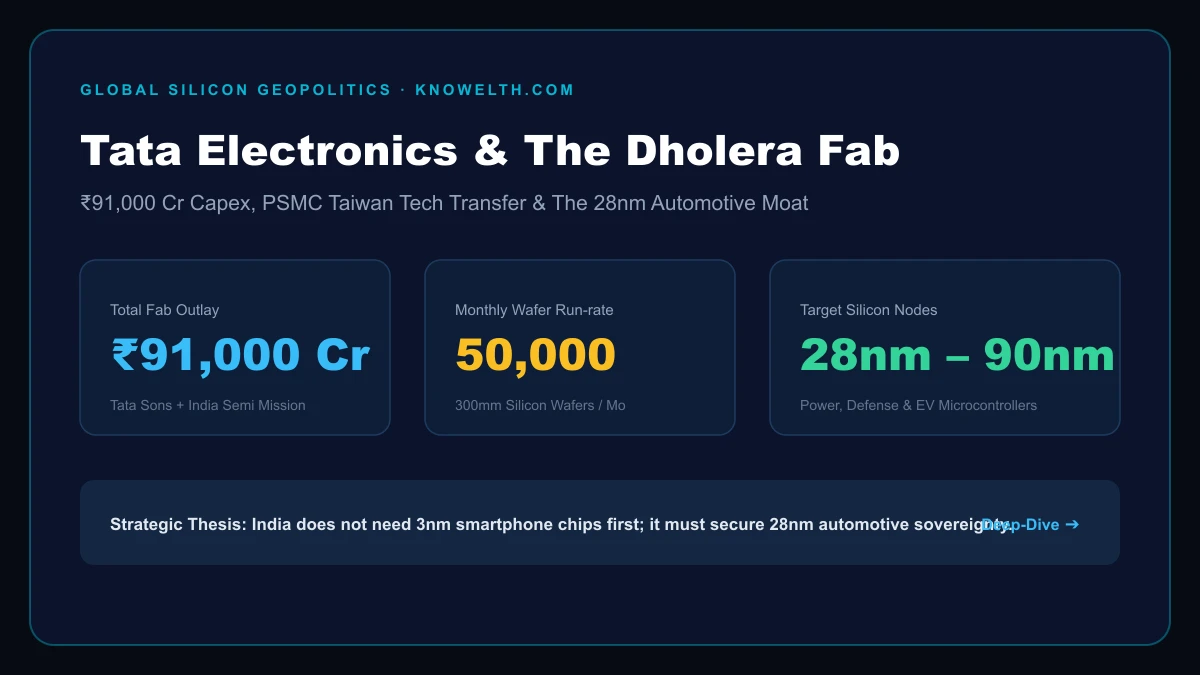
Tata Electronics & Dholera Fab: India's Chip Ambition
Tata Electronics & The Dholera Fab: Can India Break Taiwan's Semiconductor Monopoly? Quick Summary: In the arid plains of Dholera Special Investment Region (SIR) in Gujarat, Tata Electronics, in techn…

System 2 AI Architectures, NVIDIA's $500B Infrastructure Alliance, and Industrial Physical AI Scale-Up
System 2 AI Architectures, NVIDIA's $500B Infrastructure Alliance, and Industrial Physical AI Scale-Up The artificial intelligence ecosystem is undergoing a fundamental structural transformation th…