Together AI's $800M Raise, Striding AI's 'Physical AI' Launch, and South Korea's $584B Alliance

Together AI's $800M Raise, Striding AI's 'Physical AI' Launch, and South Korea's $584B Alliance
Three July 2026 developments define the capital and hardware escalation underlying the AI race. Together AI's $800M raise (at $3.5B valuation) validates open-source AI cloud infrastructure as a distinct investable market; Striding AI's stealth exit commercialises fleet-scale Physical AI — coordinated multi-robot intelligence trained on generalised world models; and South Korea's $584B public-private semiconductor mega-alliance — the largest industrial investment in any country's history — locks in Samsung and SK Hynix's dominance in High-Bandwidth Memory for the next decade.
🤖 Together AI — The Open-Source AI Cloud Infrastructure Market
Why Open-Source AI Infrastructure Is a Distinct Business
The AI model market has bifurcated into two distinct segments:
| Segment | Examples | Pricing Model | Enterprise Control |
|---|---|---|---|
| Closed-source API | OpenAI GPT-4.5, Anthropic Claude, Google Gemini | Per-token | Low (no weight access, no deployment control) |
| Open-weight models on cloud | Llama 4, Gemma 4, DeepSeek V3, Mistral | Per-token or per-hour GPU | High (own deployment, fine-tune, data stays private) |
| Open-weight models, self-hosted | Llama 4, Gemma 4 (self-managed) | $0 per token (hardware only) | Maximum |
Together AI sits in the middle segment — providing the cloud infrastructure optimised specifically for running open-weight models, serving enterprises that want: (a) data privacy (weights and data stay in Together's managed environment, not OpenAI/Google's), (b) model flexibility (swap Llama for Gemma for DeepSeek without re-engineering), (c) cost reduction (Together AI's inference pricing is 60–80% cheaper than equivalent OpenAI API calls for comparable open models).
Together AI's Business Model and Competitive Position
Together AI vs Competitors (July 2026):
| Platform | Specialty | Llama 4 405B Price (per 1M output tokens) | GPU Infrastructure |
|---|---|---|---|
| Together AI | Open-model optimised cloud | $3.50 | NVIDIA H100/H200 clusters |
| Fireworks AI | Speed-optimised inference | $4.10 | H100 clusters |
| Anyscale | Ray-based distributed inference | $5.20 | H100/A100 |
| Replicate | Developer-focused model hosting | $7.80 | H100/A100 |
| OpenAI API (GPT-4.5 equivalent) | Closed-source | $15.00 | Proprietary |
Together AI's proprietary inference engine — the technical moat: Together AI's "Kairos" inference engine achieves lower per-token costs than competitors through:
- Continuous batching — rather than waiting for a full batch to assemble, Kairos dynamically slots new requests into in-flight GPU computation, improving GPU utilisation from ~55% to ~87%
- Speculative decoding — a smaller "draft" model predicts 4–8 tokens ahead; the full model verifies in parallel rather than sequentially, reducing effective inference latency by ~30%
- Kernel-level optimisation — custom CUDA kernels for specific open-model architectures (Llama, Mistral, Gemma attention patterns) rather than generic transformer kernels
The $800M round — terms and valuation:
- Valuation: $3.5B post-money (up from $1.25B at Series B in 2024)
- Lead investors: Sequoia Capital (led), Tiger Global, Greenoaks Capital
- Use of funds: 60% GPU cluster expansion (targeting 100,000 H100-equivalent GPUs by Q1 2027), 25% inference engine R&D, 15% international expansion (EU sovereign cloud compliance)
🦾 Striding AI — Fleet-Scale Physical AI Architecture
The Transfer Learning Problem in Robotics
The critical bottleneck in physical AI (intelligent robotics) has been the sim-to-real gap: AI models trained in simulation fail when deployed in real physical environments because:
- Simulated physics is perfect; real-world physics is noisy (friction variation, sensor noise, actuator backlash)
- Simulated visual environments are clean; real environments have varied lighting, occlusion, and reflections
- Single-task training overfits: a robot trained to pick a red block fails with a blue block, then fails with a cube
Striding AI's approach — generalised world model for robotics:
| Approach | Technology | Advantage |
|---|---|---|
| Sensor fusion foundation model | Multi-modal transformer trained on vision (RGB + depth) + proprioception + force/torque data simultaneously | Understands 3D physical state without simulation assumptions |
| Real-world dataset | 500M+ robot-hours of teleoperated + autonomous operation data (sourced from undisclosed manufacturing partners) | Eliminates sim-to-real gap — model trained directly on real physics |
| Fleet coordination protocol | Decentralised multi-agent communication protocol (similar to Fleet DDPG with attention communication) | Enables 10–1,000 robots to coordinate without a central server |
| Continuous learning | On-device model updates from fleet experience — individual robots share learned policies without sharing raw data | Fleet improves collectively without data privacy exposure |
Target markets and initial deployments:
| Industry | Application | Robot Type | Fleet Size |
|---|---|---|---|
| Logistics/warehousing | Autonomous sortation + loading dock operations | AMR (autonomous mobile robots) | 100–5,000 |
| Construction | Rebar placement + concrete inspection | Legged robots (quadruped + biped) | 10–200 |
| Mining | Underground ore extraction + tunnel inspection | Specialised wheeled + tracked | 5–100 |
| Manufacturing | Multi-arm assembly coordination | Industrial arms + mobile platforms | 20–500 |
Funding at launch: $95M Series A led by Lux Capital + a16z; $40M strategic investment from Hyundai Motor Group (wanting fleet robotics for their automobile manufacturing plants).
🇰🇷 South Korea's $584B Semiconductor Alliance — HBM Dominance
Enjoyed this post?
Get our weekly digest delivered free.
Why High-Bandwidth Memory Is the Critical AI Hardware Chokepoint
LLM inference requires moving model weights from memory to compute at high speed. The key bottleneck is not floating-point operations per second (FLOPS) — it is memory bandwidth. High-Bandwidth Memory (HBM) is the only memory technology with sufficient bandwidth to feed modern AI accelerators:
Memory technology bandwidth comparison:
| Memory Type | Bandwidth | Capacity per Stack | Who Makes It | Used In |
|---|---|---|---|---|
| DDR5 (standard DRAM) | 89.6 GB/s | 32–64 GB | Samsung, SK Hynix, Micron | CPUs, consumer PCs |
| GDDR7 (graphics) | 1,152 GB/s | 24 GB | Samsung, SK Hynix | Gaming GPUs |
| HBM3 | 819 GB/s per stack | 24 GB | Samsung, SK Hynix | Nvidia H100/H200 |
| HBM3e | ~1,200 GB/s per stack | 36 GB | SK Hynix (dominant) | Nvidia B200, GB200 |
| HBM4 (2026 production) | ~2,000 GB/s per stack | 48 GB | SK Hynix + Samsung | Next-gen AI accelerators |
South Korea's HBM market dominance:
- SK Hynix: 53% of global HBM production (dominant supplier for Nvidia H100/H200/B200)
- Samsung: 38% of global HBM (growing; recently qualified for Nvidia's supply chain after yield improvements)
- Micron (US): 9% (small but growing, focus on HBM3e for AMD MI300X)
The $584B Alliance — Structure and Goals
Capital allocation (President Lee Jae Myung's announcement):
| Category | Allocated Capital | Timeline | Specific Projects |
|---|---|---|---|
| New fab construction (SW region) | $220B | 2026–2034 | 4 new fabs in Cheongju/Icheon cluster expansion (Samsung); Yongin M16 expansion (SK Hynix) |
| Advanced packaging clusters | $85B | 2026–2030 | CoWoS-equivalent HBM packaging near Seoul; 2.5D/3D stacking infrastructure |
| HBM4/HBM4e R&D | $120B | 2026–2035 | HBM4 (2026) → HBM4e (2028) → next-generation (2032) |
| Green data centre construction | $95B | 2027–2033 | AI-native data centres with co-located semiconductor R&D |
| Talent development | $34B | 2026–2035 | 100,000 semiconductor engineers over 10 years; 5 new university campuses |
| Government infrastructure | $30B | 2026–2030 | Power grid expansion, water infrastructure, transportation (new freight rail to SW cluster) |
The "triple axis" strategic rationale: President Lee framed the alliance around three interdependent national priorities:
- Semiconductors — HBM supply chain; foundry capacity in non-TSMC risk mitigation
- Physical AI — domestic robot manufacturing powered by Korean HBM and AI chips
- Green energy data centres — Korean-built, Korean-powered AI infrastructure for sovereign cloud
Geopolitical context: South Korea's alliance is a direct response to the US CHIPS Act ($52.7B), Taiwan's chip sovereignty investments, and China's own $41B National Integrated Circuit Industry Investment Fund III. In the event of cross-strait military conflict affecting TSMC, South Korean fabs are the only Western-aligned alternative with sufficient scale.
📌 The Bottom Line
- together-ai-800m-open-source-cloud: $800M at $3.5B valuation (from $1.25B in 2024); Kairos inference engine: continuous batching (55%→87% GPU utilisation), speculative decoding (-30% latency), custom CUDA kernels; Llama 4 405B: $3.50/1M tokens (vs OpenAI $15 equivalent); 60% GPU capex ($100K H100-equivalent by Q1 2027), 25% R&D, 15% EU expansion; enterprise migration driver: 60-80% cheaper + data privacy + model swap flexibility vs closed-source APIs.
- striding-ai-fleet-robotics: $95M Series A (Lux + a16z) + $40M Hyundai strategic; multi-modal world model: RGB/depth + proprioception + force/torque fusion transformer; 500M+ real-robot-hours training data (no simulation dependency); decentralised fleet coordination (10-1,000 robots, no central server); continuous learning: individual robots share policies without raw data (privacy-preserving); targets: logistics (100-5,000 AMRs), construction (legged robots), mining, manufacturing.
- south-korea-584b-semiconductor: $584B total: $220B 4 new SW-region fabs, $85B CoWoS-equivalent HBM packaging, $120B HBM4/4e R&D, $95B green AI data centres, $34B talent (100K engineers/10 years), $30B infrastructure; SK Hynix 53% + Samsung 38% = 91% global HBM share; HBM bandwidth: DDR5 89GB/s → HBM3e 1,200GB/s → HBM4 2,000GB/s; "triple axis": semiconductors + physical AI + green data centres; TSMC contingency: only Western-aligned alternative at scale in Taiwan-conflict scenario.
📬 Stay Updated
Get the best of AI & technology delivered to your inbox every week. Subscribe to our free newsletter →
Disclosure: This post contains affiliate links. If you purchase through our links, we earn a small commission at no extra cost to you. We only recommend products we believe in.
Technical architecture teardowns, artificial intelligence evaluations, and software benchmarks published on Knowelth reflect independent developer testing and publicly available documentation. We maintain complete editorial independence from vendor sponsorships. Read our Editorial Policy.
Enjoyed this post?
Get our weekly digest delivered free.
Share this post:
Knowelth is reader-supported. We may earn a commission from links in this article at no extra cost to you. Read our disclosure.
Related Posts
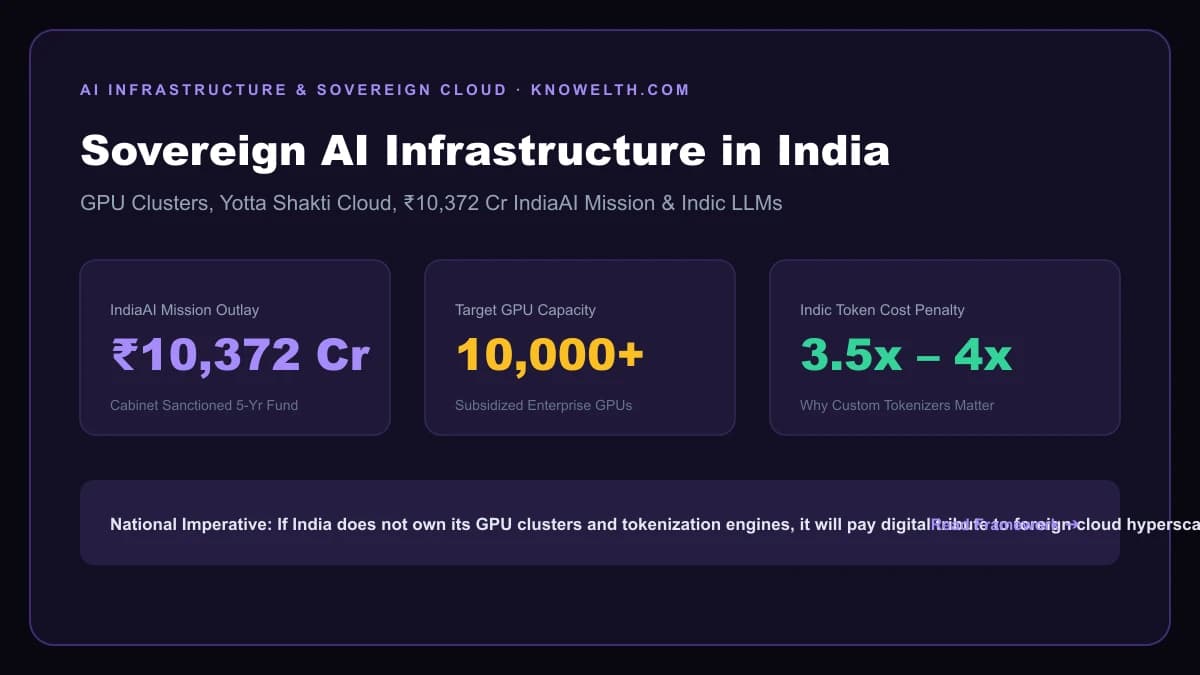
Sovereign AI India: GPU Cloud & Indic LLMs
Sovereign AI Infrastructure in India: GPU Clusters, Yotta Shakti Cloud, and Indic LLMs Quick Summary: In the global race for artificial intelligence hegemony, computing power has superseded crude oil …
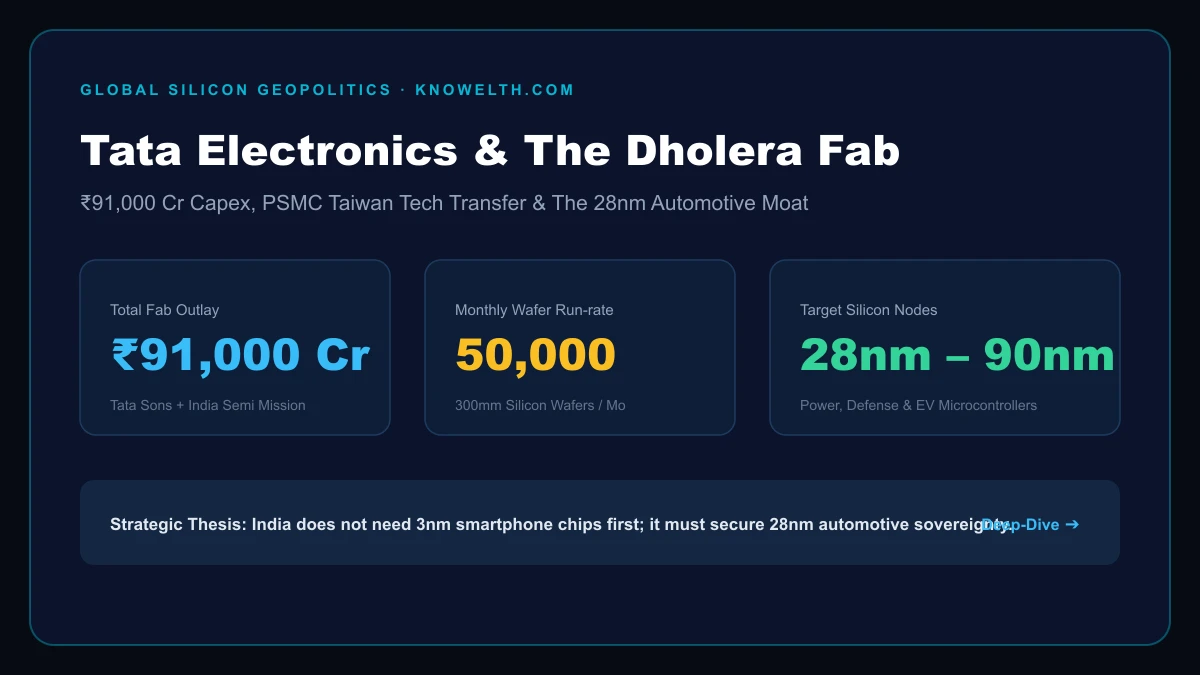
Tata Electronics & Dholera Fab: India's Chip Ambition
Tata Electronics & The Dholera Fab: Can India Break Taiwan's Semiconductor Monopoly? Quick Summary: In the arid plains of Dholera Special Investment Region (SIR) in Gujarat, Tata Electronics, in techn…

System 2 AI Architectures, NVIDIA's $500B Infrastructure Alliance, and Industrial Physical AI Scale-Up
System 2 AI Architectures, NVIDIA's $500B Infrastructure Alliance, and Industrial Physical AI Scale-Up The artificial intelligence ecosystem is undergoing a fundamental structural transformation th…