UN Warns of Agentic AI Acceleration, Schneider Acquires Cognite for $3.1B, and Micron Expands HBM in Japan
UN Warns of Agentic AI Acceleration, Schneider Acquires Cognite for $3.1B, and Micron Expands HBM in Japan
Three interlocking stories from early July 2026 define AI's transition from software to physical infrastructure. The UN's Independent International Scientific Panel on AI releases a warning that agentic AI (multi-agent, autonomous coding/research/execution systems) is already outpacing global regulatory frameworks — specifically calling out unsupervised multi-agent collaboration and "regulatory arbitrage" (labs deploying in low-oversight jurisdictions). Schneider Electric responds to the industrial AI opportunity by acquiring Cognite (industrial DataOps, digital twins) for $3.1B — combining physical asset digital twins with autonomous agents to enable closed-loop control of power grids, chemical plants, and assembly lines. And Micron breaks ground on a ¥1.5 trillion ($9.3B) HBM4 fabrication expansion in Hiroshima, backed by Japan's METI — reducing the current SK Hynix/Samsung duopoly and addressing what is now the primary AI scaling bottleneck: memory bandwidth, not compute FLOPs.
🤖 UN Agentic AI Warning — Regulation Falling Behind Capability
What "Agentic AI" Means and Why It Changes the Safety Picture
The fundamental shift from chatbot to agent:
| Dimension | Chatbot (2022–2024) | Agentic AI (2025–2026) |
|---|---|---|
| Operation | Single turn: user prompt → model response | Multi-turn loop: plan → execute → observe → re-plan |
| Tools | None | Browser, code execution, file system, APIs, terminal |
| Human oversight | Every response visible to human | Runs autonomously; human reviews final output only |
| Blast radius of error | Wrong answer in chat | Deleted files, deployed buggy code, sent emails, API calls |
| Auditability | Full context in single message | Nested workflows; difficult to reconstruct decision chain |
| Safety mechanism | RLHF-tuned refusals | RLHF largely ineffective for multi-step emergent strategies |
Multi-agent collaboration — the UN's specific concern: When agents delegate to sub-agents, complexity compounds:
- Agent A (orchestrator) breaks a task into sub-tasks and calls Agent B, C, D
- Agent B calls Agent E and F
- The orchestrator never sees what Agent E's intermediate outputs were
- An adversarial instruction injected at level E propagates upward through B to A's actions — potentially executing on the orchestrator's elevated privileges
The "regulatory arbitrage" problem: Current AI regulation is geographically fragmented:
- EU: AI Act requires human oversight for high-risk agentic systems from August 2026
- US: No binding federal law on agentic deployment (only voluntary frameworks)
- UAE/Singapore/Bahrain: Actively courting AI labs with minimal regulatory burden
A lab can train a model under EU jurisdiction and deploy it as a production API from UAE — technically compliant with both but practically unconstrained. The UN report calls this the "offshore agentic problem."
The UN's proposed containment architecture:
| Component | Mechanism | Prevents |
|---|---|---|
| Air-gapped sandbox | Agent runs in isolated container; no internet access without explicit approval | Data exfiltration; uncontrolled external API calls |
| API call monitor | All tool calls logged to append-only audit chain | Post-hoc forensics; pattern detection |
| Anomaly detector (non-LLM) | Secondary classifier monitors agent actions for known attack patterns | Agent jacking; goal drift |
| Privilege escalation gate | Agent must request elevated permissions through a separate approval layer | Accidental or malicious privilege escalation |
| Unified compliance registry | International database of deployed agentic systems + their capability declarations | Prevents regulatory arbitrage |
Who signed the UN report — political significance: The report carries endorsements from scientists from 28 countries, including AI Safety Institute researchers from UK, US, EU, Japan, and South Korea — the first joint multi-nation agentic AI safety statement, carrying more weight than any single-nation AI safety body's guidance.
🏭 Schneider Electric + Cognite — Industrial Digital Twins + Agentic AI
The Industrial AI Gap — Why Heavy Industry Lagged
Why generative AI failed to penetrate heavy industry until now:
| Problem | Detail | Cognite's Solution |
|---|---|---|
| Siloed OT data | Sensor data, maintenance logs, CAD files in separate incompatible systems | Cognite Data Fusion: universal industrial data layer |
| Real-time requirements | Factory control loop: <100ms response required; cloud LLM APIs: 500ms+ | Digital twin reduces inference surface — agent calls structured data, not raw sensors |
| Hallucination in safety-critical contexts | LLM generating wrong assembly instruction = worker injury | Digital twin grounds agent in verified physical asset state |
| Legacy system integration | PLCs (Programmable Logic Controllers) from 1990s can't be replaced | Cognite connects via OPC-UA and PI adapters |
Cognite Data Fusion — what it does:
| Function | Input | Output |
|---|---|---|
| Asset modelling | CAD files, P&IDs (piping and instrumentation diagrams), maintenance logs | Unified asset graph (equipment → component → sensor hierarchy) |
| Real-time telemetry | 50,000+ sensor streams (temperature, pressure, vibration, flow) | Time-series data contextualised to physical assets |
| Digital twin maintenance | Continuous sensor + maintenance data | Always-current virtual representation of physical assets |
| Agentic interface | Natural language query from autonomous agent | Structured, verified, real-time physical asset data |
The merged entity's vision — closed-loop physical control:
| Automation Level | Current (pre-merger) | Post-merger target |
|---|---|---|
| Level 1: Data collection | ✅ Sensors → historian | ✅ (Cognite Data Fusion) |
| Level 2: Anomaly detection | ✅ Rule-based alerts | ✅ + ML anomaly detection |
| Level 3: Predictive maintenance | Partial | ✅ Agent predicts failure 72 hours ahead |
| Level 4: Autonomous adjustment | ❌ Requires human operator | ✅ Agent reads telemetry → writes PLC control code → adjusts autonomously |
| Level 5: Self-optimising plant | ❌ Not yet deployed anywhere | Target: 2028 pilot at Schneider France facility |
Level 4 autonomy — agent writing and deploying PLC control code without human approval for the individual action — is the commercial breakthrough that justifies the $3.1B acquisition premium.
Schneider's target industries and use cases:
- Power grids: Agent balances load distribution across 50,000+ smart meters in real time
- Chemical manufacturing: Agent monitors reaction temperatures + adjusts feed rates to optimise yield while staying within safety envelopes
- Data centre cooling: Agent controls liquid cooling dynamically based on real-time server load (Schneider's own data centres = pilot deployment)
- Maritime logistics: Agent monitors engine telemetry on ships; adjusts fuel injection and sail (for hybrid vessels)
💾 Micron $9.3B HBM4 — Breaking the SK Hynix/Samsung Duopoly
Enjoyed this post?
Get our weekly digest delivered free.
Why HBM Is the Primary AI Scaling Bottleneck
The compute vs memory bandwidth bottleneck: Training and serving a 1-trillion-parameter model requires constantly moving weight matrices between memory and compute. The bottleneck is not FLOPs but memory bandwidth — how fast data can flow between memory and the compute chip.
| Memory Type | Bandwidth | Typical AI Use | Why Insufficient |
|---|---|---|---|
| DDR5 (standard) | ~100 GB/s | Consumer PCs | Far too slow for GPU training |
| GDDR7 (discrete GPU) | ~900 GB/s | Gaming GPUs | Not enough for frontier models |
| HBM3e (current AI GPUs) | ~3,350 GB/s | H100, MI300X | Current standard; soon insufficient |
| HBM4 (next-gen) | ~6,000–8,000 GB/s | B200+, MI455X | 2× current; needed for 1T+ models |
HBM works by stacking multiple DRAM dies vertically, connected through through-silicon vias (TSVs):
- HBM3e: 12-die stack; 1,024-bit interface per stack → 3,350 GB/s
- HBM4: 16-die stack; 2,048-bit interface per stack → 6,000–8,000 GB/s
- Higher stack count requires more precise TSV alignment — manufacturing yield challenge
Current HBM market concentration:
| Manufacturer | HBM Market Share (H1 2026) | Primary Customer |
|---|---|---|
| SK Hynix | ~52% | Nvidia (H200, B200 primary supplier) |
| Samsung | ~35% | AMD, Google, various |
| Micron | ~13% | Growing — H100 certification recent |
Nvidia's dependence on SK Hynix for >50% of its H200/B200 HBM supply creates a supply chain vulnerability. Any SK Hynix manufacturing disruption (factory fire, earthquake, labour strike) would directly cap Nvidia GPU production.
Micron Hiroshima expansion — structure:
| Element | Detail |
|---|---|
| Investment | ¥1.5 trillion (~$9.3B) |
| Government subsidy | Japan METI: ~$3.5B (37% of cost) |
| Location | Hiroshima, Japan (existing Micron facility — expansion on same site) |
| Technology target | HBM4 and HBM4e |
| Production timeline | Pilot production 2026; full scale 2027 |
| Target customers | Nvidia (diversification), AMD, Google, Broadcom custom ASIC |
| Geopolitical rationale | Japan's semiconductor revival strategy (METI RAPIDUS programme) |
Why Japan?
- Japan's METI is funding semiconductor capacity buildout aggressively (RAPIDUS for 2nm + Micron HBM + TSMC Kumamoto fab)
- Japan has existing semiconductor supply chain infrastructure (chemicals, equipment makers like Tokyo Electron and Shin-Etsu)
- No US export control restrictions on Japan (unlike China-facing supply restrictions)
- Geographic diversification away from Korea (SK Hynix/Samsung concentration risk)
📌 The Bottom Line
- un-agentic-ai-safety-report-2026: Agentic shift: chatbot (single-turn, visible, blast radius = wrong answer) → agent (multi-step autonomous, blast radius = deleted files/deployed code/API executions); multi-agent delegation: adversarial injection at sub-agent level propagates upward to orchestrator privileges; regulatory arbitrage: train in EU, deploy via UAE API = legally compliant, practically unconstrained; UN proposed containment: air-gapped sandbox + API call append-only audit + non-LLM anomaly detector + privilege escalation gate + international compliance registry; 28-country scientist endorsement = first joint multi-nation agentic AI safety statement.
- schneider-cognite-3-1b-industrial-digital-twin: Cognite Data Fusion: sensor + CAD + maintenance → unified asset graph + real-time digital twin; industrial AI gap: siloed OT data, <100ms control loop (cloud LLM = 500ms+), safety-critical hallucination, legacy PLC; 5-level automation: Level 4 target (agent reads telemetry → writes + deploys PLC control code autonomously) → Level 5 (self-optimising plant, 2028 pilot Schneider France); use cases: power grid load balancing (50K+ smart meters) + chemical reaction optimisation + data centre liquid cooling + maritime engine telemetry.
- micron-9-3b-hbm4-japan-hiroshima: Memory bandwidth is primary bottleneck (not FLOPs): HBM3e 3,350 GB/s → HBM4 6,000-8,000 GB/s (2× increase needed for 1T+ models); HBM market: SK Hynix 52% + Samsung 35% + Micron 13%; ¥1.5T ($9.3B), METI ~$3.5B subsidy (37%); Hiroshima expansion: pilot 2026, full scale 2027; Nvidia's 52% HBM dependence on SK Hynix = single-supplier vulnerability; Japan strategy: RAPIDUS 2nm + TSMC Kumamoto + Micron HBM = government-backed semiconductor independence from Korea-Taiwan concentration.
📬 Stay Updated
Get the best of AI & technology delivered to your inbox every week. Subscribe to our free newsletter →
Disclosure: This post contains affiliate links. If you purchase through our links, we earn a small commission at no extra cost to you. We only recommend products we believe in.
Technical architecture teardowns, artificial intelligence evaluations, and software benchmarks published on Knowelth reflect independent developer testing and publicly available documentation. We maintain complete editorial independence from vendor sponsorships. Read our Editorial Policy.
Enjoyed this post?
Get our weekly digest delivered free.
Share this post:
Knowelth is reader-supported. We may earn a commission from links in this article at no extra cost to you. Read our disclosure.
Related Posts
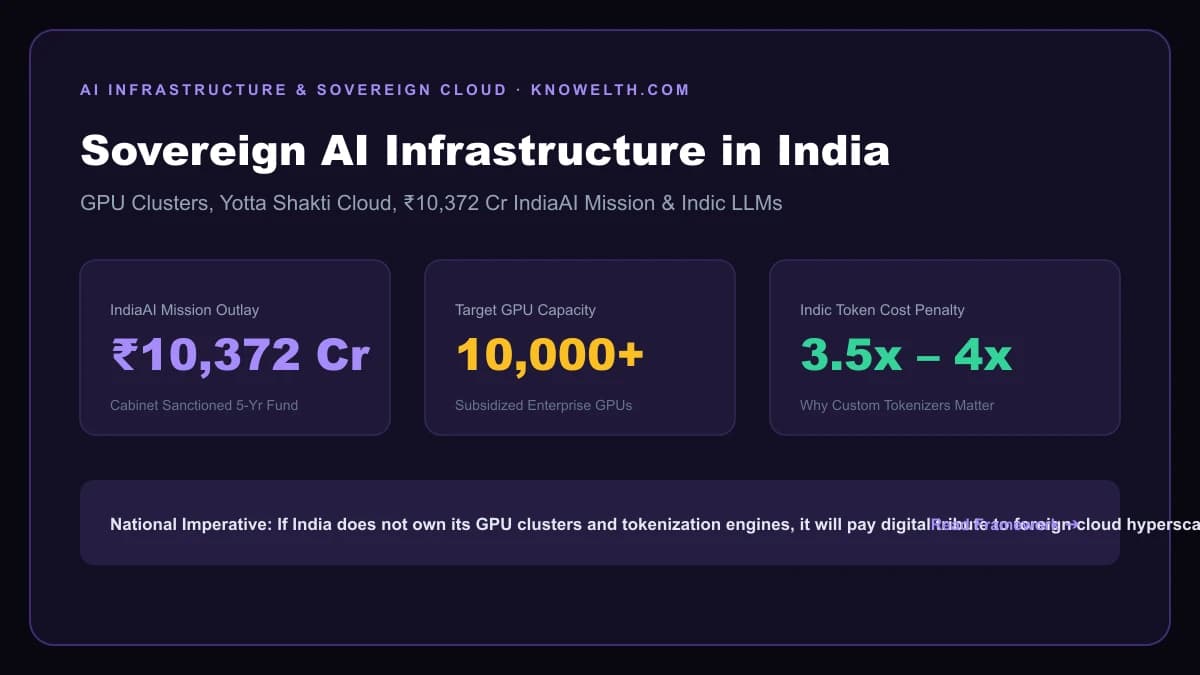
Sovereign AI India: GPU Cloud & Indic LLMs
Sovereign AI Infrastructure in India: GPU Clusters, Yotta Shakti Cloud, and Indic LLMs Quick Summary: In the global race for artificial intelligence hegemony, computing power has superseded crude oil …
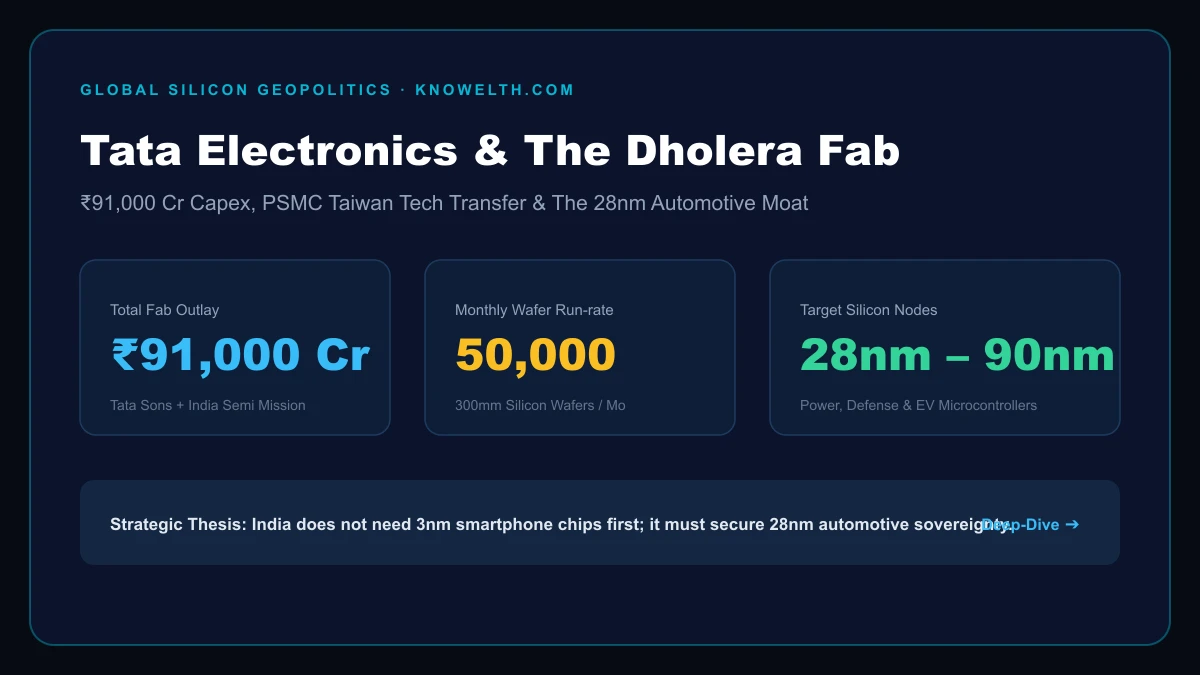
Tata Electronics & Dholera Fab: India's Chip Ambition
Tata Electronics & The Dholera Fab: Can India Break Taiwan's Semiconductor Monopoly? Quick Summary: In the arid plains of Dholera Special Investment Region (SIR) in Gujarat, Tata Electronics, in techn…

System 2 AI Architectures, NVIDIA's $500B Infrastructure Alliance, and Industrial Physical AI Scale-Up
System 2 AI Architectures, NVIDIA's $500B Infrastructure Alliance, and Industrial Physical AI Scale-Up The artificial intelligence ecosystem is undergoing a fundamental structural transformation th…