Stone Chronicles: Ellora’s Monolithic Kailasa Temple, Mahabalipuram’s Submerged Ruins, and the Soapstone Sculptures of Halebidu
Stone Chronicles: Ellora’s Monolithic Kailasa Temple, Mahabalipuram’s Submerged Ruins, and the Soapstone Sculptures of Halebidu
Across the Indian subcontinent, ancient and medieval temple complexes serve as permanent books written in stone, capturing the mathematical, geological, and artistic genius of their builders. Rather than mere places of worship, these structures represent structural achievements that pushed the boundaries of ancient engineering and material science. This week, we explore three remarkable heritage sites: the colossal monolithic excavation of Ellora’s Kailasa Temple, the marine archaeological revelations of Mahabalipuram’s submerged ruins, and the microscopic soapstone craftsmanship of Halebidu’s Hoysaleswara Temple.
🏛️ The Monolithic Mastery of Kailasa Temple at Ellora
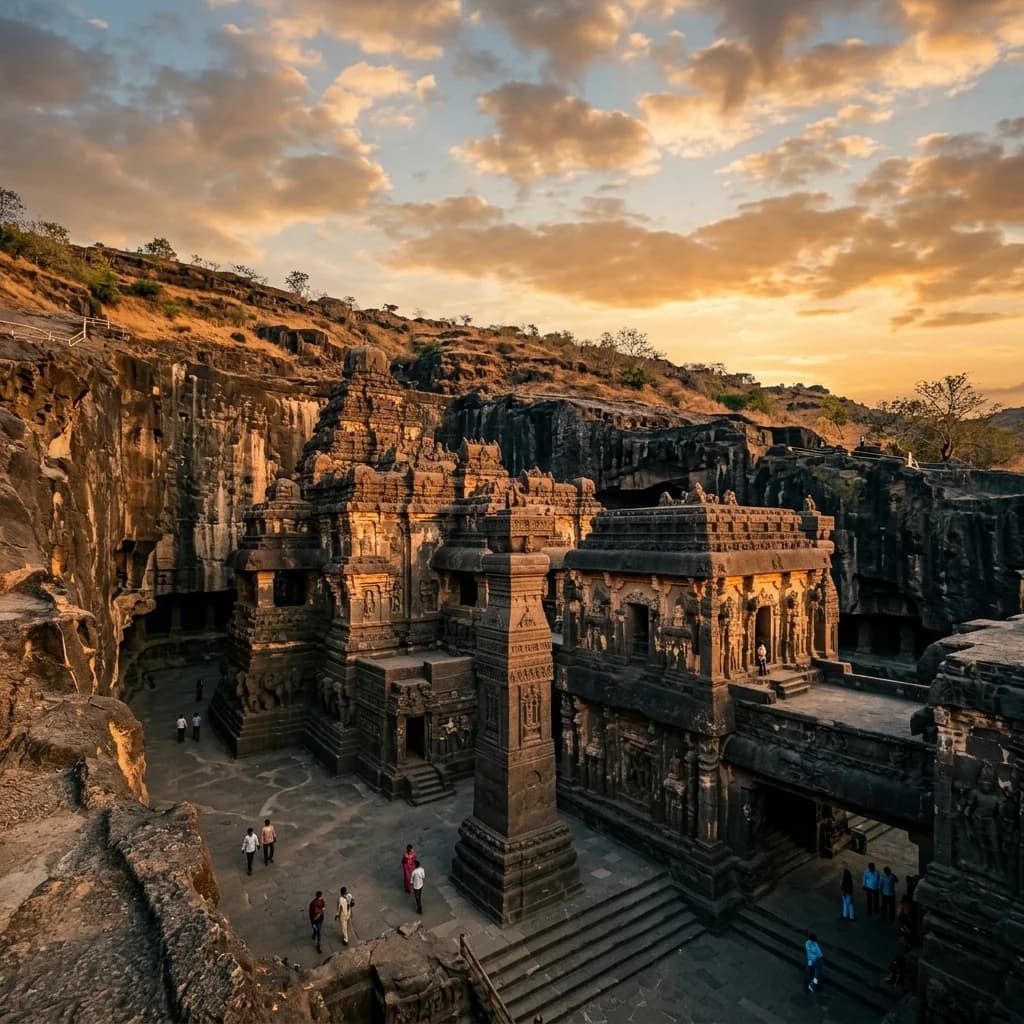
The Kailasa Temple (Cave 16) at the Ellora Caves in Maharashtra stands as one of the most astonishing architectural achievements in human history. Commissioned in the mid-8th century by King Krishna I of the Rashtrakuta Dynasty (reigned c. 756–773 CE), this massive monument was designed to represent Mount Kailash, the sacred Himalayan abode of Lord Shiva. Rather than constructing the temple from the ground up by transporting and assembling stone blocks, the Rashtrakuta engineers achieved the seemingly impossible: they carved a multi-story temple complex out of a single, solid basalt cliff.
The construction of Cave 16 relied on a highly complex "top-down" excavation technique. Starting from the summit of the basalt hill, ancient stonecutters chiseled three deep trenches into the volcanic basaltic rock of the Sahyadri range to isolate a massive block of stone. From this isolated rock mass, artisans worked downward, carving the roof, the upper stories, the pillars, the central sanctum (garbhagriha), the assembly hall (mandapa), and the entry gateway (gopuram) in a continuous, descending sequence. This approach eliminated the need for scaffolding, but it demanded absolute mathematical precision. Because the rock was carved away permanently, any crack in the basalt or error in calculation would have compromised the structural integrity of the entire temple, leaving no room for correction.
Archaeological estimates suggest that between 200,000 and 400,000 tonnes of volcanic basalt were excavated using only iron chisels, hammers, and wooden wedges over several decades. The resulting temple courtyard measures roughly 82 meters by 46 meters, with the central shrine soaring to a height of 32.6 meters. The architectural style blends northern and southern Indian designs, featuring a Dravidian-style Vimana (tower), lathe-turned pillars, and a series of grand galleries.
Among the temple’s most famous carvings is the dramatic high-relief panel depicting the demon king Ravana attempting to shake Mount Kailash, demonstrating a deep understanding of depth, perspective, and narrative tension. The volcanic basalt, part of the ancient Deccan Trap formations, has proved remarkably resilient to weathering, preserving the sharp details of the sculptures and the chisel marks of the medieval builders for over twelve centuries.
🗿 Mahabalipuram's Submerged Secrets: The Legend of the Seven Pagodas
Standing on the edge of the Bay of Bengal in Tamil Nadu, the Shore Temple of Mahabalipuram (Mamallapuram) is a masterpiece of Pallava structural architecture. Built during the reign of King Narasimhavarman II, also known as Rajasimha (reigned c. 700–728 CE), the temple represents a transition from rock-cut cave temples to free-standing masonry structures constructed from dressed granite blocks. However, the Shore Temple is not just a monument on land; it is the focal point of one of India's most fascinating marine archaeological investigations.
For centuries, European mariners and merchants, including the Venetian traveler Marco Polo, referred to Mahabalipuram as the "Seven Pagodas." According to local legends and historical accounts, the Shore Temple was merely the lone survivor of a grand alignment of seven coastal temples. The other six, folklore claimed, were swallowed by the sea during a catastrophic inundation. While modern historians long dismissed these accounts as maritime myths, underwater explorations conducted over the past two decades by the Archaeological Survey of India (ASI) and the National Institute of Oceanography (NIO) have revealed a different reality.
Using side-scan sonar, sub-bottom profiling, and marine diving operations, archaeologists identified a series of submerged, man-made structures on the seabed, located hundreds of meters off the coast at depths of five to eight meters. Divers mapped straight rows of dressed granite blocks, fallen pillars, stone platforms, flights of stairs, and structural foundations covered in marine growth. These submerged ruins run parallel to the current shoreline, confirming the existence of a massive stone complex that was gradually reclaimed by coastal erosion, tectonic activity, and rising sea levels over the last 1,500 years.
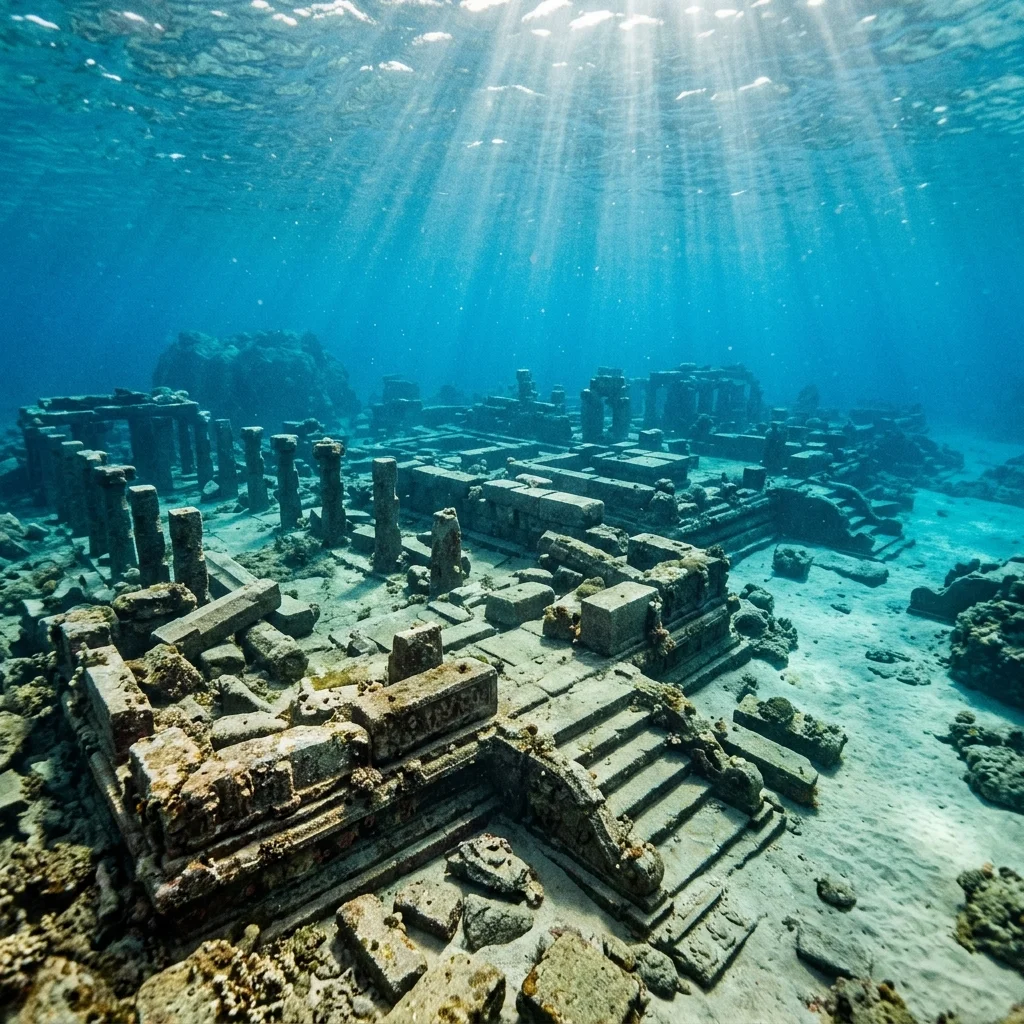
Figure 1: Underwater ruins off the coast of Mahabalipuram, showing submerged granite blocks and structures.
Furthermore, recent excavations and dating of materials near the Shore Temple have uncovered pottery and structural remains dating back to the 1st century CE. This suggests that before the Pallavas built their granite monuments, Mahabalipuram was already a major Roman trade port in the early historic period. The catastrophic Indian Ocean tsunami of December 2004 briefly pulled back the coastline, exposing several massive stone sculptures, including a monolithic lion and elephant, further validating the presence of a vast, partially submerged archaeological landscape.
🔱 The Soapstone Sculptures of Halebidu's Hoysaleswara Temple
In the Hassan district of Karnataka, the Hoysaleswara Temple of Halebidu stands as the peak of the Hoysala Empire's artistic output. Commissioned around 1121 CE by Ketamalla, a commander under the Hoysala King Vishnuvardhana, the temple served the imperial capital of Dwarasamudra (later named Halebidu, meaning "the old ruins," after being twice plundered by the Delhi Sultanate in the 14th century). Designated as a UNESCO World Heritage Site in 2023 as part of the "Sacred Ensembles of the Hoysalas," the temple is renowned for having the most detailed stone carvings in the world.
The secret behind the extraordinary detail of Hoysala carvings lies in the material selected by the master builders: chloritic schist, commonly known as soapstone. Unlike granite, which is extremely hard and prone to fracturing under fine tools, soapstone is relatively soft and talc-like when first quarried. This allowed Hoysala sculptors to treat the stone like wood, carving microscopic details with fine iron chisels—including hollowed-out spaces, individual beads on jewelry chains, fingernails, hair braids, and delicate floral scrolls. Over time, upon exposure to the atmosphere, the chloritic schist undergoes a chemical hardening process, transforming the soft carvings into durable, rock-hard stone.
The architectural layout of the Hoysaleswara Temple is a double temple (dvikuta) design, featuring two identical shrines dedicated to the Hoysaleswara and Santaleswara Shiva lingas. The temple is built upon a star-shaped, raised stone platform (jagati) that mirrors the stellate plan of the main structures. This jagged, star-shaped geometry was not merely aesthetic; it strategically maximized the surface area of the exterior walls, creating dozens of angled projections that allowed sculptors to display high-relief carvings in natural light and shadow throughout the day.
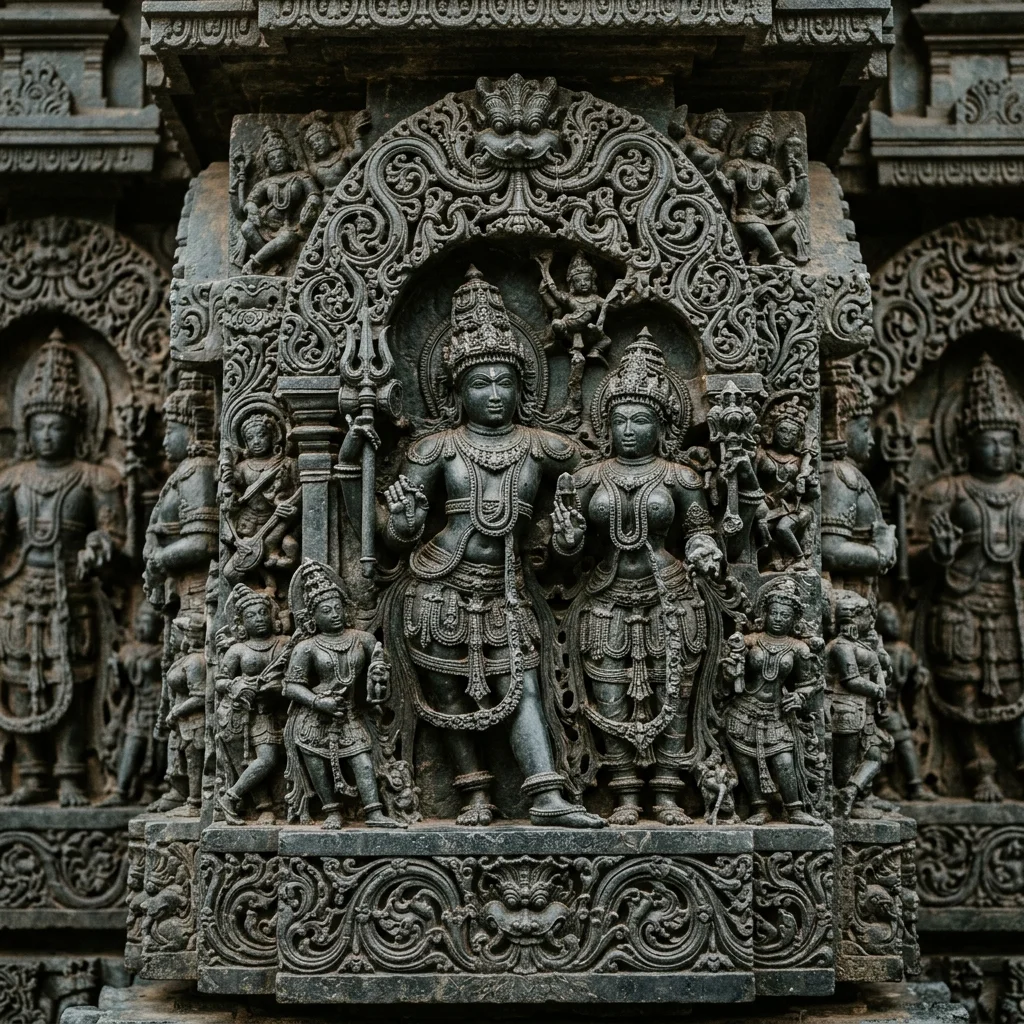
Figure 2: Architectural details and intricate high-relief carvings at Hoysaleswara Temple, Halebidu.
Running along the base of the exterior walls are horizontal bands of friezes, featuring hundreds of unique elephants (representing stability and strength), lions (courage), horses (speed), and narrative panels depicting episodes from the Ramayana, Mahabharata, and Bhagavata Purana. Above these bands are the large sculpture panels, which depict deities and celestial figures (madanikas) adorned with jewelry so intricate that it is carved in three dimensions, detached from the background stone. The interior of the temple is equally impressive, featuring highly polished, lathe-turned pillars that appear to have been turned on a modern machine, showcasing the mechanical ingenuity of the 12th-century Hoysala engineers.
📌 The Bottom Line
- ellora-kailasa-temple: Carved entirely top-down from a single basalt cliff, the Kailasa Temple represents a triumph of monolithic engineering and spatial planning.
- mahabalipuram-submerged-ruins: Marine archaeology off the coast of Tamil Nadu has transformed the legend of the "Seven Pagodas" into scientific fact, revealing a vast submerged harbor city.
- halebidu-soapstone-carvings: The Hoysaleswara Temple utilizes the unique properties of chloritic schist soapstone to achieve the most intricate, micro-carved architectural details in ancient India.
Disclaimer: The information provided in this post is for educational and informational purposes only. It is not intended to be a substitute for professional historical or archaeological advice. Always consult official academic and heritage preservation sources for detailed scholarly inquiries.
Enjoyed this post?
Get our weekly digest delivered free.
Share this post:
Knowelth is reader-supported. We may earn a commission from links in this article at no extra cost to you. Read our disclosure.
Related Posts
Stone Chronicles of Sovereignty and Democracy: The Epigraphic Legacy of Aihole's Meguti Temple, Uttiramerur's Assembly Inscriptions, and the Royal Reliefs of Hampi's Hazara Rama
Stone Chronicles of Sovereignty and Democracy: The Epigraphic Legacy of Aihole's Meguti Temple, Uttiramerur's Assembly Inscriptions, and the Royal Reliefs of Hampi's Hazara Rama Across the diverse lan…
Monolithic Cliffs, Alpine Spires, and Chariots of Stone: The Architectural Feats of Dhamnar, Baijnath, and Melkadambur
Monolithic Cliffs, Alpine Spires, and Chariots of Stone: The Architectural Feats of Dhamnar, Baijnath, and Melkadambur Across the vast geographical expanse of the Indian subcontinent, ancient and medi…
Sacred Corridors, Interlocking Stone Chains, and Thousand-Pillar Sanctuaries: The Architectural Marvels of Rameswaram, Kanchipuram, and Moodabidri
Sacred Corridors, Interlocking Stone Chains, and Thousand-Pillar Sanctuaries: The Architectural Marvels of Rameswaram, Kanchipuram, and Moodabidri Across the Indian subcontinent, sacred architecture r…