Renewable Cancer Immunotherapy, Sunlight-to-UV Upconversion, and Ultrafast Proton Jumping
Renewable Cancer Immunotherapy, Sunlight-to-UV Upconversion, and Ultrafast Proton Jumping
This week has marked major strides across the biological, chemical, and physical sciences, offering new paradigms for medicine and green technology. From the development of a self-renewing cellular platform for custom immunotherapies to a solid-state material that "upgrades" ambient sunlight, researchers are finding innovative ways to harness nature's machinery. At the fundamental scale, the first real-time observation of ultrafast proton transfer resolves a long-standing mystery of molecular choreography, bringing us closer to directing chemical reactions at the femtosecond scale.
🔬 Renewable Immunotherapy: Culturing Off-the-Shelf Cancer-Hunting Cells
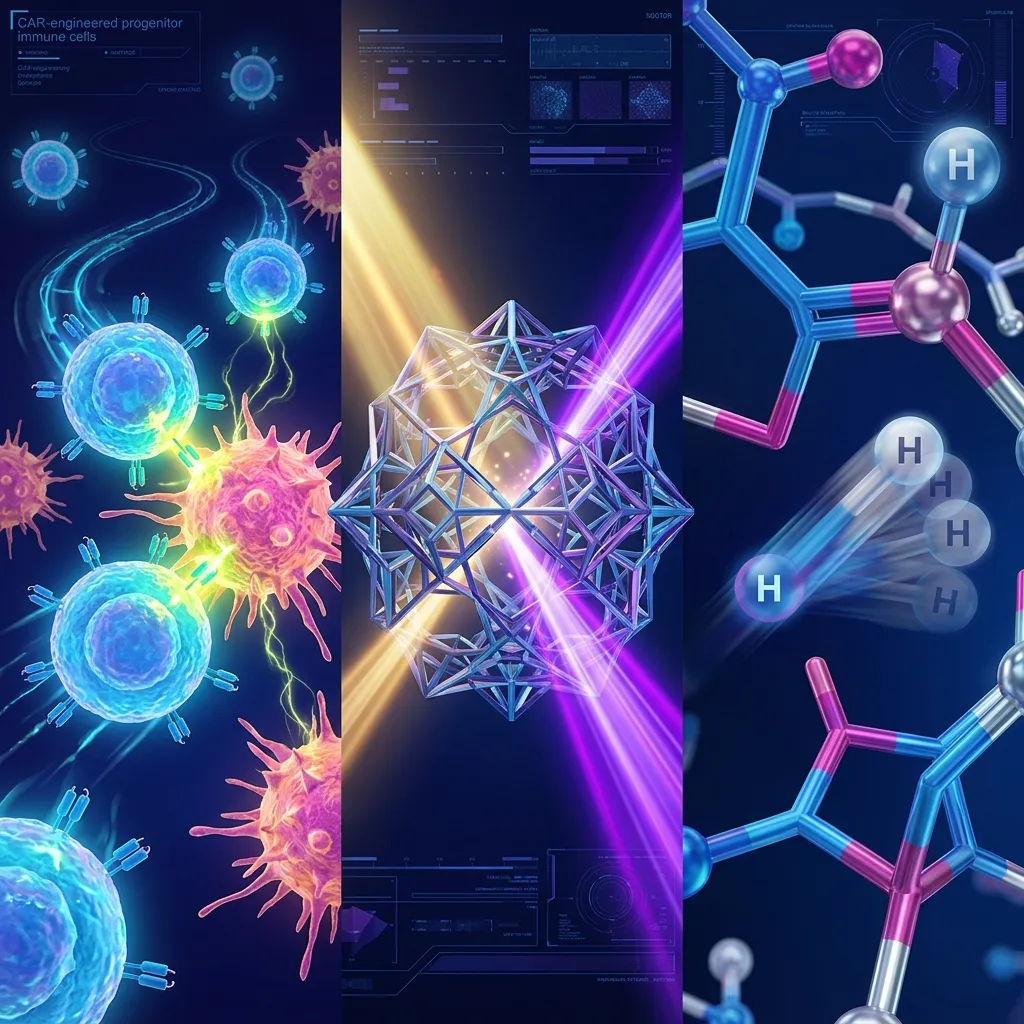
In cellular medicine, researchers have unlocked a method to generate a virtually limitless supply of engineerable immune cells. Cellular immunotherapies, particularly those using chimeric antigen receptors (CAR) to target tumors, have revolutionized cancer treatment. However, macrophage-based therapies (CAR-M) have historically faced a massive roadblock: mature macrophages do not divide in the laboratory and are notoriously difficult to modify genetically. A collaborative study led by corresponding author Qi-Long Ying, MD, PhD, of the Eli and Edythe Broad Center for Regenerative Medicine and Stem Cell Research at USC (USC Stem Cell), alongside researchers from Stanford University and Harvard Medical School, has solved this by targeting the precursor stage of these immune cells. The study was published in the journal Cell.
The team focused on granulocyte-monocyte progenitors (GMPs), the intermediate cells that naturally mature into macrophages, granulocytes, and monocytes. Traditionally, the capacity for indefinite self-renewal was believed to reside almost exclusively in hematopoietic stem cells. The USC-led team challenged this paradigm by identifying myeloperoxidase (MPO) as a critical regulator of progenitor division. By designing a chemically defined culture system that modulates MPO and related signaling pathways, they successfully maintained GMPs in a self-renewing state, allowing them to divide indefinitely in vitro without losing their cellular identity or myeloid potential.
Once this expandable pool of GMPs was established, the researchers used genetic engineering to introduce CAR constructs targeting cancer cells. When these modified GMPs were induced to mature into macrophages, they successfully targeted and engulfed tumor cells in animal models, demonstrating potent anti-tumor activity and restoring immune function. By establishing a scalable, highly engineerable progenitor platform, this research paves the way for "off-the-shelf" macrophage immunotherapies, bypassing the need to harvest and genetically modify cells from patients individually and drastically reducing the cost and complexity of cancer treatment.
💡 Solar Upconversion: Solid-State Chemistry Upgrades Sunlight to UV Rays
At the intersection of materials science and chemistry, researchers at Kyushu University have developed a novel solid-state organic material capable of converting visible light into high-energy ultraviolet (UV) light under natural solar conditions. Ultraviolet light is a crucial driver of industrial photochemistry, including air and water purification, resin curing for 3D printing, and chemical synthesis. However, UV light represents only about 6% of the solar spectrum reaching Earth, whereas visible light makes up over 40%. The ability to upconvert visible photons into UV photons has long been a holy grail for solar energy harvesting. The study, led by Associate Professor Yoichi Sasaki of Kyushu University's Faculty of Engineering, was published in Nature Communications.
The upconversion process relies on a quantum mechanism known as triplet-triplet annihilation (TTA). In TTA, two distinct molecules absorb low-energy visible photons, exciting them to their triplet states. When these two triplet-state molecules collide or interact closely, they pool their energy to generate a single high-energy singlet state, which subsequently relaxes by emitting a high-energy UV photon. While TTA has been successfully demonstrated in liquid solutions, translating it to solid-state materials has been highly inefficient. In solids, the close packing of molecules typically causes the excited triplet states to lose their energy as heat before they can interact—a phenomenon known as self-quenching.
To overcome this structural barrier, the Kyushu team engineered a crystalline organic material with precise molecular architecture. By attaching custom alkyl chains to sp³ hybridized carbon atoms within the acceptor molecules, they created microscopic "molecular spacers." These spacers prevent the molecules from stacking too tightly, reducing thermal dissipation while still allowing the excited triplets to migrate and undergo TTA. The resulting solid-state material achieved a record-breaking 1.9% conversion efficiency under natural outdoor sunlight, maintaining a high fluorescence yield of over 60%. This breakthrough opens up practical, solar-powered chemical synthesis and sterilization technologies, unlocking the untapped potential of natural sunlight.
⚛️ Ultrafast Proton Jumping: Witnessing Molecular Choreography in Real-Time
Deep within the molecular domain, scientists have achieved the first direct, real-time observation of a hydrogen atom—a single proton—"jumping" between positions inside a molecule. Proton transfer is one of the most fundamental reactions in all of chemistry and biology, serving as the basis for enzyme catalysis, acid-base chemistry, and the light-driven energy conversion of photosynthesis. It is also a key mechanism behind spontaneous genetic mutations, occurring when protons jump between DNA base pairs at critical moments during replication. Because this transfer happens on a sub-picosecond timescale, capturing the motion has historically been impossible. A research team led by chemistry professor Munira Khalil at the University of Washington (UW) has successfully mapped this process, publishing their findings in Nature Communications.
The team, including UW researchers Somnath Biswas, Jason Sandwisch, and Robert Weakly, focused on capturing the ultrafast "molecular choreography" using advanced femtosecond vibrational spectroscopy. By hitting a model chemical system with a precise pulse of laser energy, the researchers triggered the proton transfer and probed the structural changes at a resolution of femtoseconds—millionths of a billionth of a second. This allowed them to observe the molecule transforming into its structural "alter ego" as the proton migrated.
Crucially, the study revealed that the proton does not move in isolation. Instead, the transfer is driven by coherent, synchronized vibrations—or "wiggles"—of the surrounding molecular framework. These internal vibrations temporarily contract the distance between the donor and acceptor atoms, lowering the energy barrier and creating a transient hydrogen-bond bridge that allows the proton to jump across. Understanding the cooperative nature of these vibronic motions provides chemists with a blueprint to predict, model, and ultimately control chemical reactions at their most fundamental quantum level, opening new paths for catalysis and molecular design.
📌 The Bottom Line
- renewable-immunotherapy: A defined culture system targeting myeloperoxidase allows granulocyte-monocyte progenitors (GMPs) to self-renew indefinitely, providing a scalable, off-the-shelf platform for CAR-engineered macrophage cancer immunotherapy.
- solar-upconversion: A new solid-state organic material uses triplet-triplet annihilation with precise molecular spacers to convert visible sunlight into high-energy UV light at 1.9% efficiency, enabling solar-driven industrial photochemistry.
- ultrafast-proton-jumping: Researchers captured the real-time transfer of a proton within a molecule on a femtosecond scale, demonstrating how synchronized molecular vibrations facilitate the atomic jump.
References & Scientific Literature:
- Ying Q-L, et al. "Expansion and CAR engineering of granulocyte-monocyte progenitors for cellular immunotherapy." Cell, June 2026. DOI: 10.1016/j.cell.2026.05.012.
- Sasaki Y, et al. "Solid-state visible-to-UV upconversion under natural sunlight using triplet-triplet annihilation." Nature Communications, June 23, 2026. DOI: 10.1038/s41467-026-72811-3.
- Biswas S, Sandwisch J, Weakly R, Khalil M. "Tracking coherent vibronic and vibrational motions in ultrafast proton transfer." Nature Communications, June 2026. DOI: 10.1038/s41467-026-72661-9.
Enjoyed this post?
Get our weekly digest delivered free.
Share this post:
Knowelth is reader-supported. We may earn a commission from links in this article at no extra cost to you. Read our disclosure.
Related Posts

Targeted Protein Degrader Rewrites Leukemia Drug Sensitivity, Oxytocin Selectively Modulates Low Trust, and Siberian Permafrost Methane Surge Doubles
Targeted Protein Degrader Rewrites Leukemia Drug Sensitivity, Oxytocin Selectively Modulates Low Trust, and Siberian Permafrost Methane Surge Doubles Scientific discovery rarely moves in a single dire…
Global Research Breakthroughs: HCMI Patient Cancer Organoids, Ultra-Durable Nanochannel Fuel Cells, and 567-Million-Year-Old Deep-Ocean Fossils
Global Research Breakthroughs: HCMI Patient Cancer Organoids, Ultra-Durable Nanochannel Fuel Cells, and 567-Million-Year-Old Deep-Ocean Fossils Across biology, materials physics, and evolutionary pale…
Tumour Organoid Vulnerability Map, 567M-Year-Old Ediacaran Fossils, and NIH's TrialGPT AI Breakthrough
Tumour Organoid Vulnerability Map, 567M-Year-Old Ediacaran Fossils, and NIH's TrialGPT AI Breakthrough Three landmark studies published in the first week of August 2026 span the full breadth of modern…