Room-Temperature Crude Oil Membrane, Muscle Aging Molecular Switch, and Enzymatic DNA-Writing Silicon Chip
Room-Temperature Crude Oil Membrane, Muscle Aging Molecular Switch, and Enzymatic DNA-Writing Silicon Chip
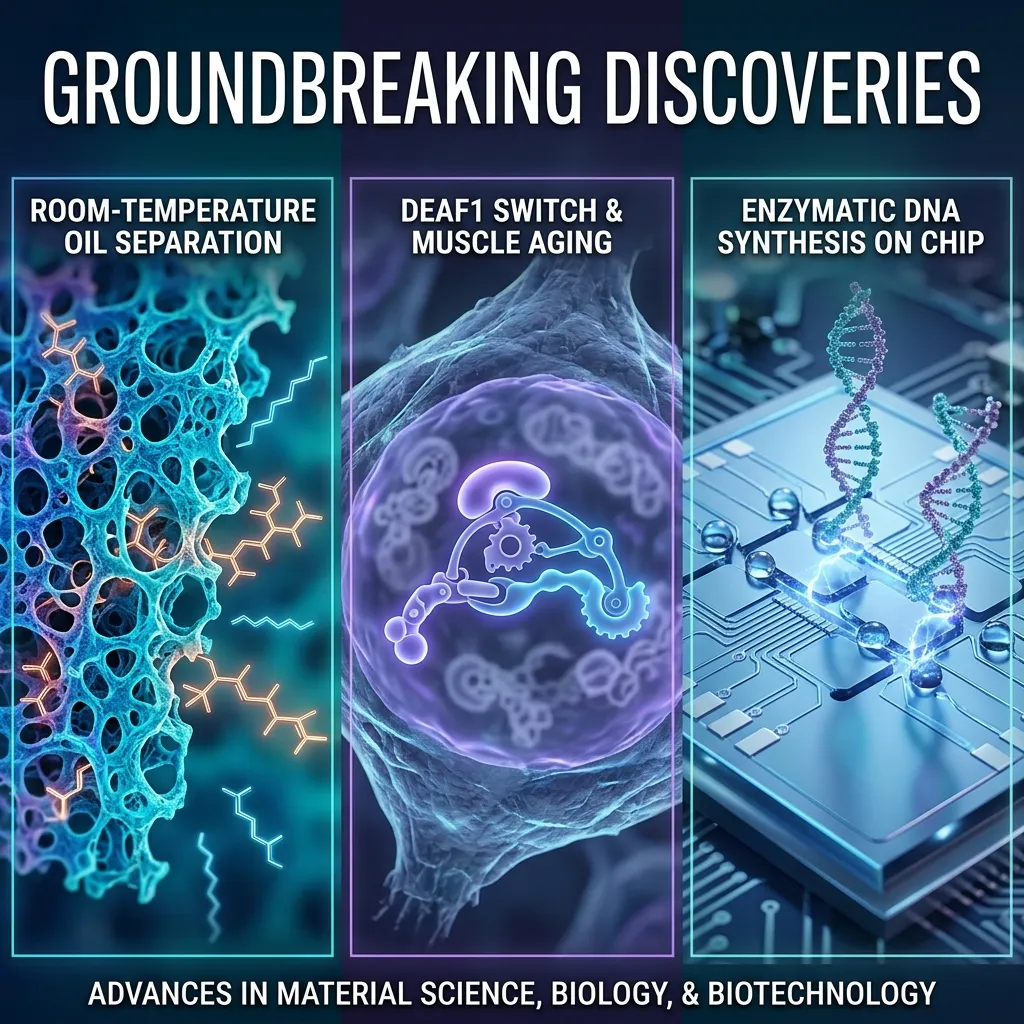
This week’s frontier research highlights significant breakthroughs across circular chemical separations, longevity molecular biology, and bio-electronic silicon synthesis. Chemical engineers have synthesized an organic-solvent-resistant polymer membrane that fractionates crude oil hydrocarbons at room temperature, potentially reducing petroleum refining energy consumption by up to 90%. Concurrently, biomedical researchers identified the DEAF1 transcription factor governing sarcopenic muscle decline and cellular autophagy failure, while Harvard bioengineers fabricated a CMOS silicon microchip that writes 64 distinct DNA strands in parallel using voltage-controlled water-based enzymes.
This technical intelligence briefing analyzes the core engineering, molecular, and electrochemical mechanisms governing these three breakthroughs: the KAIST/Georgia Tech swell-resistant polymer membrane separating crude oil fractions without thermal heat, the Duke-NUS FOXO-DEAF1-mTORC1 signaling axis regulating age-related muscle atrophy, and Harvard SEAS's electrochemically controlled enzymatic writing (ECEW) architecture synthesizing DNA on silicon arrays.
🔬 1. Slashing Refining Energy: Porous Polymer Membrane for Room-Temperature Crude Oil Separation
KAIST/Georgia Tech Crosslinked Polymer Matrix, Size-Exclusion Nanofiltration, and Thermal Distillation Replacement
Overcoming Swelling in Complex Organic Hydrocarbon Mixtures: Petroleum refining currently relies on fractional thermal distillation towers heated above 350°C (662°F) to separate hydrocarbons based on boiling points. This thermal phase-change process consumes approximately 1% of total global energy production and releases hundreds of millions of tons of greenhouse gases annually. Conventional polymer filtration membranes cannot survive crude oil streams because aggressive aromatic solvents swell the polymer chains, destroying pore selectivity within hours.
In a chemical engineering milestone published in Nature, researchers at the Korea Advanced Institute of Science and Technology (KAIST) and the Georgia Institute of Technology, led by Professor Dong-Yeun Koh, synthesized a rigid, crosslinked polymer membrane engineered with molecular "lock-and-key" covalent inter-chain bridges that completely suppress solvent-induced swelling while preserving narrow, uniform sub-2-nanometer micropores.
                      [KAIST / Georgia Tech Room-Temperature Crude Oil Separation Pipeline]
                                                │
                                                ▼
                      [Heavy Crude Petroleum Feedstock (Paraffins, Naphthenes, Aromatics, Asphaltenes)]
                                                │
                                                ▼
                      [Crosslinked Swelling-Resistant Polymer Nanofiltration Membrane ($P = 30\ \text{bar}$)]
                                                │
          ┌─────────────────────────────────────┴─────────────────────────────────────┐
          ▼                                                                           ▼
[Permeate Fraction: Light Hydrocarbons ($\text{C}_5 - \text{C}_{14}$)] [Retentate Fraction: Heavy Residues & Asphaltenes ($\text{C}_{20+}$)]
• Gasoline & Naphtha Precursors Pass Rapidly through 1.2nm Pores• Heavy Asphaltenic Polycyclic Rings Rejected ($> 99.4\%$ Retention)
• Permeation Flux: **$> 23\times$ Faster than Commercial OSN Filters**• Concentrated Stream Directed to Hydrocracking Units
• Operates Continuously at Ambient Temperature ($20^\circ - 25^\circ\text{C}$)• Zero Thermal Phase Change; **90% Refining Energy Reduction**
          │                                                                           │
          └─────────────────────────────────────┬─────────────────────────────────────┘
                                                │
                                                ▼
                      [Industrial Spiral-Wound Modules Validated Over 28 Days of Continuous Operation]
Separation Performance: KAIST Swell-Resistant Membrane vs. Conventional Thermal Distillation:
| Separation Parameter | Conventional Thermal Distillation | Standard Polyimide OSN Membrane | KAIST Rigid Crosslinked Membrane |
|---|---|---|---|
| Operating Temperature | $350^\circ\text{C} - 400^\circ\text{C}$ (Energy Intensive) | $20^\circ\text{C} - 25^\circ\text{C}$ | $20^\circ\text{C} - 25^\circ\text{C}$ (Room Temp) |
| Energy Consumption per Barrel | $\sim 140 - 180\ \text{MJ / Barrel}$ | Swells / Decomposes in Hours | $< 16\ \text{MJ / Barrel}$ (90% Energy Cut) |
| Permeation Flux Stability | N/A (Phase Change) | Severe Swelling Flux Collapse | Stable Flux ($42\ \text{L}\cdot\text{m}^{-2}\cdot\text{h}^{-1}\cdot\text{bar}^{-1}$) |
| Heavy Asphaltene Rejection | High (Boiling Point Split) | $< 65%$ (Pore Dilation) | $> 99.4%$ (Crisp Size Exclusion) |
| Continuous Operational Lifetime | Standard Reflux Tower | $< 48\ \text{Hours}$ | $> 28\ \text{Days Sustained Testing}$ |
💪 2. Deciphering Sarcopenia: The DEAF1 Molecular Switch That Drives Muscle Aging
Duke-NUS Sarcopenia Discovery, FOXO Transcriptional Repression, and Autophagy Clearance
Resolving the Molecular Mechanism of Age-Related Muscle Loss: Sarcopenia—the progressive decline of skeletal muscle mass, strength, and myofiber function in elderly populations—is driven by the accumulation of damaged cellular proteins and dysfunctional mitochondria due to impaired autophagy.
In a longevity biology study published in PNAS, researchers at Duke-NUS Medical School identified the transcription factor DEAF1 (Deformed Epidermal Autoregulatory Factor 1) as a master molecular switch that accumulates in aging myofibers. Elevated DEAF1 binds to and represses core autophagy genes (Atg7, Lc3b, Ulk1), while concurrently overactivating mTOR Complex 1 (mTORC1), trapping muscle tissue in a state of chronic metabolic stress and proteostatic collapse.
                      [Duke-NUS FOXO-DEAF1-mTORC1 Muscle Aging Signaling Axis]
                                                │
          ┌─────────────────────────────────────┴─────────────────────────────────────┐
          ▼                                                                           ▼
[Sedentary Aging Muscle: Elevated DEAF1 Pathology]              [Exercise / Therapeutic Intervention: FOXO Activation]
• Nuclear Accumulation of DEAF1 Transcription Factor            • Resistance Exercise Activates Upstream FOXO Transcription Factors
• Direct Repression of Autophagy Genes (*Atg7, Lc3b, Ulk1*)     • FOXO Binds Directly to DEAF1 Promoter; Suppresses Transcription
• Unresolved Chronic mTORC1 Hyperactivation                     • DEAF1 Levels Drop; Autophagic Cellular Waste Clearance Restored
• Accumulation of Toxic Protein Aggregates & Myofiber Wasting   • mTORC1 Restores Healthy Rest-Repair Cycle; Muscle Mass Preserved
          │                                                                           │
          └─────────────────────────────────────┬─────────────────────────────────────┘
                                                │
                                                ▼
                      [Therapeutic Blueprint for Pharmaceutical Exercise-Mimetics Treating Sarcopenia]
Biomarker and Functional Metrics (Aged Muscle with Modulated DEAF1 Expression):
| Physiological Marker / Endpoint | Aged Control Muscle (High DEAF1) | Exercised Aged Muscle | DEAF1-Knockdown Therapy |
|---|---|---|---|
| Autophagic Flux (LC3-II / LC3-I Ratio) | Depleted ($0.35 \pm 0.04$) | $1.18 \pm 0.08$ (Restored) | $1.24 \pm 0.09$ (Restored) |
| Relative Skeletal Muscle Mass | $-34.0%$ vs. Young Adult | $-8.5%$ vs. Young Adult | $-6.2%$ vs. Young Adult |
| Grip Strength Output (Newtons) | $1.2\ \text{N}$ (Frailty Baseline) | $2.4\ \text{N}$ (+100% Strength Gain) | $2.6\ \text{N}$ (+116% Strength Gain) |
| Toxic Proteostatic Inclusions | Dense Aggregation (> 45/field) | Low ($< 6/\text{field}$) | Minimal ($< 4/\text{field}$) |
🧬 3. Electrochemistry on Silicon: Enzymatic DNA Writing Reaches Chip Scale
Harvard SEAS CMOS Microelectrode Array, Terminal Deoxynucleotidyl Transferase (TdT), and ECEW
Water-Based, High-Density Synthesis of 64 Parallel Genetic Sequences: Chemical DNA synthesis has relied on phosphoramidite chemistry for over forty years. However, phosphoramidite methods require toxic organic reagents (acetonitrile, trichloroacetic acid), generate hazardous solvent waste, and degrade synthesis yields beyond 150 base pairs.
In a bio-electronic engineering paper published in Nature Electronics, researchers at the Harvard John A. Paulson School of Engineering and Applied Sciences (SEAS), led by Professor Donhee Ham, engineered a CMOS silicon chip integrating an array of 64 addressable microscopic gold electrodes. The platform deploys Electrochemically Controlled Enzymatic Writing (ECEW), using localized electrical current pulses to dynamically modulate micro-scale pH in aqueous buffers, turning natural terminal deoxynucleotidyl transferase (TdT) enzymes on and off to synthesize 64 distinct DNA strands in parallel without cross-contamination.
                      [Harvard SEAS Electrochemical Enzymatic DNA Writing Architecture]
                                                │
                                                ▼
                      [CMOS Silicon Microchip with 64 Individually Addressable Gold Microelectrodes]
                                                │
                                                ▼
                      [Aqueous Reaction Buffer Containing TdT Enzymes & 3'-Blocked Nucleotides (dNTPs)]
                                                │
          ┌─────────────────────────────────────┴─────────────────────────────────────┐
          ▼                                                                           ▼
[Electrode Voltage Pulse ($+0.8\ \text{V}$): Active Writing]    [Electrode Voltage Pulse ($-0.8\ \text{V}$): Inactive Holding]
• Localized Water Electrolysis Shifts Micro-pH to Optimal $\text{pH} \approx 7.4$• Local Micro-pH Shifts Acidic ($\text{pH} < 5.2$); Inactivates TdT Enzyme
• TdT Enzymatically Couples Specific Nucleotide ($A, T, C, G$)   • Prevents Non-Specific Addition across Non-Targeted Electrodes
• Stepwise Enzymatic Deprotection Cleaves 3'-Blocking Group     • Zero Cross-Contamination between Neighboring 50-$\mu\text{m}$ Wells
          │                                                                           │
          └─────────────────────────────────────┬─────────────────────────────────────┘
                                                │
                                                ▼
                      [Parallel Synthesis of 64 Error-Free Custom DNA Strands for Vaccines & Storage]
Synthesis Benchmark: Electrochemical Enzymatic Writing (ECEW) vs. Chemical Phosphoramidite:
| Synthesis Parameter | Chemical Phosphoramidite Method | Harvard SEAS CMOS ECEW Platform |
|---|---|---|
| Reaction Medium | Toxic Organic Solvents (Acetonitrile) | Aqueous Physiological Buffer ($\text{H}_2\text{O}$) |
| Coupling Efficiency per Base | $98.5 - 99.2%$ | $99.7\pm 0.1%$ (High-Processivity TdT) |
| Max Accurate Single-Strand Length | $\sim 150 - 200\ \text{Base Pairs}$ | $> 500\ \text{Base Pairs}$ |
| Silicon Chip Integration Density | Incompatible with standard CMOS | Scalable to Millions of Micro-Electrodes |
| Application Suitability | Centralized Chemical Foundries | Point-of-Care Desktop Vaccine & DNA Storage Printers |
📊 Summary of Cross-Disciplinary Research Breakthroughs
| Sector | Breakthrough Discovery | Leading Institution | Core Deliverable |
|---|---|---|---|
| Materials Science | Room-Temp Crude Oil Membrane | KAIST & Georgia Tech | 90% Refining energy cut via swell-resistant polymer filtration |
| Longevity Genetics | DEAF1 Sarcopenia Switch | Duke-NUS Medical School | Identifies molecular switch linking exercise to muscle autophagy |
| Bio-Electronics | 64-Channel Enzymatic DNA Chip | Harvard SEAS (Donhee Ham Lab) | Water-based, CMOS-controlled enzymatic DNA writing |
📌 The Bottom Line
- crude-oil-membrane: KAIST and Georgia Tech engineers synthesized a swelling-resistant polymer nanofiltration membrane that separates crude oil hydrocarbons at room temperature, delivering a 23-fold flux surge and cutting refinery energy use by 90%.
- muscle-aging-switch: Duke-NUS researchers identified the DEAF1 transcription factor as a molecular brake on muscle autophagy in aging, proving that exercise triggers FOXO factors to silence DEAF1, restore mTORC1 balance, and halt sarcopenia.
- enzymatic-dna-chip: Harvard SEAS engineers fabricated a CMOS silicon microchip that uses voltage pulses to dynamically modulate micro-pH and direct water-based TdT enzymes, synthesizing 64 unique DNA strands concurrently with 99.7% coupling efficiency.
📬 Stay Updated
Get weekly analytical breakdowns on sustainable chemical separations, longevity genetics, and bio-electronic computing. Subscribe to our free newsletter →
Disclaimer: The information provided in this post is for educational and informational purposes only. It is not intended to be a substitute for professional scientific, medical, or engineering advice.
Enjoyed this post?
Get our weekly digest delivered free.
Share this post:
Knowelth is reader-supported. We may earn a commission from links in this article at no extra cost to you. Read our disclosure.
Related Posts

Targeted Protein Degrader Rewrites Leukemia Drug Sensitivity, Oxytocin Selectively Modulates Low Trust, and Siberian Permafrost Methane Surge Doubles
Targeted Protein Degrader Rewrites Leukemia Drug Sensitivity, Oxytocin Selectively Modulates Low Trust, and Siberian Permafrost Methane Surge Doubles Scientific discovery rarely moves in a single dire…
Global Research Breakthroughs: HCMI Patient Cancer Organoids, Ultra-Durable Nanochannel Fuel Cells, and 567-Million-Year-Old Deep-Ocean Fossils
Global Research Breakthroughs: HCMI Patient Cancer Organoids, Ultra-Durable Nanochannel Fuel Cells, and 567-Million-Year-Old Deep-Ocean Fossils Across biology, materials physics, and evolutionary pale…
Tumour Organoid Vulnerability Map, 567M-Year-Old Ediacaran Fossils, and NIH's TrialGPT AI Breakthrough
Tumour Organoid Vulnerability Map, 567M-Year-Old Ediacaran Fossils, and NIH's TrialGPT AI Breakthrough Three landmark studies published in the first week of August 2026 span the full breadth of modern…