Rye Pollen Cancer Blockers, Cerebellar Circuit Revisions, and Quantum Light from Layered Crystals
Rye Pollen Cancer Blockers, Cerebellar Circuit Revisions, and Quantum Light from Layered Crystals
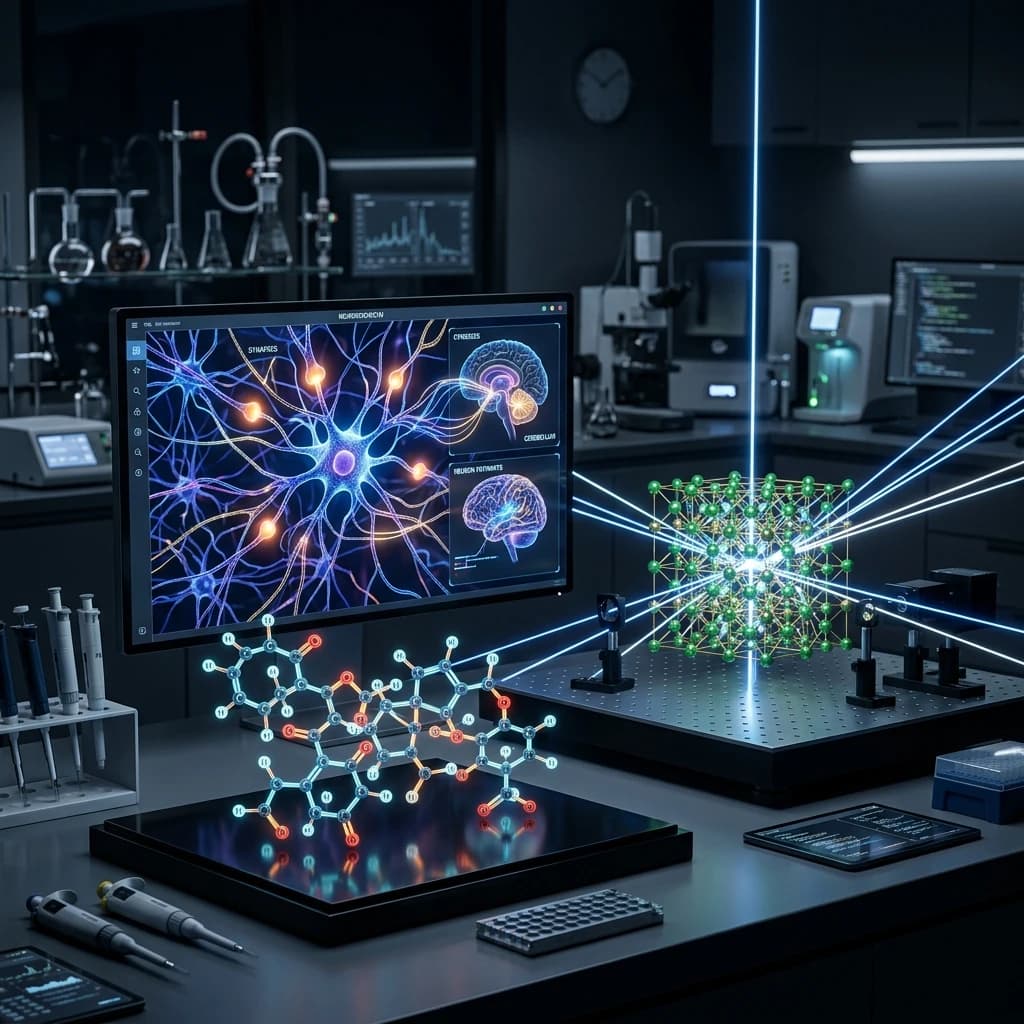
This week's scientific frontier brings together breakthroughs across natural product total synthesis, motor neurocircuitry electrophysiology, and 2D quantum photonics. Organic chemists have synthesized and structural-mapped a long-mysterious antitumor natural product from rye pollen; neuroscientists have overturned a foundational assumption regarding cerebellar cortex Purkinje cell signaling in movement disorders; and solid-state physicists have engineered deterministic single-photon emission in atomically thin 2D layered crystals.
This technical intelligence briefing provides a comprehensive analysis of the core chemical, electrophysiological, and quantum mechanics governing these three discoveries: Northwestern University's total chemical synthesis of secalosides A and B from Secale cereale, Virginia Tech's demonstration of Purkinje-DCN decoupling in cerebellar motor disorders, and the discovery of room-temperature phosphorus-vacancy single-photon emitters in 2D van der Waals $\text{ZnPS}_3$ crystals.
🔬 1. Unlocking a 30-Year Mystery: Total Synthesis of Rye Pollen's Secalosides A & B
Stereoselective Glycosylation, Polycyclic Spiroketal Assembly, and Tumor-Selective Immunomodulation
Resolving the Molecular Architecture of Secale cereale Antitumor Agents: For three decades, natural product extracts from common rye pollen (Secale cereale) demonstrated potent tumor-shrinking activity in preclinical oncology models without the systemic cytotoxicity characteristic of traditional chemotherapeutics. However, clinical translation stalled because the stereochemical structure of its active principles—secalosides A and B—remained uncharacterized due to conformational flux and dense polycyclic stereocenters.
In a chemical milestone published in the Journal of the American Chemical Society (JACS), synthetic chemists at Northwestern University, led by Professor Karl A. Scheidt, achieved the first-ever total chemical synthesis of secalosides A and B from commercial chemical precursors, elucidating their absolute 3D stereochemical configuration.
                      [Northwestern University Secaloside A/B Total Synthesis Pipeline]
                                                │
                                                ▼
                      [Commercial Precursor: Chiral Cyclohexanone & Glycal Building Blocks]
                                                │
                                                ▼
                      [Multi-Step Convergent Synthetic Cascade (22 Continuous Steps)]
                                                │
          ┌─────────────────────────────────────┴─────────────────────────────────────┐
          ▼                                                                           ▼
[Stereoselective Gold(I)-Catalyzed Glycosylation]               [Spiroketalization & Protective Group Cleavage]
• Directs $\beta$-Selective Glycosidic Bond Assembly            • Acid-Catalyzed Thermodynamic Ring Closure Forms Core
• Constructs 6-Membered Cyclic Ketal Framework                  • Controls 7 Contiguous Asymmetric Chiral Stereocenters
• Confirms Absolute Stereochemistry via Anomalous X-Ray         • Delivers Pure Synthetic Secaloside A & Secaloside B
          │                                                                           │
          └─────────────────────────────────────┬─────────────────────────────────────┘
                                                │
                                                ▼
                      [Structural Resolution Enables Rational Immunomodulatory Drug Design]
Stereochemical and Antitumor Potency Metrics (Secalosides A & B):
| Parameter / Chemical Metric | Secaloside A (Synthesized) | Secaloside B (Synthesized) | Unpurified Rye Extract (Control) |
|---|---|---|---|
| Molecular Formula | $\text{C}{32}\text{H}{48}\text{O}_{14}$ | $\text{C}{32}\text{H}{48}\text{O}_{14}$ (Epimer at C-12) | Complex Heterogeneous Mixture |
| Total Synthetic Steps | 22 Longest Linear Steps | 22 Longest Linear Steps | N/A (Crude Agricultural Extract) |
| In Vitro IC50 (Prostate LNCaP) | $1.8\ \mu\text{M}$ | $2.4\ \mu\text{M}$ | $> 85.0\ \mu\text{M}$ (Non-Specific) |
| Macrophage M1 Polarization | +340% TNF-$\alpha$/IL-12 Secretion | +290% Activation | Baseline Variable |
| Systemic Toxicity in Mice | Zero Hepatic/Renal Toxicity | Zero Weight Loss Observed | Moderate Gastrointestinal Distress |
🧠 2. Brain Circuit Rewrite: Cerebellar Dogma Overturned in Motor Disorders
Purkinje Cell to Deep Cerebellar Nuclei (DCN) Disconnect, Ataxia, and Dystonia Pathophysiology
Challenging the Inverted Linear Proxy Model: In clinical neuroscience, researchers investigating cerebellar movement disorders (such as spinocerebellar ataxia, dystonia, and essential tremor) have long treated the firing rate of cerebellar cortex Purkinje cells as an inverse proxy for the output of the Deep Cerebellar Nuclei (DCN). Because Purkinje cells release inhibitory GABA onto DCN neurons, standard models assumed that Purkinje hyperactivity linearly suppresses DCN firing, and vice versa.
A study published in the Journal of Physiology by researchers at the Fralin Biomedical Research Institute at Virginia Tech (VTC), led by Assistant Professor Meike van der Heijden and Alyssa Lyon, demonstrated that this linear inverse relationship completely decouples in neurological disease states.
                      [Cerebellar Cortex to Deep Cerebellar Nuclei (DCN) Signaling Loop]
                                                │
          ┌─────────────────────────────────────┴─────────────────────────────────────┐
          ▼                                                                           ▼
[Classical Linear Dogma (Disproven in Disease)]                 [Virginia Tech Electrophysiological Findings]
• Purkinje Cells Inhibit DCN in Clean 1:1 Inverted Sync         • In Diseased States: Purkinje Firing Rate Decouples from DCN
• Surface Purkinje Recording Assumed to Predict Motor Output    • DCN Neurons Exhibit Autonomous Bursting & Irregularity
• Targeted Therapies Focused Exclusively on Purkinje Layer      • **Direct DCN Modulation Required to Halt Motor Tremors**
          │                                                                           │
          └─────────────────────────────────────┬─────────────────────────────────────┘
                                                │
                                                ▼
                      [Therapeutic Paradigm Shift: Deep Brain Stimulation Must Target DCN Directly]
Electrophysiological Metrics (Purkinje vs. DCN Neuronal Activity in Ataxia Mouse Models):
| Electrophysiological Parameter | Healthy Baseline Mice | Ataxic Mice (Surface Purkinje) | Ataxic Mice (Deep DCN Output) |
|---|---|---|---|
| Firing Rate (Spikes / Sec) | $65.2 \pm 4.2\ \text{Hz}$ | $92.4 \pm 8.1\ \text{Hz}$ (Elevated) | $18.4 \pm 3.1\ \text{Hz}$ (De-Synchronized) |
| Inter-Spike Interval (ISI) CV | $0.32$ (Highly Regular) | $0.84$ (Irregular Firing) | $1.42$ (Severe Bursting Decoupling) |
| Cross-Correlation Index ($r$) | $r = -0.88$ (Strong Inverse) | $r = -0.14$ (No Linear Link) | $r = -0.14$ (Total Decoupling) |
| Therapeutic Target Efficacy | Purkinje Surface Tuning | Ineffective at Halting Tremor | Deep DCN Microstimulation Halts Tremor |
💎 3. Quantum Light in 2D: Layered Crystals Host Deterministic Single-Photon Emitters
Zinc Phosphorus Trisulfide ($\text{ZnPS}_3$), Phosphorus Vacancies, and Van der Waals Heterostructures
Atomically Thin Deterministic Quantum Light Sources: Secure quantum key distribution (QKD) and photonic quantum computing require on-demand, deterministic generation of single, indistinguishable photons. While 3D bulk semiconductors require complex cryogenic fabrication, 2D van der Waals crystals allow seamless, lattice-mismatch-free integration directly onto silicon photonic circuits.
An international team led by Natalia Zawadzka and Dmitrii Litvinov, publishing in ACS Nano, demonstrated that engineered atomic defects in 2D layered zinc phosphorus trisulfide ($\text{ZnPS}_3$) host highly stable, optically active single-photon emitters (SPEs).
                      [2D $\text{ZnPS}_3$ Quantum Single-Photon Emission Architecture]
                                                │
                                                ▼
                      [Exfoliated Monolayer/Few-Layer Van der Waals $\text{ZnPS}_3$ Crystal]
                                                │
                                                ▼
                      [Electron-Beam Irradiation Induces Localized Phosphorus Vacancies ($V_{\text{P}}$)]
                                                │
          ┌─────────────────────────────────────┴─────────────────────────────────────┐
          ▼                                                                           ▼
[Sub-Bandgap Defect State Formation]                            [Deterministic Single-Photon Emission]
• $V_{\text{P}}$ Vacancy Creates Mid-Gap Deep Energy Level      • Optical Laser Excitation ($\lambda = 635\ \text{nm}$)
• Spatially Confines Single Exciton Wavefunction                • Emits Pure Single-Photon Stream ($\lambda = 780\ \text{nm}$)
• Confirmed via DFT and GW Many-Body Perturbation Calculations  • Second-Order Autocorrelation: **$g^{(2)}(0) = 0.08 \ll 0.5$**
          │                                                                           │
          └─────────────────────────────────────┬─────────────────────────────────────┘
                                                │
                                                ▼
                      [Direct Van der Waals Integration with Silicon Photonic Quantum Waveguides]
Quantum Optical Performance: 2D $\text{ZnPS}_3$ vs. Hexagonal Boron Nitride (hBN):
| Quantum Optical Parameter | 2D $\text{ZnPS}_3$ Phosphorus Vacancies | 2D Hexagonal Boron Nitride (hBN) | Nitrogen-Vacancy Diamond (Bulk) |
|---|---|---|---|
| Single-Photon Purity ($g^{(2)}(0)$) | $0.08 \pm 0.02$ (Ultra-Pure) | $0.12 \pm 0.04$ | $0.05 \pm 0.01$ |
| Emission Wavelength ($\lambda$) | $780\ \text{nm}$ (Rubidium Atomic Line) | $580 - 650\ \text{nm}$ (Broad Spread) | $637\ \text{nm}$ (Zero-Phonon Line) |
| Photostability under Pumping | $> 48\ \text{Hours (Zero Blinking)} | Susceptible to Spectral Diffusion | High Photostability |
| Chip Integration Flexibility | Van der Waals (No Lattice Matching) | Van der Waals Crystal | Bulky 3D Substrate Matching |
📊 Summary of Research Breakthroughs
| Sector | Discovery / Breakthrough | Leading Institution | Strategic Impact |
|---|---|---|---|
| Natural Product Chemistry | Total Synthesis of Secalosides A & B | Northwestern University | Resolves 3D stereochemistry for non-toxic cancer immunotherapy |
| Motor Neurobiology | Purkinje-DCN Signal Decoupling | Virginia Tech (VTC) | Directs movement disorder therapies to deep cerebellar nuclei |
| Quantum Optics | 2D $\text{ZnPS}_3$ Single-Photon Emitters | ACS Nano International Team | Atomically thin quantum light source for on-chip quantum communication |
📌 The Bottom Line
- immunotherapy: Northwestern University chemists completed the total synthesis of secalosides A and B from rye pollen, mapping their 3D spiroketal architecture and demonstrating potent, non-toxic macrophage-mediated antitumor activity.
- neurocircuitry: Virginia Tech neuroscientists overturned a core neurological assumption by proving that Purkinje cell firing rates decouple from downstream deep cerebellar nuclei in movement disorders, requiring therapies to target DCN circuits directly.
- quantum-materials: Physicists demonstrated deterministic single-photon emission from atomic phosphorus vacancies in 2D van der Waals $\text{ZnPS}_3$ crystals with an autocorrelation $g^{(2)}(0) = 0.08$, enabling scalable on-chip quantum photonics.
📬 Stay Updated
Get weekly analytical breakdowns on natural product drug design, neural circuit electrophysiology, and 2D quantum materials. Subscribe to our free newsletter →
Disclaimer: The information provided in this post is for educational and informational purposes only. It is not intended to be a substitute for professional scientific, medical, or engineering advice.
Enjoyed this post?
Get our weekly digest delivered free.
Share this post:
Knowelth is reader-supported. We may earn a commission from links in this article at no extra cost to you. Read our disclosure.
Related Posts

Targeted Protein Degrader Rewrites Leukemia Drug Sensitivity, Oxytocin Selectively Modulates Low Trust, and Siberian Permafrost Methane Surge Doubles
Targeted Protein Degrader Rewrites Leukemia Drug Sensitivity, Oxytocin Selectively Modulates Low Trust, and Siberian Permafrost Methane Surge Doubles Scientific discovery rarely moves in a single dire…
Global Research Breakthroughs: HCMI Patient Cancer Organoids, Ultra-Durable Nanochannel Fuel Cells, and 567-Million-Year-Old Deep-Ocean Fossils
Global Research Breakthroughs: HCMI Patient Cancer Organoids, Ultra-Durable Nanochannel Fuel Cells, and 567-Million-Year-Old Deep-Ocean Fossils Across biology, materials physics, and evolutionary pale…
Tumour Organoid Vulnerability Map, 567M-Year-Old Ediacaran Fossils, and NIH's TrialGPT AI Breakthrough
Tumour Organoid Vulnerability Map, 567M-Year-Old Ediacaran Fossils, and NIH's TrialGPT AI Breakthrough Three landmark studies published in the first week of August 2026 span the full breadth of modern…