Frontiers of Discovery: Graphene Superconductivity, Early Ozone Loss, and Chromatin Loop DNA Shields
Frontiers of Discovery: Graphene Superconductivity, Early Ozone Loss, and Chromatin Loop DNA Shields
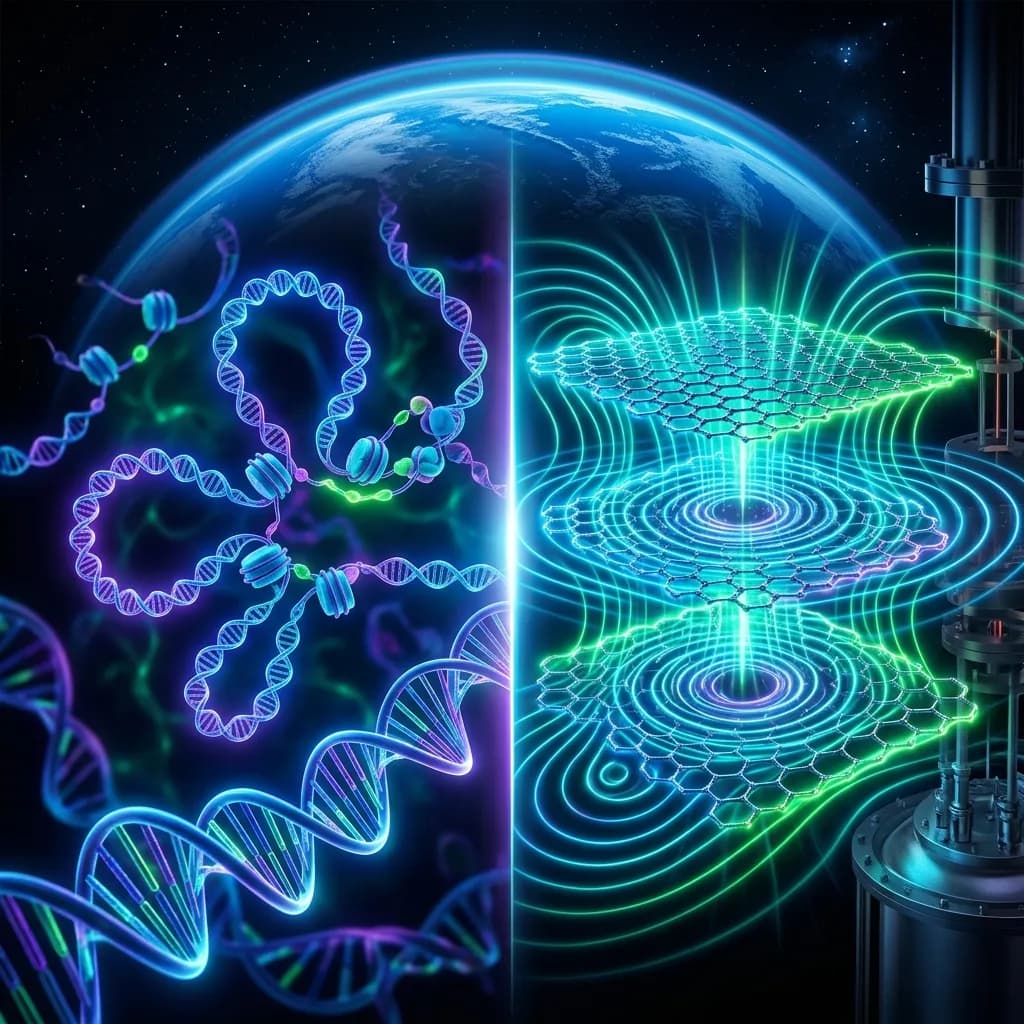
This week has witnessed major scientific breakthroughs that challenge existing assumptions across quantum physics, climate history, and cell biology. From multilayer graphene that becomes superconductive under intense magnetic fields to models showing human-induced ozone loss beginning in the late 1950s, researchers are rewriting long-held theories. At the same time, geneticists have mapped a crucial physical shield cells construct from chromatin loops to protect stalled DNA replication machinery and prevent catastrophic genomic collapse.
🔬 Superconductivity Untwisted: Rhombohedral Graphene Defies Magnetic Fields
In the field of condensed matter physics, unconventional superconductivity—where electrons pair up and flow without resistance via mechanisms outside traditional theories—remains a highly sought-after phase of matter. Recently, researchers have focused on "twisted" graphene structures, which require alignment at very precise "magic angles" to exhibit these quantum properties. However, a major study led by Professor Long Ju and his research team at the Massachusetts Institute of Technology (MIT), published in Nature in June 2026, has uncovered a new family of unconventional superconducting states in naturally occurring rhombohedral tetralayer and pentalayer graphene.
What makes this discovery particularly striking is the material's behavior under strong magnetic fields. In conventional Bardeen-Cooper-Schrieffer (BCS) superconductors, magnetic fields are the ultimate enemy; they align the opposite spins of electron pairs (Cooper pairs), breaking the bond and instantly destroying the superconducting state. The MIT team found that the superconducting states in rhombohedral graphene are extraordinarily robust, persisting and even strengthening when exposed to in-plane magnetic fields up to 9 Tesla—which is tens of times higher than the conventional Pauli limit.
graph LR
    subgraph Standard BCS Superconductor
        A[Magnetic Field Applied] -->|Aligns Electron Spins| B[Cooper Pairs Broken]
        B -->|Result| C[Superconductivity Destroyed]
    end

    subgraph Rhombohedral Multilayer Graphene
        D[In-Plane Magnetic Field up to 9T] -->|Spin-Triplet Pairing| E[Cooper Pairs Remain Stable]
        E -->|Result| F[Superconductivity Preserved/Enhanced]
    end

    style C fill:#ffebee,stroke:#c62828,stroke-width:2px
    style F fill:#e8f5e9,stroke:#2e7d32,stroke-width:2px
To achieve this, the MIT researchers fabricated clean devices using naturally stacked rhombohedral graphene, which features carbon layers in a specific ABC stacking sequence. They utilized electrostatic gating (voltages) as an experimental tuning knob, adjusting the carrier density and temperature of the system. This allowed them to map several distinct superconducting phases. The resilience to high magnetic fields suggests the presence of spin-triplet pairing, a state where paired electrons share parallel rather than opposite spins, making them immune to magnetic realignment.
| Material System | Stacking Method | Superconducting State Type | Magnetic Field Tolerance | Control Mechanism |
|---|---|---|---|---|
| Twisted Bilayer Graphene | Engineered (Magic Angle rotation) | Unconventional (Spin-singlet/triplet mixed) | Lower (Destroyed by weak fields) | Twist angle, Electrostatic gating |
| Rhombohedral Graphene | Natural (ABC stacking order) | Unconventional (Spin-triplet) | High (Robust up to ~9 Tesla) | Electrostatic gating (voltages) |
By bypassing the need for complex angle twisting, rhombohedral graphene offers an exceptionally clean, naturally stable platform for exploring correlated electron physics. This breakthrough opens up new pathways for designing topological quantum computing architectures, where spin-triplet Cooper pairs could serve as the foundation for highly stable, fault-tolerant quantum bits (qubits).
🌍 Rewriting Climate History: Human-Induced Ozone Loss Detected in 1957
For decades, the story of anthropogenic ozone depletion was thought to have begun in the 1970s, culminating in the shocking discovery of the Antarctic ozone hole in 1985. This depletion was primarily blamed on chlorofluorocarbons (CFCs) widely used in aerosol sprays and refrigeration. However, a groundbreaking study published in the Proceedings of the National Academy of Sciences (PNAS) by renowned MIT atmospheric chemist Susan Solomon and her team has rewritten this timeline, demonstrating that human-induced ozone loss was detectable as early as 1957.
Using advanced chemical transport modeling, the MIT team simulated historical atmospheric chemistry using modern data collection and analysis tools. Their retrospective "thought experiment" analyzed how early industrial emissions interacted with the stratosphere during the mid-20th century. Surprisingly, the model identified a statistically significant signal of ozone depletion starting nearly three decades before the ozone hole was formally discovered.
graph TD
    A[Early Industrial Activities] -->|Emissions of Carbon Tetrachloride CCl4| B[Accumulation in Upper Tropical Stratosphere]
    B -->|UV Photolysis| C[Release of Chlorine Radicals]
    C -->|Catalytic Cycle| D[Ozone Depletion Detected by 1957]

    style A fill:#fff3e0,stroke:#ef6c00,stroke-width:2px
    style D fill:#ffebee,stroke:#c62828,stroke-width:2px
Crucially, this early ozone loss did not originate over the poles. Instead, it was concentrated in the upper stratosphere of the tropics. Furthermore, the primary chemical culprit was not CFCs, but rather carbon tetrachloride (CCl4), a compound extensively used in dry cleaning, fire extinguishers, and industrial solvents during the early and mid-20th century. When transported to the upper tropical stratosphere, carbon tetrachloride is broken down by intense solar ultraviolet radiation, releasing chlorine radicals that catalytically destroy ozone molecules.
This finding dramatically alters our historical understanding of human atmospheric impact. It shows that industrial activities were already leaving a measurable chemical footprint on the Earth's stratospheric protective shield much earlier and through different chemical pathways than previously believed. It also underscores the long latency period between human chemical emission and our ability to detect its global environmental consequences.
🧬 Molecular Shields: How Chromatin Loops Safeguard Stalled Replication Forks
Every time a cell divides, it must copy billions of base pairs of DNA with near-perfect accuracy. However, the replication machinery (the replisome) constantly encounters obstacles—such as DNA damage, tight protein-DNA complexes, or secondary DNA structures—causing the replication fork to stall. This condition, known as replication stress, is highly dangerous. If stalled replication forks are not protected, they can be degraded by cellular nucleases, leading to double-strand DNA breaks, chromosomal rearrangement, and genomic instability.
In a study published in Nature on July 1, 2026, an international research team led by scientists at the Erasmus MC Cancer Institute and the Oncode Institute in the Netherlands, alongside collaborators from the University of Barcelona, has identified a key mechanism cells use to protect these vulnerable sites. They discovered that cells form transient chromatin loops to physically shield and stabilize stalled replication forks.
graph TD
    subgraph DNA Replication Stress
        A[Replication Fork Stalls] -->|Occurs at| B[Convergent CTCF Motifs]
        B -->|Triggers| C[CTCF Enrichment at Stalled Fork]
        C -->|Constrains| D[Loop Extrusion Process]
        D -->|With G9a Heterochromatin| E[Stable Chromatin Loop Formed]
        E -->|Result| F[DNA Fork Shielded & Stabilized]
        F -->|Prevents| G[Double-Strand Breaks & Genome Instability]
    end

    style A fill:#ffebee,stroke:#c62828,stroke-width:2px
    style E fill:#e8f5e9,stroke:#2e7d32,stroke-width:2px
    style G fill:#fffde7,stroke:#fbc02d,stroke-width:2px
Using high-resolution genomic mapping and imaging, the team showed that replication forks preferentially stall at genomic regions containing convergent motifs for the architectural protein CTCF (CCCTC-Binding Factor). When a fork stalls, it triggers a stress-dependent accumulation of CTCF at the site. The CTCF proteins act as physical barriers or "anchors" that halt the loop extrusion machinery. Together with the methyltransferase enzyme G9a (which deposits repressive heterochromatic marks), CTCF organizes the local chromatin into a protective loop that encapsulates the stalled replisome, blocking access by destructive nucleases.
Understanding this protective shield is highly relevant for cancer therapy. Cancer cells divide rapidly and experience chronic, high levels of replication stress. Many chemotherapy agents work by exacerbating this stress to trigger cell death. By mapping the exact molecular pathways of loop-mediated fork protection, researchers can now design small-molecule inhibitors to target CTCF or G9a in cancer cells, stripping away their molecular shields and making them selectively vulnerable to DNA-damaging therapies.
📌 The Bottom Line
- rhombohedral-graphene-superconductivity: MIT physicists discovered unconventional superconductivity in naturally occurring rhombohedral multilayer graphene that resists and is enhanced by in-plane magnetic fields up to 9 Tesla, suggesting a rare spin-triplet electron pairing.
- ozone-depletion-1957: A retrospective modeling study by MIT reveals that human-caused ozone depletion began as early as 1957, driven by carbon tetrachloride emissions in the tropical upper stratosphere, decades before the polar ozone hole was identified.
- chromatin-loop-fork-stability: An international team demonstrated that cells form transient chromatin loops anchored by CTCF and stabilized by G9a to physically shield stalled DNA replication forks from degradation, preventing chromosomal damage.
References & Scientific Literature:
- Ju L., et al. "Unconventional superconductivity in rhombohedral tetralayer and pentalayer graphene." Nature, June 2026. DOI: 10.1038/s41586-026-04218-y.
- Solomon S., et al. "Anthropogenic tropical ozone depletion detectable by 1957." Proceedings of the National Academy of Sciences, June 2026. DOI: 10.1073/pnas.2608472123.
- Erasmus MC Cancer Institute, Oncode Institute, et al. "Replication-stress-induced chromatin loops protect fork stability." Nature, July 1, 2026. DOI: 10.1038/s41586-026-04981-w.
- Note: Data from the UniProt Knowledgebase was referenced for human CTCF (Accession P49711) and histone-lysine N-methyltransferase EHMT2/G9a (Accession Q96KQ7) to verify structural domains, protein binding characteristics, and their roles in chromatin organization.
Enjoyed this post?
Get our weekly digest delivered free.
Share this post:
Knowelth is reader-supported. We may earn a commission from links in this article at no extra cost to you. Read our disclosure.
Related Posts

Targeted Protein Degrader Rewrites Leukemia Drug Sensitivity, Oxytocin Selectively Modulates Low Trust, and Siberian Permafrost Methane Surge Doubles
Targeted Protein Degrader Rewrites Leukemia Drug Sensitivity, Oxytocin Selectively Modulates Low Trust, and Siberian Permafrost Methane Surge Doubles Scientific discovery rarely moves in a single dire…
Global Research Breakthroughs: HCMI Patient Cancer Organoids, Ultra-Durable Nanochannel Fuel Cells, and 567-Million-Year-Old Deep-Ocean Fossils
Global Research Breakthroughs: HCMI Patient Cancer Organoids, Ultra-Durable Nanochannel Fuel Cells, and 567-Million-Year-Old Deep-Ocean Fossils Across biology, materials physics, and evolutionary pale…
Tumour Organoid Vulnerability Map, 567M-Year-Old Ediacaran Fossils, and NIH's TrialGPT AI Breakthrough
Tumour Organoid Vulnerability Map, 567M-Year-Old Ediacaran Fossils, and NIH's TrialGPT AI Breakthrough Three landmark studies published in the first week of August 2026 span the full breadth of modern…